 Language
 简体中文
简体中文
- On the 2018 National Day holiday, Lifet completed six 100 ton large tonnage lifting belts as a gift
- The role of suspension net in the transportation of goods turnover
- Cargo soft lifting net, lifting net, lifting net, lifting net, bag, climbing net
- Precautions for using Lifutiden elevator
- How to make circular lifting straps
Contact: Wang Lili
E-mail:18066002268
Phone:702461526@qq.com
Address: Lifute Industrial Park, Taizhou City, Jiangsu Province

Lift Sling Rigging Co., Ltd manufactures high‑performance Single Use Endless Webbing Sling, a cost‑effective one‑time lifting solution for export shipment, construction, logistics and heavy‑duty rigging jobs. Built from high‑tenacity synthetic webbing, this endless loop lifting sling delivers stable load distribution and anti‑slip performance for single‑lift operations, eliminating sling recovery and post‑use inspection costs.Lightweight and compact for easy transport and rig‑up, it protects finished surfaces from scratches compared with metal slings. Compliant with international lifting standards, our single‑use webbing sling covers multiple working load limits and customizable lengths to match diverse load requirements. Ideal for container export, machinery shipping and temporary onsite hoisting. Count on Lift Sling Rigging Co., Ltd for reliable, factory‑direct single use endless webbing sling for your one‑way rigging and lifting projects.
Hits: ℃
Release time:2026-09-27 09:22
Lift Sling Rigging Co., Ltd manufacture Single Use Endless Webbing Sling,Polyester Single Use One Way endless webbing sling,Disposable endless webbing sling,Disposable Flat Webbing Sling,Singl e-Use Lifting Slings Endless Loop.
Single Use Endless Webbing Sling — the Loop That Has Nothing to Fit, Nothing to Adjust and Nothing to Bring Back
A single use endless webbing sling is a flat woven band closed into a continuous loop, bought for one journey and not recovered. Every one of those four words removes something fro m the article, and the removals are what this page is about. Single use removes the return journey, and with it the storage rack, the periodic inspection and the asset register. Endless removes the ends, and with them the eyes, the fittings and the hardware. Webbing removes the round core, and with it the sleeved cover that protects it. Sling leaves the one thin g that cannot be removed: it still has to carry a load, and the person who attaches it still has to be competent.
What this page does not do is explain the four words again. The meaning of the term single use as a commercial category, and the economics that made the trade buy it, are on the single use lifting sling page. The standard that governs the label on a one-trip band is on the one way sling page. How a closed loop is woven, joined and tested, and how the same family is ordered and packed, is on the endless webbing sling page. What is left for this page, and the reason it exists, is the part that none of those covers: an article that is not an asset has to be bought l ike a consumable, issued like a consumable and counted like a consumable — and the trade, which buys these by the thousand, rarely writes any of that down.
That is the subject here. The sections that follow take the article as a store item rather than as a rigging component: what the buyer must supply because the article does not carry it, where a clo sed loop can and cannot be attached, what changes when nothing comes back, how the leftover piece is handled, what an issue note has to say, what a large delivery can be checked for without opening ev ery pack, and the three duties on which this article is the wrong purchase. The construction, the fibre choice, the coefficient and the label are all covered by the pages linked above, and this page l inks to them rather than repeating them, because two pages on one site that say the same thing are two pages competing for the same search.

The article, and the page's own photograph of it. One flat woven band, closed into a loop, printed with a working load limit and a length. Three facts are legible from the band alone: what it will carry, how long it is, and who made it. Three are not: which fibre it is woven from, how wide the band is, and which production bat ch it belongs to. The first of those is settled by the order, and the third is the only handle a store has on the piece — which is what sections 2, 6 and 7 are about.
1. What This Page Is For, and What the Four Words Rule Out
It is worth being precise about what each word in the name takes away, because on this article the removals are the specification. A buyer who reads the four words as a description of a product wil l order a loop. A buyer who reads them as four removals will notice, before the order is placed, that he also has to supply the eye, the fitting, the adjustment and the return route that the article n o longer carries — and that two of those he supplies physically at the load, and two he supplies commercially on paper.
This is not a warning about the article. It is the reason the article is cheap, and the removals are all legitimate. A loop with no eye has nothing to protect at the end of the band, so nothing wea rs there. A band with no fitting has no fitting to lose, to inspect or to replace. A sling with no adjustable element has no mechanism to jam, and no length that can be changed by someone who should n ot be changing it. A single-use article has no return journey, which is the whole of the commercial argument. Every one of those is a saving, and every one of them moves a small amount of work from th e factory to the user. On a one-trip job with a competent receiver, that is a good trade. On a job without one, it is the reason the band is used wrongly.
| Word in the name | What it removes | What the buyer then supplies, and where |
|---|---|---|
| Single use | The return journey, the rack, the periodic inspection, the asset register. | A decision about the piece at the end of the job, and a count. Both on paper, in the store. |
| Endless | The two ends, and therefore the eyes that would be sewn into them. | Something for the loop to go round: the load itself, a hook, or an attachment point on the load. §3. |
| Webbing | The enclosed core of a round sling, and the woven sleeve that protects it. | An honest look at the surface the band will cross, because a flat band has nothing behind it but its own weave. |
| Sling | Nothing. This is the word that survives every reduction, and it is the one that carries the obligation. | A planned lift and a competent person, which no purchase order can supply. |
The last row is the one worth keeping. A consumable article is cheap because it is not built to be looked after, and that property is not the same as being exempt from being used properly. The rule s that apply to any lift apply to this article exactly as they apply to an expensive one; what is different is that nobody will find the error later, because the article will not come back to be inspe cted. The consequences of a mis-specified loop therefore land entirely on the lift it was bought for, which is why the specification has to be right at the point of purchase rather than corrected in s ervice.
2. A Loop Has No Ends: What the Buyer Supplies Instead
A flat woven band with a sewn eye at each end carries, in the eye, a piece of engineered reinforcement: the eye is longer than the band is wide, it is formed by a lap of known length, and it is the part of the article that hangs on the hook. A closed loop has none of that, and the reason is not economy alone. An endless band is woven as a tube and closed so that the load path around the whole l oop is continuous, which is exactly what an end cannot be: an end is a place where the band stops and the joint starts, and a loop is a way of arranging the article so that the joint never sits in the bend.
What the buyer loses with the ends is worth listing plainly, because each loss has a replacement that has to be arranged at the load rather than ordered from a catalogue. There is no eye to hang on a hook, so the band itself hangs on the hook, doubled. There is no eye to pin inside a shackle, so the loop is passed through or round whatever has to be picked. There is no reinforced end to take th e wear, so wear moves to the bottom of the loop where the band turns. And there is no tail, so there is nothing to grip, nothing to pull and nothing to stand on — a point that matters more than it sou nds on a load that has to be rotated or steadied.
| What an eye-end band has | What a closed loop has instead | What changes at the load |
|---|---|---|
| A reinforced eye at each end | One continuous band, of even width, with the same cross-section everywhere. | The band is doubled over the hook rather than hung from an eye, so the hook throat has to accept two thicknesses. §3. |
| A place to pin a shackle | Nothing. The loop is either passed through a fitting or wrapped round a part of the load. | The attachment point moves from the band to the load, so the load's own geometry has to allow it. |
| Ends that can be protected with a sleeve | Nothing at the ends, but a turning point at the bottom of the loop wherever the band changes direction. | Wear relocates to the loaded turn, so the shape of the load's underside becomes part of the specification. |
| Two thicknesses of band over the hook at most | Two thicknesses as well, but the two runs diverge at a working angle rather than lying flat together. | The band sits on the hook's bearing surface in a curve rather than flat, which is a contact the hook's design has to accept. |
| A tail to hold or pull | No loose end anywhere on the article. | Nothing to grip. On a load that has to be steadied or turned, that is a rigging task, not a sling feature. |
| One length, one rating, one label position | The same, and the label has to be readable on a band that will be doubled over a hook and wrapped under a load. | The printed block has to be placed so that at least one copy of it is legible with the loop already in position. §7. |

A closed loop, laid out flat. This is what the account in the table above looks like in the hand: a band of even width from one end of the picture to the other, the two runs parallel, and no eye, no thimble, no fitting and no tail anywhere on it. The absence is the specification. Everything the article does at the load it does by going round something.
3. Where a Closed Loop Attaches, and What It Bears On
There are only three places a closed loop can be attached, and the choice belongs to the person rigging the lift rather than to the factory. The loop can go under the load, with bo th legs rising to the hook; it can go round the load and be drawn closed on itself; or it can be passed through something — an eye, a lifting point, a shackle bow, a hole — and then taken to the hook. On all three, the band is doing the same two things at once: carrying the mass and conforming to whatever it touches, and that second job is where a flat band differ s from every other kind of sling.
Under the load is the arrangement the article is normally bought for and the one this site's own photographs show. The band passes beneath and both legs rise. The band is loaded in the two places w here it turns, and the load is supported over the width of the band at those two places. The two things to be settled before the lift are whether there is a gap for the band to pass through, and what the band bears on when it gets there. A load that sits flat on the ground with no gap has to be raised by something else first, or slung before it is closed up — which is the situation described on th e pre-slung cargo page, where the loop is fitted at the point of packing precisely because there will never be a gap again.
Round the load is a different duty, and it is the one buyers most often confuse with the first. Here the loop is wrapped round the load and drawn closed, so the band is loaded in a way the article was not rated for unless the maker's own figures say so. A flat band drawn closed on a hard corner is the single most damaging arrangement in this family, because the closing action concentrates the e ntire load into a short length of weave at the point where the band crosses itself. If a load can only be rigged this way, that is a question for the maker before the order, not a decision for the rig ger on the day.
Passed through something is the arrangement that asks least of the band and most of the thing it passes through. An eye in a casting, a lifting point on a fabricated item, a coil's own eye: all of these take the band as a line rather than as a face, so the contact is a small one and the band's own width does the spreading. The question to settle here is not the band but the hole: its edge, its radius and its finish, since a band passing through a rough hole is being asked to survive a surface the factory has never seen.
| Where the loop goes | What the band bears on | What has to be true before the lift |
|---|---|---|
| Under the load, two legs to the hook | The band's own face across the underside, and its flank at the two turns. | That there is a gap for the band, and that the underside is not an edge or a machined face. |
| Round the load, drawn closed | A crossed band on itself, at the point where it closes, plus whatever corner the load presents there. | That the maker's figures cover the arrangement, because the load in the band is no longer the load in the lift. |
| Through an eye or a lifting point | The edge of the hole, on a short length of band, once per leg. | That the hole's radius and finish suit a woven band rather than a wire rope or a pin. |
| Through a shackle bow or a ring | A smooth, generous, round section, which is the friendliest contact a flat band can have. | That the attachment is rated for the lift, since the band's rating says nothing about the fitting. |
| Over the hook, doubled | The hook's bearing surface, in two thicknesses, in a curve. | That the hook throat is wide enough for the doubled band and that its surface is not worn into a step. §4 is about this contac t. |
| Two loops, one hook, four pick points | Four turns rather than two, and a hook that now carries four thicknesses. | That the load is a unit that can be picked at four points, and that the angle between the legs is known before the length is o rdered. |

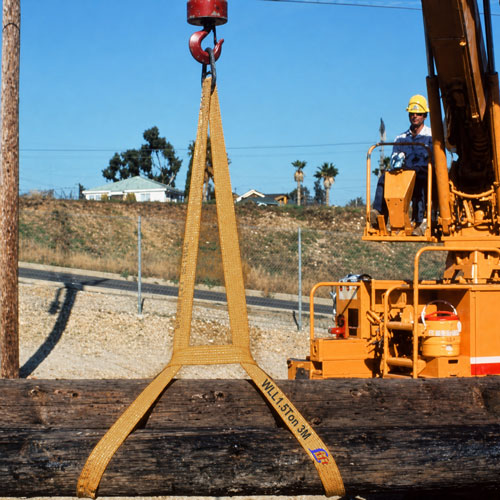
The same class of band in service, arranged the way the article is normally used: under the load, in two places, with both legs rising to the appliance. Read the three elements in the frame separately. The band is under the log and not round it, which is the arrangement the article is rated for. The two legs diverge from the h ook, so the angle between them is doing work that the band's length decided. And the load is a round, irregular, heavy one that the band has to conform to at both turns — which is the second job a fla t band does and the one no capacity figure describes.
4. What Changes When Nothing Comes Back
A returnable sling and a consumable loop are the same object for the length of one lift and different objects for every minute after it. A returnable sling is managed: it is received, recorded, sto red, issued, inspected at intervals, returned, and eventually withdrawn from service under a documented decision. A consumable loop is managed once, at purchase, and after that it is simply a quantity . Understanding the difference is what makes the difference between two kinds of buyer: the one who buys consumables and controls them as stock, and the one who buys consumables and discovers at the e nd of a contract that nobody can say how many were used or where they went.
The controls that survive the loss of the return journey are three, and all three are counting rather than inspecting. The quantity is controlled because a consumable is bought in a defined number for a defined job, so the number itself is the control: a store that issues four hundred and receives one hundred and thirty back as never-issued knows more about its consumption than a store that inspects every piece. The batch identity is controlled because it is the only thread from a piece in the receiver's hand back to a record of what happened when that prod uction run was tested, and it is printed on the article rather than filed on the article. The issue record is controlled because a consumable's life is decided at the moment it is dra wn from the store, and after that nothing about it is known at all.
The control that is given up is the one that dominates every returnable system: the periodic examination. The rules for examining a synthetic webbing sling are set out on this site's own pages for the returnable article, and they are not repeated here because the regime does not transfer: a consumable has no history to examine and no next lift to be released for. What replaces that regime is no t a weaker version of it — it is a different discipline, applied earlier, at the point where the article is specified and bought. The whole of the quality effort moves one step upstream, which is unco mfortable for buyers who are used to catching problems at goods-in and at the rack, and it is why this page spends its length on the purchase and the count.
| Control | On a returnable sling | On a single use endless loop |
|---|---|---|
| Identity | A serial or a location, carried on the piece or in the register, so that the piece can be found and its history reopened. | A batch reference printed on the band itself. No serial, because nothing will ever ask about this piece again. |
| Periodic examination | The core of the system: an interval, a competent person, a record and a withdrawal decision. | One look before the lift, and no interval, because the piece will not be in the store next month to be looked at again. |
| Storage | An organised place, in the knowledge that the article will come back to it and its condition there matters. | Whatever keeps the quantity dry, dark and countable until the job starts. §5. |
| Quantity | Maintained because a lost returnable is a cost, and a short count is a signal. | The primary control. The count is the record, and the difference between issued and used is the only consumption figure availa ble. |
| End of life | A decision, taken by someone, against criteria, and recorded. | Nothing to decide about a piece that has been used, and one honest decision about the pieces that have not. §6. |
| Where the risk sits | Spread across the article's life, and caught by the inspection regime if it appears late. | Concentrated at purchase. Nothing downstream will catch a specification error, so the specification is the control. |
5. Where the Loop Is Kept Until the Job Starts
A consumable loop spends most of its existence in a store, and the store is where its condition is decided. The point is not that storage is delicate; a flat woven band of high-tenacity synthetic f ibre is a robust object and the article is not made of anything fragile. The point is that a consumable has no intermediate examination between the store and the lift, so whatever state it is in when it is drawn is the state it will be used in. Three influences do the damage, and all three are ordinary conditions of a works rather than exotics.
The first is light. Ultraviolet exposure degrades synthetic fibre, and the practical trap in a store is not a dark room but a bright one: a band left in the window of an office, on an open rack under a skylight, or on a pallet beside a door that stands open all summer is being aged while nobody is looking at it. Keeping the article in the packaging it arrived in, or under a cov er, is not a rule about delicacy; it is a rule about not spending the article's life before the job starts. The second is moisture and the things that travel with it. A band that has been wet and dried is still a band, but a band that has been wet in the same space as acid, alkali, salt or a strong cleaning agent has had a chemistry lesson, and this is one of the few places where a woven article can be damaged invisibly. The third is the surface it rests on. A loop stored on a rough concrete floor under a stack of other goods is being abraded from below, and t he damage will be exactly where the weave is loaded hardest later: at the turns.
None of this needs a special room. What it needs is for the packed quantity to be kept together, in its own packing or under a cover, off a rough floor, away from the drums shelf. And it needs one further thing that is easy to overlook: a store that keeps the packed unit's own identification intact, so that the quantity still resolves to an order, a batch and a specification wh en the first piece is drawn. A pile of loose bands in a tote has lost the only information the store had about them, and a consumable whose specification is unknown is not a consumable; it is a liabil ity waiting for a job.
| Influence | What it does to a woven band | The store habit that removes it |
|---|---|---|
| Ultraviolet light | Attacks the fibre itself, and does it slowly enough that no single day looks like damage. | Keep the article in its packing or under a cover; do not use a window ledge or an open rack as a shelf. |
| Water, and what is dissolved in it | Water alone is survivable; the chemistry it carries may not be, and the effect can be invisible from outside. | Keep the quantity away from the chemicals shelf, and treat any wetting by an unknown liquid as a reason to quarantine the pack . |
| Heat and its sources | A woven synthetic band has a temperature range, and a store that doubles as a workshop can exceed the top of it beside a heate r or a hot process. | Keep the quantity out of the heat shadow of plant. The temperature rules for the fibre are on the pages linked above, not repe ated here. |
| A rough floor and a stack of goods | Abrasions the weave from below and along the flanks, precisely where the turns are loaded later. | A pallet, a shelf or a liner under the quantity — anything that is not bare concrete. |
| Loose goods in the same tote | Cuts and snags from the edges of whatever else is in the container, which is the commonest mechanical damage in a store. | Keep the article in its own packing, and never store it in the same box as sharp hardware. |
| Losing the pack's identity | Nothing to the band, and everything to the store: a quantity whose order, batch and specification are unknown cannot be issued against a job. | Issue from the pack, keep the pack's label with the remainder, and never empty two orders into one box. |
6. The Piece That Was Never Loaded: the Leftover Stock and the Decision at the End of a Job
Every consumable campaign ends with a quantity that was bought and not used, and this article produces three kinds of leftover that are not the same as each other. There is the piece that was drawn from the store, been on site, and never been loaded onto anything. There is the piece that was never issued at all and is still in the pack it arrived in. And there is the piece that was used and is now somewhere along the supply chain, on a load that has reached its destination, with nothing to bring back. The third kind is the article working exactly as intended. The first two are the store's p roblem, and the trade handles them badly because a consumable's paperwork has no field for them.
The distinction that matters is not age; it is what has happened to the article. A band that has never been loaded is a new band, and its condition is the question — whether it has been kept as §5 describes, or whether it has spent a month in the back of a van on a building site. A band that has been under a load has been used, and on a single-use article the honest position is that it is not c oming back into a planned lift whatever its appearance says, because the one thing this category does not have is a documented history to release it against. That position is uncomfortable for anyone who has ever looked at a band in good condition and thought it had another journey in it, and it is the position the category requires.
What the buyer should therefore decide before the campaign, rather than at the end of it, is what the leftover pieces will be for. The two defensible answers are to hold the unissued piece s as stock for a future job with the same specification, keeping them identifiable as §5 requires, or to use them for the purpose this whole family exists for and put them on the next load that is goi ng the same way. What is not defensible is to put them back on the store rack with the returnable slings and let the next person find them, because the next person will have no way of telling a never- loaded consumable from a used one, and neither will the register.

A quantity of the same article at the bench. This is the shape a consumable has in the store rather than in the rigging bag: not one piece, but a countable group that shares a specification, a batch and a job. The reason sections 5, 6 and 7 keep coming back to the count is visible in the photograph: nothing about any one band in that pile distinguishes it from its neighbours, so the group's paperwork is the only thing that knows what the group is.
| Kind of leftover | What is known about it | What to do with it |
|---|---|---|
| Never issued, still in the original pack | Everything: the order, the batch and the specification are on the pack, and the pack has not been opened. | Hold as identified stock for the next job of the same specification, stored as §5 describes. |
| Issued, on site, never loaded | The batch, if the printed block is still legible, and the issue record. Nothing about what happened to it on site. | A decision somebody has to take and record. Treating it as new requires someone to have owned it, which is why the issue note in §7 exists. |
| Used once, at the destination | That it did its job. It is with the goods, and nobody at this end will see it again. | Nothing. This is the article working as designed, and the count is how the store records it. |
| Damaged in store before issue | Whatever the damage shows: a cut, a snag, a contamination, an abrasion along a flank. | Remove from the quantity at once and record it, so that the pack's count stays true. |
| Cut down on site for another purpose | Nothing usable. A cut loop is no longer an article of this family and carries no figure. | Withdraw it from the rigging store entirely, because the danger of a cut loop is that it looks like a sling. |
| Specified for a job that was cancelled | Everything, if it is still packed. The specification may not suit the next job, which is a different question from condition.< /td> | Re-check the specification against the new load before issuing it at all. Same band, different job, new decision. |
7. The Issue Note and the Printed Block: the Only Record This Article Has
A returnable sling has an identity that lives in a register and a condition that lives on the article. A consumable loop has neither, and what it has instead is one printed block of text on the ban d plus whatever the store writes down when it draws the piece. That is the whole information system of the article, and it is worth writing properly for the same reason that a packing list is worth wr iting properly: it is not paperwork for its own sake, it is the only mechanism by which anything about the piece can be known after it has left the store.
The printed block is the article's own statement and it travels with the load. What it must carry is fixed by the standard the article is made to, and the list of items belongs to the page that deals with that standard, the one way sling page. What matters here is a placement question that is easy to get wrong on a closed loop: the band will be doubled over a hook and wrapped under a load, so a printed block that exists in one place on the loop will very often be the one place the rigger cannot see. A loop that carries its marking in more than one position, or on a sewn-in label as well as in print, is a loop that can still be read with the load already on the hook. That is not a cosmetic preference; it is the difference between a figure that can be checked and a figure that has to be taken on trust.
The issue note is the store's own statement, and it does not exist unless somebody decides it should. It needs six lines to be useful: the date and the job, the quantity issued, th e batch reference off the article, the specification the pieces were ordered to, the pick points or the lift the pieces are for, and a line for what came back. A store that keeps that much has a consu mption figure, a traceability path and a defence; a store that keeps none of it is handling a rated item with less control than it applies to a box of fasteners, and the difference in cost between the two is one minute of somebody's time per issue.
| Line | What it holds | What it answers later |
|---|---|---|
| Date and job | When the pieces went out, and what for. | Which campaign a piece belonged to, which is the first question asked about a leftover. |
| Quantity issued | A number, counted, not estimated. | The consumption figure, which is the only performance measure this article produces. |
| Batch reference | The identification printed on the band, copied character for character. | The route back to the maker's record for the production run the piece came from. |
| Specification | The load, the length and the width the pieces were ordered to, as ordered rather than as remembered. | Whether a leftover piece can be used on a later load, which is a specification question before it is a condition question. |
| Pick points | Where on the load the loop is to sit, and how many positions are used. | Whether the pieces are the right length for the lift, which is the error a store cannot detect from the band alone. |
| Return line | How many came back, how many did not, and the reason for each that did. | The stock position at the end of the campaign, and the decision at §6 about the pieces that never went out. |

The block, and how it is carried. On this loop the identification sits in a woven band crossing the face rather than being print ed into the weave, which is one of the two ways a closed loop can be marked and has one virtue that matters on this article: the marking does not fade with the print. Whatever the method, the question the paragraph above leaves open is the same one — whether at least one readable copy of the block can be seen once the loop is over the hook and under the load.
8. What Arrives, and the Check a Large Delivery Needs Without Opening Every Pack
A delivery of consumable loops is not a delivery of a rigging item; it is a delivery of a quantity, and the check has to be designed for a quantity rather than for a piece. The mistake buyers make is to apply the goods-in routine of a returnable sling — take one out, look at it closely, put it back — and then to assume the rest of the pallet is the same. It usually is the same, because it came off one production run and one packing line, and the whole point of the check is to establish exactly that: that the delivery is one thing rather than several things wearing the same description.
Four checks do that, and none of them requires the delivery to be unpacked. The first is the count against the order, per pack and in total, because the pack is the unit the store will issue from and a pack that is short is a problem that only reveals itself when somebody is standing on a load with three slings instead of four. The second is the packed marking: that each pack states what is in it, to which specification and from which order, since a mixed pallet of two specifications is the commonest failure of this kind and the least visible. The third is one piece from each pack, drawn and read against the order for the two figures that can be read off a band, and against the order for the width and the fibre, which cannot. The fourth is the batch reference, because a delivery that comes in under several batch references is normal but has to be recorded as several, so that the store's issue note can name the right one later.
What this check cannot do is verify the article's strength, and no goods-in procedure can. The figure printed on the band is a declaration by the maker, supported in the way the standard behind it requires and by whatever record the maker keeps for the run; the buyer's protection is not a test at goods-in but the choice of maker, the specification written on the order and the batch reference th at connects the delivered pieces back to a record that can be asked for. That is why §7 spends its length on the count and the reference rather than on the inspection card, and why the check described here is deliberately shallow on each piece and deliberately thorough on the delivery.
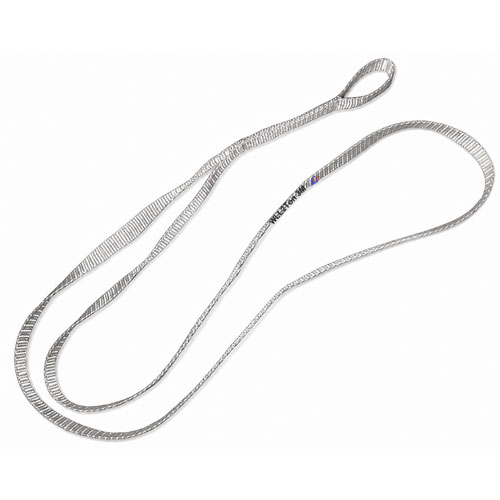
The article as it comes out of a pack: one loop, of even width, with its marking block and nothing else. Everything the goods-in check can establish, it establishes from this view — that the band is a woven band of the ordered width, that the loop is closed, that the printed figure and the length are legible and agree with the order, and that the article looks like a sling rather than like a piece of webbing. Everything else about it is established by the maker's record for the run, which the batch reference on the band is the route to.
| Check | How it is done on a quantity | What it catches |
|---|---|---|
| Count | Per pack and in total, against the order, before anything is drawn off. | Short packs, and the slow leakage of a quantity that is issued without being counted. |
| Packed marking | Read the marks on each pack, not the marks on the pallet. | Two specifications mixed on one pallet, which is the failure that survives every other check. |
| One piece per pack | Draw a single loop, check the width and the fibre against the order, and read the printed block. | A delivery built to a different width or a different fibre from the one ordered, which is invisible from the outside of a pack . |
| Batch references | Record every distinct reference in the delivery, pack by pack. | An issue note that names a batch which only some of the pieces came from — the traceability error that only appears after a pr oblem. |
| Packed form | Note how the pieces are held, so that the store opens and stores them the same way. | The slow damage that begins the day a quantity is decanted from its packing into a general-purpose tote. |
| The record itself | File the count, the references and the specification together, against the order. | A leftover quantity at the end of the campaign that nobody can issue because nobody knows what it is. §6. |
9. The Three Duties Where a Consumable Loop Is the Wrong Buy
The commercial case for this article is narrow and it is worth restating in one line before the exceptions, because the exceptions are all cases where the case does not apply: a loop bought for one journey is the right purchase when the journey is one-directional, the receiver is competent, and nothing about the lift depends on an inspection history. Where any of those three fails, the arithmet ic that made the article cheap is arithmetic about the wrong thing, and the purchase should be a different article.
The first duty to refuse is repeated picking of the same load. A consumable has no history to release it against, so a duty that relies on the periodic examination of a known piece cannot be served by it. This is not a statement about the article's quality; it is a statement about what the article is for. A load that will be picked every day for a month is a load that needs an article with a register, an interval and a withdrawal decision, and the fact that the consumable is cheaper on the first day says nothing about the thirtieth.
The second is any lift over people, over live plant, or in a position from which a dropped load cannot be recovered. The requirement here is not strength — a loop of adequate ratin g is as strong as any other article of the same rating — but of an inspectable chain of custody behind the piece being used. Where the lift is unforgiving, the buyer should be buying a documented arti cle and paying for the documentation, because the documentation is what the duty needs. The third is any duty where the band is being asked to hold rather than to lift. A loop used to hold a load down on a vehicle or inside a container is outside the basis on which it was rated, and the site's cargo lashing b elt page exists because lashing has its own equipment and its own numbers.
Two further cases are narrower and worth naming because they are the ones a buyer arrives at after the first three have been ruled out. A hot or chemically aggressive load may rule out the default fibre long before it troubles the form of the article, and that is a fibre question which the syn thetic webbing endless sling page deals with properly; a store that simply orders the same loop it always orders, for a warm or a pickled load, has made a decision without noticing. And a load that presents an edge may be better served by an article with a protective sleeve than by a bare woven band, because a flat band with nothing behind its weave has to survive that edge on its own; the sleeved construction is described on the endless round sling page.
| The duty | Why the consumable is the wrong instrument | What to buy instead |
|---|---|---|
| One load, one journey, competent receiver, nothing else depending on it | It is not the wrong instrument. This is the case the category was created for. | This article, in the form the load needs, specified as §1 to §3 describe. |
| Repeated picking of the same load over weeks | The control that the duty needs is an examination history, and a consumable has none by design. | A returnable article with a register and an interval, of which this site makes several forms. |
| Over people, over live plant, or a load that cannot be dropped | Nothing about the rating, everything about the custody of the piece. The duty needs documentation, not merely a figure. | A documented, inspectable article, bought with whatever certificate the duty requires. |
| Holding a load rather than lifting it | A lifting rating is not a lashing rating, and the two numbers are not interchangeable. | Lashing equipment, rated and marked as such. |
| A warm load straight from a process | The default fibre may not be the right fibre, which is a chemistry question and not a form question. | The same form in the fibre the temperature calls for, chosen with the maker rather than from a list. |
| A load that presents a cut edge or a machined face | A flat band has no cover behind its weave, so the edge is met by the weave itself. | A sleeved construction, or a bare band with the edge protection quoted into the order. |
| A receiver who will have to rig the loop without a plan | The article is finished, but the lift is not, and nothing on the loop tells the receiver where to put it. | The same article fitted at the packing station to a slinging plan, as the pre-slung route describes. |
10. How This Article Is Described, and Where to Go With a Different Question
Several pages on this site are named with words that overlap this one heavily, and the reason they are separate pages is that the question behind each name is different. This section is a map, writ ten so that a buyer who has landed here with the wrong question can leave in under a minute. Each entry states what that page answers; none of them is summarised here, because a site that summarises i ts own pages on every page ends up with one page repeated many times, which is a worse outcome for the buyer than a link.
| Page | The question it answers | Go there instead when |
|---|---|---|
| Single use lifting sling | What the category means, why the trade buys it, and which rules still apply to an article used once. | The question is whether a single-use article is legitimate on your duty, rather than how to buy and control one. |
| One way sling | The paper on the band: the items the label has to carry, the colour the standard requires and the test regime behind it. | The question is what has to be printed on the article, rather than where the store should keep it. |
| Endless webbing sling | How a closed loop is woven, closed and verified, and how the same family is ordered, packed and exported. | The question is how the article is made or how a made-to-order loop is ordered. |
| Endless sling | The continuous loop as a form: the arrangements it can make and the two ways its length can be stated. | The question is the geometry of the loop rather than the commercial life of the article. |
| One-way synthetic webbing endless sling | The word synthetic as a class rather than a fibre, and the rules that decide which fibre is right. | The load's chemistry or temperature is the open question. |
| One way lifting sling for export steel and steel tube | The cargo side of a one-trip consignment: what steel and steel tube are as a unit load, and how a consignment is packed for a voyage. | The question is the load that is being slung rather than the loop that slings it. |
| Disposable pre-slung cargo sling and steel plant sling f or ribbed steel bar | Fitting the loop at the packing station to a slinging plan, and the whole journey of the article on a steel works duty. | The receiver must not have to rig anything, or the duty is a mill's own handling of bar. |
| Endless round sling and eye and eye sling | The two neighbouring forms: the sleeved loop with a core, and the flat band with a sewn eye at each end. | The load needs protection over a woven band, or the lift needs ends to attach to. |
One confusion is worth naming explicitly because it is the one that brings the wrong buyers here. A closed loop and a sling with eyes are not two versions of one article; they are two answers to di fferent questions about the load, and the loop's answer — that the band goes round something — requires the load to allow it. A buyer whose load cannot be wrapped, cannot be passed under and has no li fting point is not looking at a loop with the wrong length; he is looking at the wrong form, and the pages in the table above will get him to the right one faster than another loop will.
11. Frequently Asked Questions
Q1: What is a single use endless webbing sling?
Q2: Can it be used like a sling with eyes, through a shackle?
Q3: What must the buyer supply that the article does not?
Q4: How should a quantity of these be stored?
Q5: What should be done with the pieces left at the end of a job?
Q6: How is a large delivery checked without unpacking it all?
Q7: Is this the cheapest article for a one-trip job?
Q8: What is printed on the band, and what happens if the print wears off?The items that the standard behind the article requires are carried on the label and, on many woven articles, printed on the band
as well; the list of items belongs to the one way sling page, which deals with the standard rather than with the store. The practical po
int for a consumable is placement: a loop is doubled over a hook and wrapped under a load, so a marking that exists in one position will often be the one position the rigger cannot see, and marking th
at survives the print — a sewn label, or a marking woven into the band — is what keeps the figure available with the load already on the hook. If a delivered piece arrives with an illegible identifica
tion, treat it as a batch control failure and take it up with the maker before the quantity is issued.
Q9: Does it need a certificate, and can it be tested?
Q10: Which of the forms on this site should I be reading?
Contact
Lift Sling Rigging Co., Ltd weaves and closes flat woven slings in the endless form and with eyes, in the fibre and the width the duty needs, with the working load limit and the length on the artic le and the identification that ties a piece to its production run. For a consumable loop, tell us the load and the pick, the length and the width, the quantity and the packed form you want, and where the pieces are going — and we will quote the article and the documents that travel with it.
Telephone and WeChat: 18066002268
E-mail: 702461526@qq.com
Address: Lifute Industrial Park, Taizhou City, Jiangsu Province, China
HS code: 630790
- Previous:One Way Endless Lifting Slings Single Eyes for Lifting Steel Pipe and Tube and timber industries
- Next:No time
-
Drone Anti-collision Net
-
Extra Large Capacity Cargo Net
-

Cargo Webbing Net
-

Color changing nylon double buckle loop nylon braided rope
-

Two end buckle lifting rope, double buckle round lifting rope, double fork nylon lifting rope, non jointed nylon lifting rope
-

Emergency escape lifeline, fire escape rope, fire safety escape emergency rope, steel wire core fire rope

