 Language
 简体中文
简体中文
- On the 2018 National Day holiday, Lifet completed six 100 ton large tonnage lifting belts as a gift
- The role of suspension net in the transportation of goods turnover
- Cargo soft lifting net, lifting net, lifting net, lifting net, bag, climbing net
- Precautions for using Lifutiden elevator
- How to make circular lifting straps
Contact: Wang Lili
E-mail:18066002268
Phone:702461526@qq.com
Address: Lifute Industrial Park, Taizhou City, Jiangsu Province
Lift Sling Rigging Co., Ltd manufacture One Way Lifting Sling for Export Steel and Steel Tube,Pipe lifting belt for lifting work,Single-Trip Cargo Lifting,Steel Pipe Lifting One Way Webbing Slings.A one way lifting sling for export steel and steel tube is a flat woven band bought for one journey with a steel consignment, and the cargo decides the specification before the sling does: a cut edge, a pipe end, a hollow section corner or a bundle held together only by its own strapping each ask something different of the same band. Lift Sling Rigging Co., Ltd prints the working load limit and the length on the band, closes the loop to the convention the order names, and keeps the batch record that the printed marking resolves to.
Hits: ℃
Release time:2026-09-25 09:03
Lift Sling Rigging Co., Ltd manufacture One Way Lifting Sling for Export Steel and Steel Tube,Pipe lifting belt for lifting work,Single-Trip Cargo Lifting,Steel Pipe Lifting One Way Webbing Slings.
Lift Sling Rigging Co., Ltd manufacture One Way Lifting Sling for Export Steel and Steel Tube,Pipe lifting belt for lifting work,Single-Trip Cargo Lifting,Steel Pipe Lifting One Way Webbing Sl ings.
One Way Lifting Sling for Export Steel and Steel Tube — the Cargo Comes First, the Sling Comes Second
A one way lifting sling for export steel and steel tube is a flat woven band bought for one journey with a consignment of steel. The interesting half of that sentence is not the sl ing. It is the words export, steel and steel tube, because those three decide the form of the load the band will meet: a section with a cut edge, a hollow shape with a machi ned end, a bundle held together with its own steel straps, a unit that was packed to survive a sea voyage rather than to be lifted off a bench. A sling chosen from the sling catalogue alone is a sling chosen without its load.
This page therefore starts at the cargo and arrives at the band. It covers what the steel trade means by the four words in the name, what a steel consignment actually looks like when a crane reache s for it, how the unit load is built and what holds it together, where a flat band fails first on steel, what export packing adds to the job, which records travel with the steel and which one travels with the sling, and what to write on the order so that the band arrives in the right width, the right length and the right rating for the bundle in front of it.
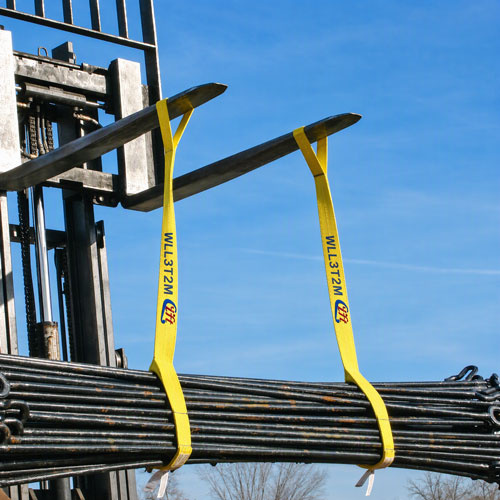
The three photographs that follow are all taken from this site's own production and service record, and each one shows a different half of the problem. The first is the article itself, on the bench . The second is the same class of band in service, under a bundle of ribbed steel bar. The third is the same band class again, under a stack of steel tube, with the crane hook in frame and nothing bet ween the band and the weather. Read together they make the point this page is built on: on a steel consignment the band is the least complicated part of the lift and the load is the most, and the spec ification that matters is written from the load backwards.

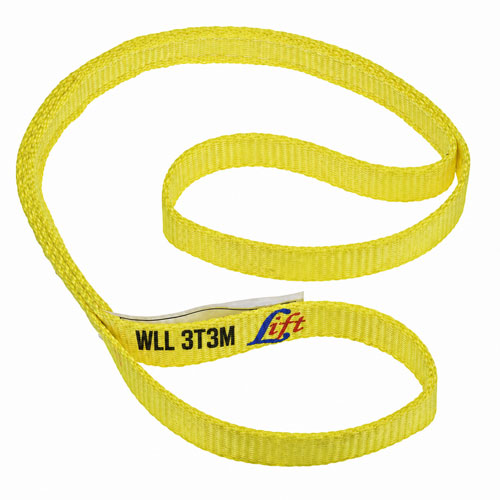
The article, photographed on the bench. A flat woven band closed into an endless loop, with the working load limit and the lengt h printed along the face in the same block of print. Two facts are legible from the band alone and two are not: the band says what it will carry and how long it is, and says nothing about which fibre it is woven from or which consignment it is going to. Both of those are settled by the order, which is what §9 is about.
1. What This Page Covers, and the Four Words in the Name
The name on this page has four working words and one padding word. One way states the commercial arrangement: the band leaves with the consignment and does not come back. Lifting sling states the function: it carries a load on a crane hook, which is a different job from holding a load down on a trailer. Export states the journey and, through the journey, the packing. And steel and steel tube states the cargo. The slack word is for, and the reason it needs saying out loud is that a great deal of the confusion around this article comes from reading the phrase as a statement about the sling when it is a statement about the load.
That distinction is not pedantry and it has a commercial consequence. A buyer who reads the phrase as a sling description will send an enquiry that names a length and a capacity and nothing else, a nd will receive a quotation that is technically responsive and operationally useless, because the two things that decide the band on a steel consignment are not capacity and length at all. They are th e contact geometry and the unit load: how the band will sit against the steel, and what the thing it is sitting against actually is. A bundle of round tube and a stac k of plate of the same gross weight are not the same lift, and a band chosen for one is not thereby suitable for the other.
Three of the four words are already treated at length elsewhere on this site, and this page links to them rather than repeating them, because repetition across pages is how a catalogue ends up comp eting with itself. What the term one way means as a commercial arrangement, and the standard that is normally quoted for the label on such a band, are set out on the one way sling page. The category definition itself, and the point that a one-way article is still subject to the rules that apply to any lift, are on the single use page. The form of the band, and what changes when the loop has no ends at all, is on the endless sling page. Fitting the band at the packing station, so that the receiver does not have to rig anything, is the subject of the pre-slung cargo page. What none of those pages does is ask what the cargo is. That is this page's subject, and the next three sections are the cargo.< /p>
2. First the Cargo: What "Steel" Is in an Export Consignment
The word steel covers a group of products whose only shared property is the material they are made from, and whose shared property is almost never the property that decides a lift. What de cides the lift is the product form, because the form sets the shape of the contact, the position of the cut edge, the stiffness of the unit and the way the pieces behave when the band takes the load. A specification that says steel, two tonnes says nothing that a rigger can use; a specification that says a bundle of cold formed square hollow section, six metres, two tonnes, says a lmost everything.
The forms below are the ones that appear in export consignments and therefore in the enquiries this factory receives. They are grouped the way the trade groups them rather than the way a standards library groups them, because the grouping that matters on a loading quay is the shape of the thing and how it is banded, not the chemical composition. The third column is the part that decides the sli ng: what surface the band will meet, and what that surface does to a woven strap.
| Product form | How it normally travels | What it asks of the band |
|---|---|---|
| Structural sections: angle, channel, beam | Bundled in the order book's sequence, strapped across the bundle, often with a timber or steel spacer between layers so the bu ndle does not rock. | A long, stiff unit that will not conform to the band. The band has to find a flat face and stay on it, and the bundle's own co rners are where the weave wears first. |
| Plate and sheet | Stacked flat on a timber skid or in a wooden crate, with the plate edges exposed along all four sides of the stack. | A genuinely sharp edge along the full length of the contact. This is the one form where a flat band on a bare edge is a specif ication error rather than a risk. |
| Flat bar and strip | Bundled like sections but much closer in section, so the bundle is thin, wide and prone to splaying at the ends. | The bundle holds shape only while the strapping is intact. A band that takes the load on the strapping rather than under the b undle is loading the wrong thing. |
| Hollow section: square and rectangular tube | Bundled in layers, sometimes nested, with the mill's protective coating or a light oil film still on the surface. | A flat face and a hard longitudinal edge at once. The band rides the face, and the edge it crosses is a square corner, not a r ounded one. |
| Round tube and pipe | Bundled in a stack that is closer to hexagonal than square, tied with steel strapping, with the pipe ends flush at one end of the bundle. | Nothing on the bundle is flat and nothing is square. The band contacts a curved surface and tends to migrate towards the gap b etween tubes unless the bundle is packed to prevent it. |
| Line pipe and pipe pile | Long, heavy units, frequently with a factory-applied external coating and with end caps or end protectors fitted for the voyag e. | Coated surfaces and end fittings are damage claims waiting to happen, so the contact is as much about what the band protects a s what it carries. |
| Wire rod and bar in coils | Coils tied as individual units or stacked as a split bundle, usually on a timber skid for handling. | A unit that can open under load. The band runs through the eye or around the body, and the choice changes what the band is rat ed at. |
| Ribbed and reinforcing bar | Bundled and strapped at the mill or the fabricator, with the bundle weight fixed at the works because that is where the loadin g bay is. | A ribbed surface that grips the band and abrades it at the same time. This duty is treated in detail on the steel plant sling page. |

The band in service, on the cargo this page is named for. Two loops of the same endless band run under a bundle of ribbed steel bar and up to the lifting appliance, with the working load limit legible on both legs. Three things are worth reading off the photograph before the tables: the band is under the bundle and not under t he bundle's strapping; the load is spread over two positions rather than one; and nothing protects the band from the bar it is sitting on. The last of the three is the subject of §6.
3. And Then the Tube: Round, Square and Rectangular, and the Problems Each One Brings
Tube deserves its own section rather than a line in the table above, because the export consignment of tube has a geometry problem that no other form shares and that almost no enquiry mentions. A s tack of round tube does not make a bundle in the way a stack of plate makes a bundle. The pieces touch along lines rather than across faces, the outer profiles are curved, and the assembly has a natur al tendency to settle into a different arrangement when the band takes the load, because the tubes can roll into the gaps between each other. The unit is stable on the ground and less stable in the ai r, and the load path through the bundle changes as it settles.
That is why the packing of a tube bundle involves more than strapping. A bundle of round tube for export is normally packed so that it arrives at the far end in the same arrangement it left in, and the two devices that do that work are spacers or separators between layers and the tie pattern around the whole stack. Both are the packer's decisions, and both have a consequence for the band that arrives at the far end: a bundle that has been packed to hold its shape is a bundle a single band can go under without the stack opening, and a bundle that has only be en tied as tight as the strapping allows is not.
The second tube-specific problem is the end. A tube bundle presents its pipe ends at one or both faces of the unit, and a pipe end is a machined or cut ring with a wall thickness that varies by gra de and by the standard the tube was made to. For a hot finished or cold formed structural hollow section the wall is nominal and the end is square; for line pipe the end may be bevelled, and for some products it is threaded and fitted with a protector. A band that runs across the end of a bundle rests on the ends; a band that runs around the body of the bundle rests on the outside of the outer tub es. Those are different lifts and they produce different wear patterns, and an enquiry that does not say which face the band will cross is an enquiry the factory has to guess at.
The third problem is the one the trade normally solves commercially rather than technically. Tube and pipe are sold by the metre and by the tonne at once, so the unit is long and heavy, and the cen tre of gravity of a long unit lies somewhere along a length that the crane operator cannot see. That is the reason tube bundles so often travel with a lifting position marked at the ends, or with the band already fitted at the packing station in the manner described on the pre-slung cargo page. Marking the pick poin ts on the bundle is not a formality; it is the only way the person at the far end lifts the same bundle the packer lifted.
| Tube form | What the band meets | The question the enquiry should settle |
|---|---|---|
| Round tube, bundled bare | A curved contact that is never more than a tangent, with a gap either side of the band. | Whether the bundle is packed with separators so it holds its shape, or only tied. |
| Round tube with end caps | A plastic or steel end protector with its own edge, which is a softer contact than the tube but not necessarily a friendly one . | Whether the band may bear on the protector, and whether a damaged protector is an accepted loss or a claim. |
| Square and rectangular hollow section | A flat face along the length and a square corner where the band turns from the face to the underside. | Which face the band crosses, and whether the corner it turns over is protected. |
| Coated line pipe | A coated surface the consignee expects to receive unmarked, and an end that may be bevelled or protected. | What the band may touch, and what evidence of contact will be treated as damage at the far end. |
| Mixed bundles, tube with sections | Two different contact geometries inside one unit load, and a bundle that cannot be packed to suit both. | Whether the mixed unit is a lifting unit at all, or a packed unit that has to be broken down before it is lifted. |
4. The Unit Load: the Object the Band Actually Meets
Nobody lifts steel. What is lifted is a unit load: an assembly of pieces that a packer has decided to treat as one object for handling, and the band's rating applies to that object and not to the pieces inside it. This sounds like a definition until it is applied, and then it decides most of the questions on a steel consignment. A band under a unit load has to satisfy three con ditions, and failure of any one of them is a lift that should not have been made.
The first condition is that the unit load has to be able to take the load as a unit. A bundle held together by its strapping is a unit load while the strapping is sound and while the pieces are sup ported by each other along their length. If the band lifts the bundle from two positions and the bundle is long, the pieces between the two positions are carried in bending; if the bundle is short, th ey are carried in bearing. Neither is wrong, but the packer and the rigger need to be thinking about the same one.
The second condition is that the band has to be able to reach under the unit load. On a steel bundle this is less obvious than it looks, because the bundle sits on the ground or on timber, and the gap beneath it is decided by the packing rather than by the load. A bundle that has been packed with a clearance under it can be slung in place. A bundle that has been packed flat on a skid has to be raised before it can be slung, which means the lift is either done at the packing station, before the bundle is closed, or done with a different appliance altogether.
The third condition is that the unit load has to stay the same unit at the far end. This is the condition that export adds and domestic handling does not, and it is the reason the packing specifica tion is part of the sling enquiry. A bundle that has been strapped for a road journey and a bundle that has been strapped for a sea voyage are not the same object at the end of the journey, and the di fference is what the packing section of this page deals with.
| Component of the unit load | Who decides it | What it changes about the sling |
|---|---|---|
| The pieces themselves | The mill or the fabricator, from the order. | The contact geometry, and therefore the width and the edge protection of the band. |
| The strapping or ties that hold it together | The packing line, usually from the mill's standard bundle specification. | Nothing, unless the sling is rigged to the strapping, which is the error §5 is about. |
| Separators, spacers and layer packing | The packing line, to a specification the buyer usually writes. | Whether the bundle keeps its shape in the air, and therefore whether one band or two are enough. |
| The skid, crate or pallet under it | The packing specification, and increasingly the export regulation quoted in §7. | Whether there is a gap for the band to pass under, and what the band bears on at the bottom of its travel. |
| The marked lifting position | Whoever writes the slinging plan for the unit. | The effective length of the band, because a marked position fixes where the band has to sit. |
| The total mass and its distribution | The mill's bundle card, the packing list, or a weighbridge ticket. | The working load limit of the band, and the number of bands if the unit is picked on more than two positions. |
| The identification on the unit | The mill, from the rolling schedule: heat number, grade, size, bundle number. | Nothing directly, but it is what makes the unit load traceable at the far end, as §8 explains. |
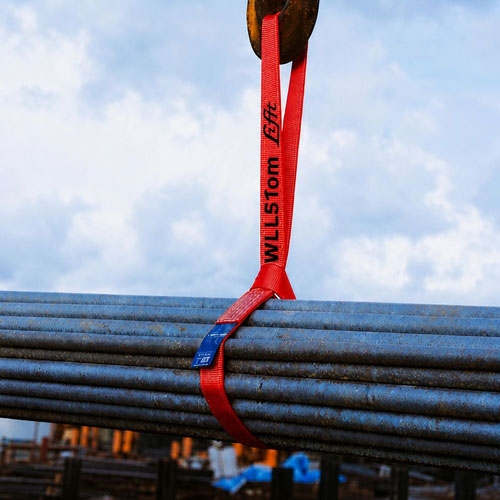
A tube consignment in service. The band leaves the hook as a single leg, opens into two runs under the stack, and takes the whol e unit load on those two runs. The stack is round tube, so there is no flat face anywhere on the contact and the band is bearing on tangents. Read the printed figure on the band against the size of th e stack and the section on unit loads becomes concrete: the figure on the band is a statement about the unit load and about nothing inside it.
5. Steel Strapping Is Not a Lifting Sling: Two Systems That Look Alike
This is the most consequential confusion on a steel consignment and the one that costs lives rather than claims, so it is worth stating in one sentence before the detail. The strapping that holds a bundle together is part of the packing; the sling that lifts the bundle is lifting equipment. They are specified, tested and marked under different regimes, and neither may do the other's job . The reason the confusion exists is not carelessness in the trade. It is that both articles are flat, both are tensioned, both are made in widths that look similar, and a bundle of steel wit h four or six steel straps around it looks like a bundle that has already been prepared to be lifted.
The two systems differ in the three places that matter. First, the design basis: lifting equipment is rated with an explicit working load limit and a design factor behind it, so th at the number on the article is a figure a lift plan can be built on. Strapping is specified as a packaging material, and its selection is driven by the tension the seal and the tool can develop and b y what the bundle has to resist in transit. The strapping standard's own scope names bundling, unitising and bracing as its purposes, and the same scope names lifting and lashing among the uses flat s teel strapping is made for, which is precisely why the two get confused in a loading bay: the same coil of strap can be sold into a bundle that will never be lifted by it and into a load that will be lashed down by it, and the buyer has to know which of the two he is buying.
Second, the direction of the load. Strapping works because it is in tension around the bundle, and its job is to stop the pieces separating. A sling works because it is in tension between the hook and the load, and its job is to carry the whole mass. A bundle's straps are loaded by the pieces pushing outwards; a sling is loaded by the whole bundle pulling downwards. The two sta tes are not the same state, and a strap sized to survive the first is not thereby sized to survive the second.
Third, the record. Lifting equipment carries a mark that a rigger can read and an identity that an inspector can follow; packing strap carries whatever the mill prints on the bundl e card. When a consignment arrives at the far end and the receiver has to decide whether the unit may be lifted as it stands, the decision turns entirely on whether the unit has been prepared for lift ing or only for transport. A bundle that has straps and no marked lifting position has been prepared for transport.
| Question | The bundle's strapping | The one way lifting sling |
|---|---|---|
| What it is for | Holding the pieces of the unit load together while it is stored, stacked and carried in transit. | Carrying the mass of the unit load between the load and the lifting appliance. |
| How it is loaded | In hoop tension around the bundle, by the pieces pressing outwards and by handling shocks in transit. | In tension along the legs, by the full mass of the unit load, multiplied by the geometry of the arrangement. |
| What number is on it | Generally nothing a rigger can use, because the article is bought by width and grade rather than by rating. | A working load limit and a length, printed on the band or carried on a label sewn to it. |
| Who owns the decision | The packing line, to a bundle specification the mill or the buyer wrote. | The person planning the lift, who has to know the mass, the geometry and the contact points. |
| What happens if the wrong one is used | A bundle that has been lifted by its straps can shed pieces in the air when a seal releases or a strap cuts through the band i t is bearing on. | A band used as a tie-down is being used outside the duty it was rated for, and the site's cargo pages state their figures in l ashing capacity rather than in kilograms for exactly this reason. |
| Where the answer is written down | On the packing specification and, if there is one, the bundle card that travels with the unit. | On the band itself, and in the batch record that the maker keeps and the buyer can ask for. |
The practical rule that follows is one line and it is worth printing on a packing line: the band goes under the bundle, never under the strap. If the band is rigged over the strapp ing, the whole mass of the load is applied through the strap and the strap's own edges, which is a load path nobody has rated. If the band is rigged under the bundle, the band carries the mass through the unit load, which is what the unit load was packed to do. Nothing about the article changes between those two sentences; everything about the lift does.

The band and its two finished ends. The reinforced loops are the part of this article that a bundle of steel will load hardest, because on a steel unit load the loop is what bears on the corner, the pipe end or the rib of the section. Note also where the rating sits: printed on the face of the band in figures a rigger can read with the load already on the hook, which is the property that separates this article from the straps around the bundle.
6. Where a One-Way Band Fails First: the Four Contact Points on Steel
A flat woven band does not fail evenly. It fails where it is loaded hardest, and on a steel consignment there are four places where that happens, in a predictable order. Knowing the order is what t urns the choice of band from a capacity calculation into a specification, because three of the four are solved by the shape of the article and its protection rather than by a bigger number.
The first is the loop against the edge. A flat band has a woven face and a finished flank, and the flank is the weaker direction. When a loop is loaded over a narrow edge, the edge be ars on a short length of the flank and cuts into the weave rather than compressing it. On a steel bundle that edge can be the cut end of a section, the corner of a hollow section, the square edge of a plate stack, or a pipe end. This is why the width of the band matters more on steel than on a soft load: a wider band spreads the same force over a longer contact and turns a cutting action into a be aring one. Where the edge cannot be avoided, the answer is either a wider band or a protector placed between the band and the steel — and the protector has to be part of the packing, because the rigge r at the far end will not have one.
The second is the bottom of the loop, where it turns. Every sling arrangement has a point at which the band changes direction, and at that point the contact pressure is at its highest . On a round bundle that point is a tangent line; on a square bundle it is a corner; on a bundle that has settled, it is wherever the pieces have rearranged themselves. The pressure at the turn is wha t determines whether the band wears, and it is reduced by lengthening the turn — that is, by using a wider band or a longer loop — rather than by strengthening the yarn.
The third is the point where the two legs meet the hook. On a two-leg arrangement the legs run together at the appliance, and the angle between them is what multiplies the force in ea ch leg. A pair of legs hung wide carries more than a pair hung steeply for the same load, and the angle is set by the length of the band and the size of the bundle rather than by the rating of the art icle. On a long bundle, that means the effective length is a load-bearing decision, not a convenience.
The fourth is anywhere the steel has a burr, a weld spatter, a tack weld, a lifting lug or a previously damaged surface. This is the one that cannot be designed out at the factory, be cause it is the condition of the cargo rather than the design of the band. It is also the reason a one-way article is inspected before the lift even though it is new: the damage that ends a flat band is more often mechanical than chemical, and it can be done in a warehouse as easily as in service.
| Contact point | Why it is loaded hardest | What reduces it |
|---|---|---|
| The loop against a cut edge or pipe end | A narrow edge bears on the flank of the band instead of across its face, concentrating the force into a short length of weave. | A wider band, or a packing detail that puts a protector between the steel and the band, since the protector has to travel with the unit. |
| The bottom of the loop on round tube | A curved surface gives a tangent contact, and the pressure at a tangent is the highest a given load can produce on a flat band . | A longer turning length, which is a length decision, and a bundle packed so the tubes cannot open under the band. |
| The turn at the bundle's square corner | The band changes direction through a sharp angle, so one small area of weave takes the whole leg force. | Packing the corner, choosing the face the band crosses, or accepting a wider band for the same rating. |
| The legs at the appliance | The angle between the two legs multiplies the load in each one, and that angle is fixed by the band's length and the bundle's width. | A longer band, so the legs hang steeper, which is again a length and order-form question rather than a rating question. |
| A burr, spatter or tack weld on the cargo | A local hard point that behaves like a blade under load, and which no drawing of the band can anticipate. | Inspection of the cargo before the lift, and the packing detail that keeps the contact away from the damage. |
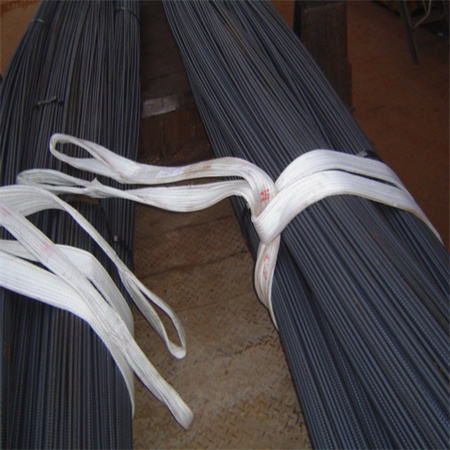
Two finished unit loads at the works. Each bundle has been closed and then slung, and the loops of the white bands stand clear o f the steel so that the load can be picked without being reopened. Notice what the photograph is and is not evidence of: it shows that the units were prepared for lifting, and it says nothing about th e mass of either one or about the surface the bands are bearing on. Those are the two figures the enquiry has to carry, and the two this page keeps returning to.
7. Packing for the Sea Voyage, Not for the Lift
Export packing is where a steel consignment stops being a lift and starts being a shipment, and it adds a set of requirements that have nothing to do with slings and everything to do with whether t he goods arrive. Two of them are worth naming in detail because both appear in the packing specification a buyer writes and both change what the sling has to do at each end of the voyage.
The first is wood. A great deal of steel export packing involves timber: crates around plate and machined parts, pallets and skids under bundles, dunnage between layers and against container walls, and cradles under anything cylindrical. Almost every destination country regulates that timber, and the regulation is a phytosanitary one rather than a commercial one: wood packaging material has to be treated so that it cannot carry pests, and the two accepted treatments are heat treatment and fumigation. Published guidance on the requirement is consistent about the heat treatment figure — the w ood is heated to a core temperature of at least 56 degrees C for a minimum of 30 minutes — and about the mark: treated wood packaging carries the ISPM 15 mark, which includes the IPPC symbol, the country code, the producer's code and the treatment code, so that an inspector at the far end can see at a glance that the timber was treated and by whom. The requirement is generally des cribed as applying to wood packaging material as a category, and the sources that describe it name crates, pallets and dunnage specifically. For a steel consignment the practical consequence is a line in the packing specification and a photograph of the mark on the timber, because the mark is applied by an authorised producer and cannot be added at the quay.
The second is the packing of the container itself. The reference here is the IMO/ILO/UNECE Code of Practice for Packing of Cargo Transport Units, known in the trade as the CTU Code , which is the international guidance on the safe packing of containers and other cargo transport units. Its subject matter is exactly the part of a steel export that no sling can fix: the distributio n of weight inside the unit, the way cargo is blocked and braced against movement, and the checks that have to be made on arrival. Steel is a dense cargo, so its weight is concentrated and its centre of gravity sits low and often off the vehicle's centreline. A bundle placed for convenience rather than for balance produces a container that is legal, sealed and badly loaded, and the sling that lift ed the bundle is not the reason the container is refused.
There is one further requirement that belongs in this section because it is the one a buyer discovers latest. A packed container has to have a verified gross mass declared to the c arrier before it is loaded, under the SOLAS requirement that came into force as a mandatory regime for shippers. The regulations permit two methods: weighing the packed and sealed container, or calcul ating the mass from the verified masses of the cargo and the packing. For a steel consignment the second method means the bundle weights have to be known at the mill rather than discovered at the port , and the first means a weighbridge. Either way, the number that goes on the shipping document is the number the sling was chosen against, and a bundle whose actual mass differs from its documented ma ss is a bundle that has already been mis-slung before it was ever lifted.
| Requirement | What it asks for | What it changes for the sling |
|---|---|---|
| Treated wood packaging | Heat treatment to a core temperature of at least 56 degrees C for 30 minutes, or fumigation, with the ISPM 15 mark on crates, pallets and dunnage. | The timber that is between the band and the steel is now a specified material, so a protector made of packing timber can be na med in the order. |
| Packing to the CTU Code | Weight distributed inside the unit, cargo blocked and braced, and the unit checked on arrival as the Code describes. | Units are packed in a fixed order, so the lifting position of a bundle is fixed by the packing plan, which fixes the band's le ngth. |
| Verified gross mass of the container | A declared mass, obtained by weighing the packed container or by calculation from verified cargo and packing masses. | The documented bundle mass becomes load-bearing information, and a mismatch between it and the actual mass is a lift planned o n the wrong number. |
| Water and condensation | A long sea voyage in a container that will sweat, with the steel often shipped with a surface film of oil or a coating. | A band that has been wet and stored in its packaging is still a new band, but the inspection before the lift is the moment to notice that the cargo surface has changed. |
| Mixed packing in one unit | Bundles of different forms and masses loaded into the same container, with the lifting positions of each one recorded separate ly. | Two or three different band lengths in one shipment, which is a quotation question rather than a technical one, and one the fa ctory prefers to answer before the container is sealed. |

A batch at the bench, on its way to a consignment. Every band in the pile carries the same printed load and length because every band in the pile is for the same unit load. That is what ordering for a steel consignment looks like from the factory's side: not a catalogue pick but a run of one specification, sized to a bundle so mebody has already described. §9 is about writing that description down.
8. What Travels With the Steel, and the One Record That Travels With the Sling
A steel consignment leaves with a file, and the file is what makes the goods the goods. Every document in it answers a different question, and the exercise worth doing before an order is to work ou t which of them will be asked for at the far end and which of them depends on the sling at all.
The steel side of the file is well established in the trade and lightly regulated by comparison with the sling. The mill test certificate, also called the inspection certificate or the material certificate, is the mill's statement about the product: the grade, the chemical analysis and the mechanical properties, tied to the heat number of the cast the steel cam e from. Its form is defined by the inspection-document standards, EN 10204 in the European system and ISO 10474 internationally, which between them describe a small s et of document types from a simple statement of compliance to a full certificate with an independent inspector's signature behind it. The distinction that matters commercially is which type the buyer asked for: the type is agreed at enquiry and order stage, and a certificate that is one grade less than the contract requires is a document problem that no amount of correct steel can fix. Alongside t he certificate travel the packing list, which is where bundle weights and bundle identification live, the bill of lading for the sea leg, and the origin documents tha t the destination's customs regime requires. The steel itself is identified on the bundle card: heat number, grade, size, bundle number and mass, which is what lets the consignee at the far end take o ne bundle off a stack and find its certificate.
The sling's own record is much shorter and, on a one-way article, much more easily lost. The band carries its printed working load limit and length, and the identification that a batch test can be tied to. That identification is the only thread connecting the band in the receiver's hand to a record of what happened when a sample of the batch was tested, and it is the reason the label on this cl ass of article is treated as a functional part of the goods rather than as a decorative one. The full list of what the label must carry belongs to the page that deals with the standard behind it, the one way sling page, and the reason it is not repeated here is that this section is asking a narrower question: which of the documents in the steel file will a receiver use to test the sling, and which will not.
| Document | What question it answers | Does it say anything about the sling |
|---|---|---|
| Mill test certificate, to the agreed type under EN 10204 or ISO 10474 | What the steel is, and whether the cast met the specification the order named. | Nothing. It is a document about the cargo, and it is the reason the cargo's mass and identity are known before the sling is ch osen. |
| Heat number and bundle card | Which cast a piece came from, and which bundle it was packed into with what mass. | Indirectly, and importantly: the bundle mass on the card is the figure the working load limit of the band was chosen against.< /td> |
| Packing list | What is in the shipment, in what units, at what weights, packed how. | It is where the count of slings per bundle or per container can be recorded, which is useful when the bands are fitted before shipment and easy to omit. |
| Bill of lading | That a carrier has received the goods for carriage, and on what terms. | Nothing. It is a document about carriage, and it is also the point at which the verified gross mass declared under the SOLAS r egime is already fixed. |
| The band's own printed marking | What this band may carry, and how long it is, readable at the load without paperwork. | Everything the receiver can check in the first minute, which is why the printing has to survive the voyage. |
| The batch test record held by the maker | What happened when a stated sample of the production run was loaded to a stated multiple of its rating. | It is the only document in the file that is about the sling, and it is only usable if the identification on the band resolves to it. |
| HS code on the customs entry | Which tariff heading the goods are declared under. For textile slings and straps this is commonly declared under heading 6307. 90, the heading for made up textile articles not specified elsewhere. | Nothing technical, but it is worth agreeing with the buyer at quotation stage, because a mis-declared consignment of slings de lays the whole shipment including the steel. |
9. What to Write on the Order for a Steel and Tube Consignment
An enquiry for this article goes wrong in a consistent way, and it goes wrong in the same place every time. The buyer describes the sling, because the sling is what is being bought, and leaves the load as an adjective. The factory then has to choose between quoting on what was written and asking what was meant, and a quotation issued against an incomplete description is the most expensive docum ent in the trade, because it is right about everything it was told and silent about everything that decides the lift.
There are eight lines that make an enquiry complete on a steel or tube consignment, and none of them is difficult to write once the load is in front of the person writing it. The first five describ e the load, not the sling: the form, the mass of the unit load, the dimensions of the unit load, the surface the band will meet, and how the unit will be picked. The last three describe the article an d the shipment: how the loop is to be measured, what the packing has to be, and what documents the consignee will ask for. That order is deliberate. Every line after the fifth is easier to answer once the first five are settled, and a factory that receives them in this order can quote the right band in a single exchange.
| Line on the enquiry | An answer that works | What it settles |
|---|---|---|
| 1. The product form | Ribbed bar, square hollow section, round tube, plate stack, coil, mixed bundle. A form, not the word steel. | The contact geometry, and therefore whether the answer is a bare loop, a wider band or a protected one. |
| 2. The mass of the unit load | The mass of the bundle as packed, with the tolerance the mill works to, and not the mass of one piece multiplied by an assumed count. | The working load limit of the band, and the margin available for the angle between the legs. |
| 3. The dimensions of the unit load | Length, width and height of the bundle, or the circumference around the band's path if that is what has been measured. | The length of the band, because the length has to reach around the unit and still leave the legs at a workable angle. |
| 4. The surface the band meets | Bare steel, mill scale, oiled, coated, galvanised, or protected by packing timber. Say it even when it looks obvious. | Whether the packed unit needs a protector, and whether the band's width is chosen for bearing or for its rating alone. |
| 5. How the unit is picked | Two positions, four positions, or through the eye of a coil; and whether the band is fitted at the packing station or by the r eceiver. | How many bands per unit, and whether the order is a plain sling order or a pre-fitted one. |
| 6. How the length is measured | Around the loop, along the band, or between the load-bearing points. §10 is about this line, and it is the one most often left out. | Whether the band that arrives is the band that was ordered, and it is the commonest dispute on this article. |
| 7. The packing and the voyage | Destination, mode, whether the unit travels in a container or on deck, and whether the wood packaging has to carry the treatme nt mark. | Whether the bands are supplied loose for fitting at the works or packed to travel with the units. |
| 8. The documents | What the consignee will ask for: the printed marking on the band, the identity that ties a band to a test record, and any decl aration the destination requires. | What has to be printed and what has to be kept on file, both of which are decided before production and neither of which can b e added afterwards. |
Two of the eight lines are worth dwelling on because they are the ones a buyer is most likely to answer from memory rather than from a document. The mass in line 2 should come from the bundle card or the packing list, not from an estimate, because the whole rating of the band cascades from it. And the pick positions in line 5 should come from whoever will actually lift the unit at the far end, not from whoever writes the purchase order, because the far end is where the band will be used by people who have never seen the bundle before and will have nothing to go on except the marked position s and the printing on the band.
10. Length, and the Circumference of the Bundle
Length is the quietest failure on this article and the most expensive, because a band of the wrong capacity fails visibly and a band of the wrong length fails silently: it arrives, it looks right, and it will not reach around the bundle in the positions the lift plan needs. The difficulty is not measurement, it is convention. There is more than one accepted way to state the length of a closed l oop, and the two conventions differ by roughly a factor of two, so a figure quoted without its convention is a figure that means nothing.
On a band whose ends are joined into a continuous loop, one convention states the length of the loop as the circumference of the closed band, and the other states it as the length of the laid-flat loop from end to end. They describe the same article, and one of them is twice the other. This is not a defect in either convention; it is what happens when a trade measures a circle and a line and us es the same word for both. The consequence for a steel consignment is specific: a bundle's circumference is a measurement the packer can take with a tape, the band's length is a figure the factory has to print, and unless the enquiry says which convention the number belongs to, the two can be entered against each other and the error will not surface until the band is around the bundle.
The bundle itself adds a second question to the same line, and it is a question about the geometry of the pick rather than about the size of the load. A band that has to pass under a bundle and ris e to a hook has to do two things at once: reach around the section of the unit, and leave enough material for the legs to hang at an angle the lift plan allows for. A band chosen exactly to the bundle 's circumference arrives with no material for the legs. The working rule is therefore to state the circumference and the required leg arrangement together, which is why §9 puts the pick positions and the length on the same form.
| What is being measured | Who can measure it | How to write it so it cannot be misread |
|---|---|---|
| The circumference of the bundle at the lifting position | The packing line, with a tape, once the bundle is closed. | Give the figure and say it is the circumference, and give the position along the bundle where it was taken. |
| The loop length of the band as supplied | The maker, at the bench, with the loop closed. | Say whether the figure is the closed circumference or the laid-flat length, because the two differ by about a factor of two. |
| The length needed for the legs | Whoever writes the lift plan, from the bundle's height and the hook's position. | State the pick positions and the working height, rather than an assumed angle between the legs. |
| The distance between two pick positions on a long unit | The packing line, from the slinging plan of the mill or fabricator. | Give it as a dimension on the bundle and mark it on the unit, so the far end rigs the same pick. |
| The length of a coiled unit's path | The mill, from the coil's outside diameter and eye. | Say whether the band passes through the eye or around the body, because the two paths have different lengths and different rat ings. |
| The tolerance on any of the above | Nobody, unless the buyer writes one. | State it. A length tolerance is a commercial term, and the factory will quote to it if it is written down. |
11. Where This Article Is Chosen, and Where It Should Be Refused
The commercial case for a one-way article on steel is straightforward and it is arithmetic rather than engineering. A consignment of steel travels from a mill or a fabricator to a destination from which the lifting equipment would have to be recovered, stored, inspected and eventually returned, and the cost of doing that on an article that is used once per unit load is frequently higher than th e cost of the article itself. Where the journey is one-directional and the destination has no rack, no inspector and no return freight, the one-way article is the right purchase. The sections above ha ve been about the two conditions that make it the right purchase safely rather than merely cheaply: the unit load has to be prepared for lifting, and the band has to be specified against the load rath er than against the price.
There are three duties on which this article should be refused, and they are refused often enough that they are worth naming in a section of their own. The first is any duty where the same load has to be picked repeatedly over a long period in different places. A band that has no inspection history worth the name is the wrong instrument for a duty that depends on one. The second is any duty whe re the load is lifted over people, over live plant, or in a position from which a dropped load cannot be recovered. The category exists because the article is not coming back; it does not exist to car ry a risk that a returnable article would carry better. The third is any duty where the band is being asked to hold a load rather than lift it, which is the strapping question of §5 arriving from the other direction: a one-way sling in a lashing role is outside its rating, and the site's cargo pages exist because that job has its own equipment with its own numbers.
| The duty | The right answer | The reason |
|---|---|---|
| Fitting at the packing station for a receiver who has no rigging capability | A one-way article, fitted before the unit is closed, to a slinging plan. This site's pre-fitted route is described on the pre-slung cargo page. | The receiver never has to choose a band, so the specification error that this page is largely about cannot be introduced at th e far end. |
| One journey, one destination, no return freight | A one-way article in the form the load requires, which is the commercial case for the whole category. | The return logistics cost more than the article on exactly this kind of consignment, which is the arithmetic that created the category. |
| Repeated picking of the same load over weeks | A returnable article with an inspection regime of its own. | The whole point of the one-way category is that it has no inspection history to maintain, which makes it unsuitable where an i nspection history is the control. |
| A lift over people, over live plant, or where a dropped load cannot be recovered | Not this category. A rated, inspectable article chosen for that duty. | A commercial saving should not be taken out of the part of the system that absorbs an error. |
| Holding a load on a trailer or in a container | Lashing equipment rated in lashing capacity, of which the site's cargo lashing belt page is one family. | Lifting and lashing are rated and marked on different bases, and the numbers are not interchangeable. |
| A hot section taken straight from a processing line | An article whose material and condition rules have been checked against the temperature of the cargo, which is a question for the maker rather than for a catalogue. | Heat is a condition of the carriage as well as of the band, and a band chosen for a cold consignment is not automatically righ t for a warm one. |
| An acid-washed or chemically processed steel line | A band whose fibre has been chosen for the chemistry, which is a fibre question rather than a rating question. The polypropylene flat sling page deals with that duty. | Two bands of the same rating and different fibre behave differently in the same chemical environment, and the rating tells you nothing about which. |
12. This Page and the Other Named Forms on This Site
Several pages on this site deal with articles that are called by the same names as this one, and the reason they are separate pages is that the named form changes the engineering. This section is a map of them, written so that a buyer who has arrived on the wrong page can find the right one in a minute. Each entry states the question that page answers, and none of them is repeated here, because the value of the internal links on a manufacturer's site is that each page carries the weight of one question rather than a share of all of them.
| Page | The question it answers | When to go there instead of staying |
|---|---|---|
| One way sling | What the term one way means commercially, and the standard normally quoted for the label on such a band. | When the cargo is not the open question and the paper on the band is. |
| Single use lifting sling | The definition of the category, and which rules still apply to an article used once. | When the buyer is arguing about the category rather than about a consignment. |
| Disposable pre-slung cargo sling | Fitting the band at the packing station, and what the receiver is entitled to assume as a result. | When the decision is not which band but who fits it and when. |
| One way endless lifting slings, single eyes, for steel pipe and tube | The endless and single-eye forms as they are applied to pipe and tube industries, where the end configuration is the deciding variable. | When the form of the band is already decided and the question is which end configuration the pipe duty needs. |
| Steel plant sling for ribbed steel bar | The same class of band on a steel works duty, traced from the bundle at the works through the journey to disposal at the far e nd. | When the duty is a works's own handling of bar and the disposal question matters as much as the lift. |
| Endless sling and endless webbing sling | The continuous loop as a construction: the arrangements it can make, and how its length is counted. | When the question is the geometry of the loop rather than the cargo it goes around. |
| Eye and eye sling | The sewn eye, the splice that forms it, and the geometry rules that go with it. | When the band has ends and the ends are the part being specified. |
| Endless round sling | The sleeved yarn loop, which is a different article from the flat band and is chosen for different reasons. | When the contact pressure of a flat band on steel is the problem being solved. |
Two of the pages in that table deserve a warning rather than a description, because they are the two most easily confused with this one by a buyer who is searching for a phrase rather than choosing an article. The pipe and tube form page named fourth is about the endless and single-eye forms on pipe and tube duties, and a buyer who has already settled the form of the band will find the answer t here and will not find it here. The steel plant page named fifth is about the bar bundle at a works, seen across the whole journey including what happens to the band at the end, and a buyer whose ques tion is what happens after the trip is on the wrong page here. Both pages are linked in good faith by this one because a buyer who needs them should reach them quickly, and neither is summarised here, because summarising them is how two pages on one site end up saying the same thing.
13. Frequently Asked Questions
Q1: What is a one way lifting sling for export steel and steel tube?
It is a flat woven band bought for one journey with a consignment of steel: it is attached to the load at the loading point, trave
ls with it to the destination, and is not recovered. The words that describe the article are one way, which is the commercial arrangement, and lifting sling, which is the function. The words that desc
ribe the job are export, steel and steel tube, and those three are what this page is about, because they decide the contact geometry, the unit load and the packing the band has to work with. The band
is normally supplied as a flat woven loop with its working load limit and length printed on the face, and it is made lighter than a returnable sling because it is not built to be inspected and stored
for years.
Q2: Why does the page start with the cargo instead of the sling?
Q3: May the sling be attached to the steel straps around the bundle?
No, and this is the mistake that most deserves to be written on a packing line. The straps around a bundle are part of the packing
: they are selected to hold the pieces together in transit, and they are loaded in hoop tension by the pieces pressing outwards. A sling is loaded in tension along its legs by the whole mass of the un
it load. If a band is rigged over the strapping, the entire mass of the load is applied through the strap and its seal, which is a load path nobody has rated, and a release or a cut in the air can she
d pieces from the bundle. The band goes under the bundle, not under the strap. §5 sets the two systems side by side.
Q4: The bundle is round tube. What changes?
Q5: How is the length of the band stated, and why does it go wrong?
Because there is more than one accepted way to measure a closed loop, and the two conventions differ by roughly a factor of two: o
ne states the closed circumference of the band, the other the laid-flat length from end to end. Both describe the same article. The failure mode on a steel consignment is specific, because the packer
can measure the circumference of the bundle with a tape while the maker prints a loop length, and a figure quoted without its convention can be entered against the wrong measurement. The rule is to gi
ve the figure, name the convention, and give the leg arrangement the band has to leave room for. §10 sets out the five measurements that appear on this kind of order.
Q6: Does export packing change the sling specification?
Q7: What documents should the consignment carry?
Q8: What should an enquiry contain?
Q9: When is a returnable sling the better purchase on steel?
Q10: Which of the forms on this site is the one for a steel consignment?
The one the load requires, which is why the enquiry has to describe the load first. A bare endless loop is the general answer for
a bundle that can be slung from underneath and picked on two positions, and the construction and its length conventions are on the endless s
ling page. Where the receiver has no rigging capability, the band is better fitted at the packing station, which is the route on the pre-slung cargo page. Where the contact pressure of a flat band on steel is the problem, the sleeved construction on the round sling page is the alternative. And where the band has ends rather than a closed loop, the eye form and its geometry rules are on the eye and eye page. §12 is the map of them all.
Contact
Lift Sling Rigging Co., Ltd weaves and closes flat woven slings in white and coloured bands, in the endless form and with eyes, with the working load limit and the length printed on the band and th e identification that ties the article to its batch record. For a steel or tube consignment, send the eight lines in §9 and we will confirm the form, the width, the loop measurement, the printed marki ng and the documents that travel with the shipment.
Telephone and WeChat: 18066002268
E-mail: 702461526@qq.com
Address: Lifute Industrial Park, Taizhou City, Jiangsu Province, China
HS code: 630790
- Previous:One-way synthetic webbing endless sling
- Next:One Way Endless Lifting Slings Single Eyes for Lifting Steel
-
Drone Anti-collision Net
-
Extra Large Capacity Cargo Net
-
Cargo Webbing Net
-

Color changing nylon double buckle loop nylon braided rope
-

Two end buckle lifting rope, double buckle round lifting rope, double fork nylon lifting rope, non jointed nylon lifting rope
-

Emergency escape lifeline, fire escape rope, fire safety escape emergency rope, steel wire core fire rope

