 Language
 简体中文
简体中文
- On the 2018 National Day holiday, Lifet completed six 100 ton large tonnage lifting belts as a gift
- The role of suspension net in the transportation of goods turnover
- Cargo soft lifting net, lifting net, lifting net, lifting net, bag, climbing net
- Precautions for using Lifutiden elevator
- How to make circular lifting straps
Contact: Wang Lili
E-mail:18066002268
Phone:702461526@qq.com
Address: Lifute Industrial Park, Taizhou City, Jiangsu Province
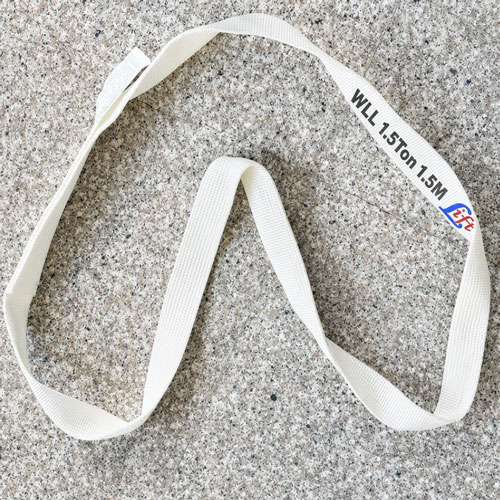
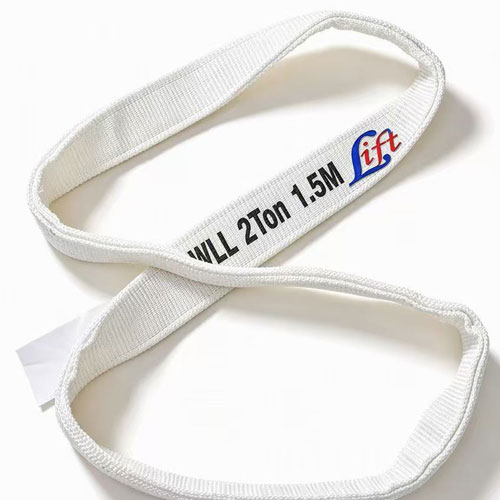
Lift Sling Rigging Co., Ltd manufacture One-way synthetic webbing endless sling,Disposable One-Way Lifting Sling,Textile disposable slings for single use lifts for lifting loads.A one-way synthetic webbing endless sling is a flat woven band closed into a continuous loop by a stitched lap and bought for one journey. The word synthetic in that name is a class rather than a fibre: the standards that govern this article name nylon, polyester and polypropylene, and require the sling to declare which one it is. Lift Sling Rigging Co., Ltd weaves the band, closes the loop and prints the working load limit it has to carry.
Hits: ℃
Release time:2026-09-25 08:31
Lift Sling Rigging Co., Ltd manufacture One-way synthetic webbing endless sling,Disposable One-Way Lifting Sling,Textile disposable slings for single use lifts for lifting loads.
Lift Sling Rigging Co., Ltd produce One-way Synthetic Webbing Endless S ling,Synthetic Webbing Sling,Synthetic Web Sling,Endless Synthetic Sling,One-Way Endless Webbing Sling.
One-way Synthetic Webbing Endless Sling — the Word "Synthetic" Is a Class, Not a Fibre
A one-way synthetic webbing endless sling is a flat woven band of man-made fibre, closed into a continuous loop by a stitched lap, and bought for one journey rather than for a serv ice life. Four of those words are settled by the drawing and the order — the width, the loop length, the working load limit, the trip. One of them is not, and it is the word this page is about.
Synthetic does not name a fibre. It names a family, and in the documents that govern this article the family is enumerated rather than implied. The United States regulation for slings lists the synthetic web materials it covers as nylon, polyester and polypropylene, and then requires, two paragraphs later, that each sling be "marked or coded to show the rated capa cities for each type of hitch and type of synthetic web material". Read those two provisions together and the consequence is plain: a sling described only as synthetic has no t identified itself, and the standard says so. The class word buys you a material family; the obligation to name the member of it sits on the sling itself.
That is a different question from the one the rest of this site answers. The endless webbing sling page covers how this artic le is made and tested; the eye and eye type page covers the numbered type system and where the endless form sits in it; the one way sling page covers the trip and its label. None of them asks what the adjective in the product's own name actually covers, or wh at changes once it has been read properly. That is this page's subject.
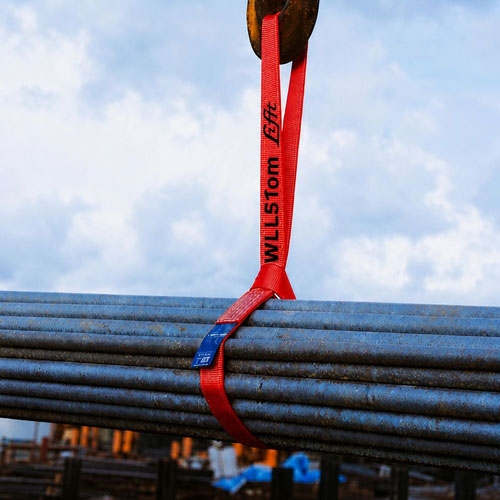
The article in service. Everything that makes this a synthetic webbing sling rather than a length of strap is invisible in the p hotograph: the polymer the yarn was extruded from, the weave that put the strength in the lengthwise threads, the finished edge along both flanks, and the stitched lap that closes the loop. The red is the only part that reads itself.
1. What This Name Says, and the One Word It Leaves Open
Read the name as a series of specifications, because each part of it is settled at a different moment. Endless describes the form: a closed loop with no ends and no fittings, so th e sling cannot be opened and there is nothing to attach. One-way describes the commercial trip: the band is not recovered, so it is built for one journey instead of for years of inspe ction and return. Webbing describes the material form — a flat woven tape rather than a rope or a sleeve. Sling describes the function. Each of those four is verifiab le from the drawing, the hook or the packing list.
Synthetic is the exception. You cannot verify it with a tape measure, you cannot see it in a photograph, and you cannot infer it from the colour of the band, because in this trade the band's colour states capacity rather than material. It is nevertheless the word that carries the most consequences, because the polymer decides what the sling may be exposed to, what temperature ends it, and — under the regulation that governs the market this article's name comes from — what the sling is required to declare about itself.
So the practical question a buyer is really asking with this phrase is not "is it synthetic", which is answered by the name itself. It is: which synthetic, and does the answer have to appe ar on the article. §2 answers the first, §3 the second.

The article this page covers, as we weave it: a flat band of synthetic webbing closed into an endless loop, with the working loa d limit and the length printed along the face. Note what the printing says and what it does not. It gives the load and the length; the fibre behind those figures is a separate declaration, and §3 is a bout where that declaration belongs.
2. What "Synthetic" Covers: the Three Polymers the Standards Name
The standards that govern flat woven webbing slings do not leave the word open. They enumerate it. The United States regulation for slings, in its scope paragraph, defines the synthetic web it appl ies to as being of nylon, polyester and polypropylene. The European standard for flat woven webbing slings covers slings "made of polyamide, polyester or polypropylene" across a state d range of widths — the same three polymers under nylon's other name. Two documents written on different continents, in different conventions and for different legal purposes, arrive at the same list. That agreement is what makes the list useful rather than arbitrary. A third document sits alongside them and is the one the trade in this market actually quotes from: the recommended standard specifi cation for synthetic web slings published by the industry's own association as WSTDA WS-1, which supplies the type definitions and the eye dimensions that catalogues sell against. Where this page need s a rule rather than a definition, it takes the rule from the regulation and the definitions from the pattern the trade has settled on.
| The word in the name | What the governing documents name | What this means for the order |
|---|---|---|
| synthetic (the class) | A family of man-made polymers. It is a category word, and it is the only word in this product's name that a quotation cannot c onfirm from a drawing. | Say the polymer out loud, in the enquiry and on the purchase order. The class word alone leaves the two most consequential pro perties undecided (§7). |
| polyamide (PA, nylon) | Named by both the US regulation and the European standard. The toughest of the three against abrasion, and the one whose chemi stry carries a specific prohibition (§7). | The usual choice where the band has to survive chafing rather than chemistry — with the acid prohibition attached, which is no t negotiable. |
| polyester (PES) | Named by both. Low moisture uptake, so its strength is stable wet or dry, and the usual specification for a band bought to a p ublished range. | The default for most of what this works makes. Its prohibition is the mirror of nylon's (§7). |
| polypropylene (PP) | Named by both. Lighter than water, indifferent to both acids and alkalis, and with the highest temperature ceiling of the thre e under the US regulation. | Chosen for chemistry rather than for capacity. Its weakness is a different family of chemicals, and it is the polymer whose ra ting is most often confused with the other two. |
| outside this class | Natural fibre rope is governed as a separate category in the same regulation. High-performance synthetics such as ultra-high-m olecular-weight polyethylene and aramid are also man-made, but they are not the materials these two flat-woven documents are written around. | If the duty needs one of those, the enquiry is for a different article on a different specification, and this page's name does not cover it. Ask for it by name rather than by the word synthetic. |
Two consequences follow, and both are worth stating before anything else on this page. The first is that the class word is not a specification. A purchase order that asks for a syn thetic webbing endless sling has described a form and a material family; it has not chosen between three polymers whose chemical and thermal behaviour differ in ways a rigging plan can fail on. The se cond is that the three polymers are not ranked — they are sorted. There is no best; there is only which of the three prohibitions your site can be held to, which is §7's table.
3. What the Word Obliges: the Sling Has to Declare Which Synthetic It Is
Here is the part of this subject that most catalogue pages never reach, and it is the reason the class word matters commercially as well as technically. In the market this article's name comes from
, the sling does not get to stay generic. The regulation for synthetic web slings requires each sling to be marked or coded to show the rated capacities for each type of hitch and
That requirement sits at 29 CFR 1910.184(i)(1), in the paragraph of the United States regulation that deals with synthetic web slings as a class. Two separate declarations, then, and both have to b e physically present on the article. The first is the familiar one — a capacity figure, and one for each hitch the sling is rated for rather than a single number that the user has to guess about. The second is the one this page is about: the material family member, not the family. A sling that says "synthetic" on its identification and stops there has not complied with the paragraph, beca use the paragraph asks for the type of synthetic web material.
| What the identification has to carry | Why it is there, and what a buyer should do with it |
|---|---|
| rated capacity, for each type of hitch | Because the same sling carries different loads in a vertical, a basket and a choker hitch. A single figure with no hitch named is the most common defect on a one-trip band, and it is invisible on a test bench and obvious in a calculation. |
| the type of synthetic web material | Because the identity of the polymer is what makes §7's prohibitions enforceable. Without it, a receiver cannot know whether th e band in front of them may be used near an acid bath, and the prohibition becomes a matter of memory rather than of reading. |
| the working load limit as a figure | The figure a rigger actually reads at the hook. On this article it is normally printed along the face of the band as well as c arried on the label, so that it remains legible when the label has worn or been folded out of sight. |
| the manufacturer, and a traceability reference | The pair that turns a band back into a batch. It is what allows a question about one sling to be answered for a shipment, and it is the first item on the removal lists of both the US regulation and the US sling standard — a sling with missing or illegible identification is removed from service on that ground alone. |
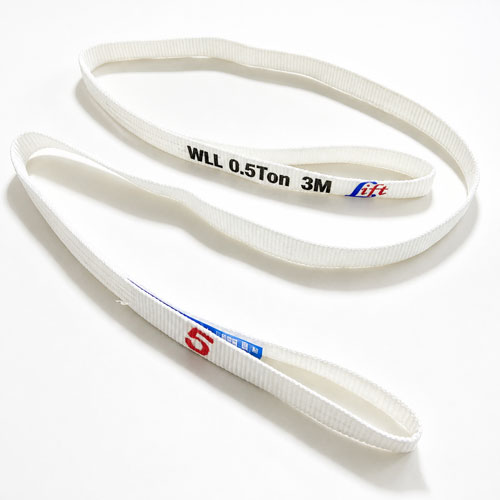
Two declarations, two places. The load and the length are printed directly onto the webbing, where they survive; the identificat ion label is the panel sewn on where the band is doubled, and that is where the material is declared. On a band this light the label is a small piece of cloth doing a legal job.
One practical point belongs with this section, because it is where a good quotation earns its place. The material declaration only works if the buyer has fixed the material before the order is plac ed. Writing "synthetic" on the order and letting the works choose leaves three defensible answers on the table, and once the band is woven and printed, changing the answer means cutting new webbing ra ther than editing a document. Every enquiry we receive that names the polymer is cheaper to answer than one that does not, and it is the reason the checklist in §11 puts the material first.
4. Selvage Edge: the Only Part of the Webbing That Gets Its Own Definition
Turn the band over in your hands and look at its two long flanks. Each of them is a narrow, slightly thicker border where the cross threads turn back into the body of the weave and are locked there . That edge has a name, and it is the only part of a synthetic web sling that the United States regulation bothers to define in its own definitions paragraph. The definition is short: the selv age edge is the finished edge of synthetic webbing, designed to prevent unraveling.
The reason this deserves its own section is not the definition. It is the sentence that follows it in the body of the regulation, which is a requirement of manufacture rather than a description: sy nthetic webbing "shall be of uniform thickness and width and selvage edges shall not be split from the webbing's width." A split selvage is therefore not cosmetic wear that a user wei ghs up. It is one of the two named defects in the webbing itself, standing next to thickness and width, in the same sentence.
| What you are looking at | What it is doing | What its failure means |
|---|---|---|
| the selvage, intact | It binds the outermost warp threads so that the woven width holds together and cannot be picked apart by handling, abrasion or a cut end. | The normal condition, and the reason a woven band does not fray along its flanks the way a cut tape does. |
| a split or separated selvage | It has come away from the body of the width, so the edge that was locking the outer threads no longer does so. | The webbing has failed the requirement that it shall not be split from the width. The width is no longer a trustworthy dimensi on, and the damage will progress along the edge under load. |
| a selvage damaged by a sharp edge | Something with an edge has been bearing on the flank of the band, which is the part of a soft sling least able to resist it. | This is a load or a rigging fault as much as a sling fault. The remedy is edge protection at the crossing point, and it is che aper than the second band. |
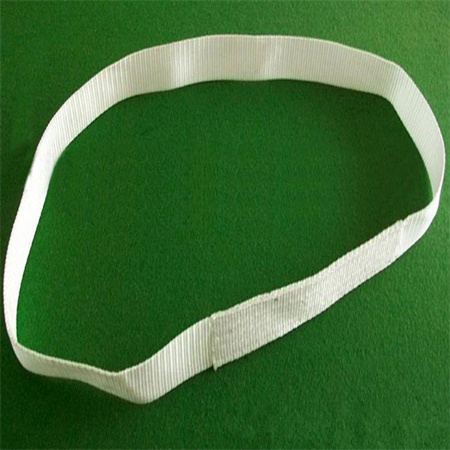
Follow either long flank of the band in this photograph from one end of the loop to the other. That narrow border, where the cro ss threads turn back and are locked, is the selvage. It is also the reason a goods-in inspection starts at the edges rather than in the middle: a band that has been dragged over an edge shows it here first.
For a one-way article the selvage carries one further consequence, and it is the practical one. A band bought to travel with a load will be handled by people who did not buy it and have no reason t o protect it: dragged across a bundle, pulled out from under a pallet, walked on in a yard. The edges take that treatment. This is why the goods-in check that matters most on a delivery of these bands is the cheapest one to run — run a thumb along both selvages and look for the place where the edge has come away from the width. It costs seconds, and it finds the failure the regulation names.
5. Uniform Thickness and Width: Buying a Tolerance, Not a Fibre
The same sentence that protects the selvage protects two dimensions, and it is worth reading because it tells you what a webbing sling is being bought for. Synthetic webbing "shall be of uniform th ickness and width". Uniform, not simply within limits — the requirement is about consistency along the band, because an inconsistent band is one whose capacity claim cannot be relied upon at every poi nt of its length.
On most slings those two dimensions are checked alongside a third requirement, the one covering fittings, which must have a minimum breaking strength equal to the sling's own and must be free of an y sharp edge that could damage the webbing. On this article that clause has nothing to bite on, and the absence is the point: an endless synthetic webbing sling is a fittingless form, so the webbing i s the entire load path and there is no component that could be stronger or weaker than the band. Everything the sling can do, and everything that can go wrong with it, happens in the textile.
| The dimension | What uniformity protects | Where it shows up in practice |
|---|---|---|
| width | The number of load-bearing lengthwise threads inside the band, and therefore the capacity the band can claim. A band that narr ows along its length has fewer threads carrying the load at that point. | It is also the number the load feels. A narrow band on a soft or finished surface marks it; the fix is a wider band, and width is a bearing-surface decision rather than a capacity one. |
| thickness | The amount of material standing between the load and the threads carrying it, and so the band's tolerance of abrasion before t he load path itself is reached. | A thick-looking band that has been flattened by wear has lost its reserve. This is the dimension a used band is most often ask ed to lie about. |
| ply count (the order's own figure) | The number of layers of webbing in the body. It is not one of the two regulated dimensions, but it is the number a buyer speci fies, and it is what turns a width into a band specification. | Width and ply multiply, and the two are not interchangeable: the same quantity of webbing in a narrower two-ply band is a diff erent product from a wider single-ply one. The trade's ranges and the way width and ply are ordered together are set out on the type page's band section. |
There is a commercial consequence to buying a tolerance rather than a fibre, and it is the reason this section exists between the chemistry and the stitch. A quotation for a synthetic webbing endle ss sling is not a quotation for a material. It is a quotation for a band at a stated width, a stated ply, a stated length, a stated working load limit and a stated polymer — and four of those five are printed on the article, while the fifth is declared on the label. When a cheaper offer arrives at the same price for the same nominal size, it is almost always one of those five that has moved.
6. The Stitch Is the Only Permitted Joint — and on This Form It Closes the Loop
Here is the sentence that decides how this article is built, and it is unusually absolute for a safety regulation. In the United States regulation for synthetic web slings, the paragraph covering t he attachment of end fittings and the formation of eyes reads: "Stitching shall be the only method used to attach end fittings to webbing and to form eyes." The thread, the paragraph continues, "shall be in an even pattern and contain a sufficient number of stitches to develop the full breaking strength of the sling."
Three things follow from that, and the third is this page's article. First, the permitted joint is stitching and nothing else — the paragraph admits no alternative, and the surrounding safe-practic e rules close the remaining doors by prohibiting the shortening of a sling with knots, bolts or other makeshift devices and forbidding knots in any part of a synthetic web sling. Second, the standard of work is not "well sewn". It is a specific performance requirement: enough stitches, in an even pattern, to develop the sling's full breaking strength. A seam that fails before the band does has not met the paragraph, however neat it looks. Third, and most relevant here, the endless form is a loop closed by exactly that joint. The American type numbering describes the endless web sling as the fo rm made by joining the ends of the webbing together with a load-bearing splice, and the description of where the endless form sits among the numbered types is on the eye and eye type page, which owns that numbering.
| How a joint might be made | Status | What its presence tells a buyer |
|---|---|---|
| a stitched lap splice | The permitted method, and the way every endless band on this site is closed. | Nothing on its own. The question is not whether it is stitched but whether the stitching is even, unbroken and sufficient — wh ich is why "broken or worn stitches" appears on the removal lists of both the regulation and the US sling standard. |
| a knot | Prohibited, twice: slings must not be shortened with knots or makeshift devices, and knots anywhere in the sling are a removal condition. | That someone has repaired or adjusted the band on site. A knotted synthetic sling has already been withdrawn by the regulation , whatever the knot is doing. |
| a metal fastener, clamp or bolt | Not a permitted method of forming the eye, and a fitting added to a synthetic web sling introduces a component that must itsel f be rated and free of sharp edges. | That the article is not the fittingless form the order described. On an endless sling this would also defeat the reason the en dless form was chosen. |
| a temporary repair, of any kind | Prohibited outright: slings, including webbing and fittings, which have been repaired in a temporary manner shall not be used. | That the band has left the system it was bought into. On a one-way article this is the whole of the disposal argument (§10). |
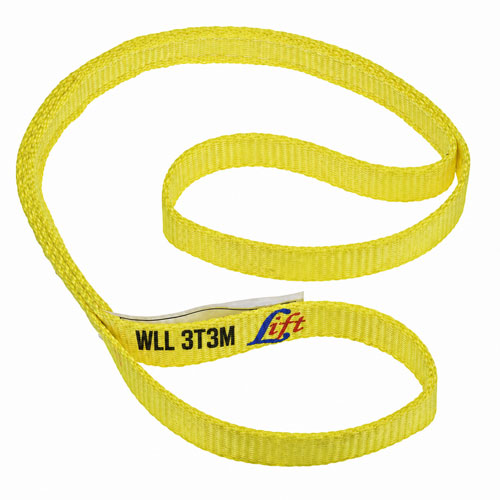
The form the stitched lap produces: a loop with no ends and nothing to attach, so the band passes through itself and the joint t ravels with the load rather than sitting at the hook. This particular band is a general purpose endless sling in the three tonne colour, not a one-trip article; the construction is what the photograph is here to show. The lap itself is inside the loop and is not visible from this angle, which is worth saying plainly rather than pretending otherwise.
One design consequence is worth taking from this section into the order, because it changes what a buyer should be buying. On a sling with two sewn eyes there are two joints, and each is loaded on every lift. On this form there is one joint, and it is loaded on every lift — so the endless loop concentrates the entire splice question into a single seam. That is not a defect of the form; it is th e reason the fold-back length and the stitch pattern are controlled at the works rather than chosen at the bench, and it is why the endless sling's manufacture and testing is described in one place on its own page rather than repeated here: see how an endless webbing sling is made and tested.
7. Three Polymers, Three Sets of Numbers: Chemistry and Heat
This is where the class word stops being vocabulary and starts being a specification. The three polymers the standards name are not three grades of one material; they are three different chemicals with different enemies and different ceilings, and the regulation sets out the differences itself rather than leaving them to a data sheet. The prohibitions below are the regulation's own, in the prop erties it names, and they are attached to the material — which is why §3's declaration requirement exists.
| The polymer | What the regulation forbids it to meet | Temperature ceiling it sets | The mistake this causes |
|---|---|---|---|
| nylon polyamide (PA) | Fumes, vapours, sprays, mists or liquids of acids or phenolics. | 180 degrees F, with polyester. | Nylon's reputation for toughness is read as general resistance. It is the most abrasion-tolerant of the three and the one with an acid prohibition, and those two facts are quoted in the wrong order. |
| polyester (PES) | Fumes, vapours, sprays, mists or liquids of caustics. | 180 degrees F, with nylon. | The default polymer is ordered by habit into a caustic environment, where the regulation forbids it. Habit is the single most common cause of a material fault in this class. |
| polypropylene (PP) | Fumes, vapours, sprays, mists or liquids of caustics — the same prohibition as polyester, but with a differen t balance elsewhere in the list. | 200 degrees F — the highest of the three. | The extra twenty degrees is read as a general upgrade. It is not: the same paragraph puts polypropylene under the caustic proh ibition, so the temperature advantage is bought without any chemical advantage over polyester. |
| any of the three (the shared condition) | Acid or caustic burns, melting or charring, snags, punctures, tears or cuts, and ultraviolet or chemical attack showing as dis coloration with brittle or stiff areas. | All three are soft textiles: none tolerates heat, and none tolerates a sharp edge without protection. | Treating the material choice as the whole answer. The removal list applies to whichever polymer was chosen, and one of its ite ms is a colour change rather than a cut. |
Two notes belong beside that table rather than in it. The first is about units. The figures above are the United States regulation's own, stated in degrees F for the three synthetic web materials i t covers. The European documents state their limits in degrees C and the numbers differ; those figures belong to the article's European specification and are given on the page covering the endless ban d's standards rather than being converted and mixed here, because a converted number is not a quoted one.
The second is a manufacturing note that customers meet when they inspect a band we have sent, and it is worth explaining because it looks like a defect and is not. Webbing for these slings is commo nly woven with a coloured identification yarn running inside the band, visible only as a fine line if the band is folded open. It is there as one of the aids used in deciding whether a sling should be withdrawn — a way of showing that the material inside the weave has been reached by damage that the outer face has not yet declared. It is one aid among several and is not a criterio n on its own; the criteria are §10's, and this yarn is a witness to them rather than a substitute. A band whose outer face is intact but whose inner yarn has become visible has almost certainly been a braded through more of its thickness than the outside suggests.

The visible marking system, read off the face of the weave: a coloured band with transverse stripes counted against the capacity . A buyer who has learned to read this at a glance is reading the capacity, not the material — which is exactly the confusion the class word in this product's name invites.
8. One Article, Three Names: US "Synthetic Web Sling", EU "Webbing Sling", and This Page's Hybrid
Nobody searching for this product uses one vocabulary, and the reason is that the article is named differently on either side of the same trade. In the United States, the regulation and the sling s tandard speak of the synthetic web sling, and the type numbering that goes with it is American. In Europe, the standard for the material speaks of the flat woven webbing sling, and the word that carries the single-journey idea — one way — comes from a national standard of the German tradition rather than from either of the other two.
The phrase this page is named after mixes the two, and it is worth noticing that it does. One-way is the European trip word. Synthetic webbing endless is the Ameri can material-and-form vocabulary, where webbing is the band and endless is a named type. A buyer who types all of it into a search box is usually holding a quotation from one naming system and comparing it with a quotation from the other, and the reason the two quotes do not line up is frequently that they are describing the same article under different sets of obligations.
| The name in use | Where it comes from | What it obliges you to say when you order |
|---|---|---|
| synthetic web sling endless web sling | The United States regulation and the American sling standard, whose numbering makes the endless form a type in its own right.< /td> | The polymer (§2, §3), and the capacities for each hitch you intend to use — because the marking requirement is written per hit ch rather than as one figure. |
| flat woven webbing sling webbing sling | The European standard for flat woven webbing slings made of man-made fibres. | The width, the ply and the destination market. The band's colour and stripe count carry meaning in this system, and the factor you are buying depends on which market's document the band is proved to. |
| one way sling single use / one trip | A national standard of the German tradition for the single-journey band, and the trade's own shorthand for a sling that is not recovered. | That the article is being bought for one journey, so the specification to argue about is the factor and the marking rather tha n a service life. The trip, its label and its documents are covered on the one way sling page. |
| this page's hybrid | Both vocabularies in one phrase — which is what a buyer ends up with when the article is quoted in one market and used in anot her. | Three things, and they are the first three lines of §11: the polymer, the destination market, and the document the sling has t o be provable to. |
The factor is the place where this vocabulary difference costs real money, and it is worth one paragraph because it explains why two quotations for what looks like the same article can differ by a third. The same nominal capacity marking corresponds to different minimum breaking loads depending on the design factor of the system the band was built to, and the factors in use across the major mar kets are not the same number. Which factor sits behind which market's documents, and what each one implies for a band marked at the same figure, is set out on the endless webbing sling page rather than repeated here. What belongs here is the conclusion for a buyer: the name does not tell you the factor, so the destination mark et has to be stated on the enquiry, and a quotation that does not ask for it is a quotation that has guessed.
9. The Three Documents Behind the Article, and What Each Is For
The obligations quoted on this page come from three documents that are frequently spoken of as though they were interchangeable, and they are not. One is law, one is a consensus standard, and one i s a recommended practice published by the industry's own association. Buying well means knowing which of the three a supplier is referring to.
| The document | What kind of document it is | What it settles for this article |
|---|---|---|
| 29 CFR 1910.184 (the slings regulation) | Law, in the United States. Enforceable on employers, and written as obligations rather than as recommendations. | The definitions — including the one for the selvage edge — the safe operating practices, the daily inspection, and paragraph ( i), which is the whole of what the law says about synthetic web slings: identification, webbing, fittings, the exclusive use of stitching, environmental conditions, temperature ceilings, repairs and r emoval from service. |
| ASME B30.9 (the slings safety standard) | A consensus standard, which the regulation leans on wherever it needs a technical figure rather than a rule. | Design and marking practice, and the removal criteria in their fuller commercial form — the list that names broken or worn sti tching in load-bearing splices alongside knots, excessive abrasive wear, and discoloration with brittle or stiff areas as evidence of chemical or ultraviolet damage. |
| WSTDA WS-1 (recommended standard specification) | A recommended practice published by the industry association for web slings and tie-downs, offered in its own words as a guide to users, industry and government. | The proper use, maintenance and inspection of synthetic web slings, and the type definitions and dimensions the trade works to . Where a catalogue in this market speaks of web sling types and of loop eye lengths, this is the document behind the numbers. |
| EN 1492-1 and the national one-way standard | The European standard for the material, and, separately, the national standard of the German tradition that covers the single- journey band. | The European half of this article's obligations: the flat woven webbing sling's design, testing and marking, and the trip-word 's own label. Both are treated on this site's European pages rather than here — see the endless webbing sling page for the first and the one way sling page for the second. |
Two practical conclusions, and they are the reason this section earns its place on a product page. First, a supplier's claim of the form "made to ASME B30.9" is a statement about the design factor, the marking and the testing regime — it is not a certificate, and it does not tell you which polymer is inside the band. The declaration you need for the material is the one required on the article i tself (§3), and it is the more useful document because it travels with the load. Second, our own production is organised by reference to the safety factor and colour code system of the EN 1492 series, and to the domestic series that governs flat woven webbing slings in our own market, with bands made to the destination market's requirement where the order says so. If your market requires a particu lar document to be named, the place to say it is the enquiry, because a factor cannot be retro-fitted to a woven band.
10. When the Stitch Fails: Removal Criteria and the Cost of a Repair
The joint that closes this loop is also the first thing the removal lists name, and that is not a coincidence — it is where the load path is interrupted and re-made. Both the regulation and the ind ustry standard put the stitch on their lists, in almost the same words: broken or worn stitches. The regulation's version is a short list of five conditions; the standard's version is a longer commerc ial list that keeps the same item and adds the conditions a user meets before the band fails outright.
| The condition | How it presents on a synthetic band | Why it is on the list |
|---|---|---|
| broken or worn stitches | A run of thread in the lap that has parted, gone slack, or abraded to a thin shadow of itself, usually where the band passes t hrough itself. | Because the seam is required to develop the sling's full breaking strength. A part-severed seam is the load path, part-cut. |
| acid or caustic burns | Localised whitening, softening or a stained patch where a chemical has been allowed to sit on the band. | Because the polymer's prohibition is absolute (§7). A burn is the prohibition made visible. |
| melting or charring | Fused, glazed or blackened areas, often only a few threads wide — a weld spatter landing, not a fire. | Every one of the three polymers is a thermoplastic with a ceiling (§7). Local heat does not need to be large to end the band.< /td> |
| snags, punctures, tears or cuts | Any interruption of the width, however small, including a clean nick in one flank. | A woven band's capacity is carried by its lengthwise threads, so a cut removes capacity in proportion to the threads it severs rather than in proportion to its area. |
| discoloration with brittle or stiff areas | A band that has changed colour and gone stiff rather than soft — the classic signature of prolonged sunlight or a slow chemica l exposure. | Because this damage is invisible in the figures and unmistakable in the hand. It is why storage conditions are part of a sling 's record rather than an afterthought. |
| missing or illegible identification | A band whose label has been lost, or whose printing has worn past reading. | Because without the declaration there is no way to apply any of the prohibitions above. It is the first item on both lists for exactly that reason. |
Then there is the repair question, and here the two markets diverge in a way that decides the economics of this article. Repair of a synthetic web sling is not a user activity in either system: it must be done by a sling manufacturer or an equivalent entity, and the United States regulation adds a condition that settles the argument by itself — each repaired sling must be proof tested b y the manufacturer or equivalent entity to twice the rated capacity before it returns to service, with the proof test certificate retained and available for examination, and temporary repairs prohibited outright. That group of conditions is 29 CFR 1910.184(i)(8).
Do the arithmetic on a one-way band and the conclusion is unavoidable. A proof test to twice the rated capacity, with a certificate, on an article whose whole appeal is that it was cheap enough to give away with the load, costs more than the band did. That is why the correct disposition for a repaired one-way synthetic sling is not repair but withdrawal and destruction, and why the marking on t he article matters at the far end of the journey — the argument that a disposable sling has to be put beyond use rather than returned to a rack is made on the single use page, and the version of it that applies to a band travelling with exported cargo is on the pre-slung cargo page. What this page adds is the mechanical reason: the disqualifying condition is a stitch, and a stitch is the one part of the article that cannot be restored by anyone but its maker.
11. What the Material Question Adds to an Enquiry
The general list of what to put in an order for a flat woven endless sling — the band, the width, the ply, the loop length, the quantity, the packing — belongs to the pages that own those subjects, and is set out on the endless sling page. Four items are added by the subject of this page, and they are the four that a class word lea ves open.
| Item | Why the class word makes it necessary |
|---|---|
| 1. the polymer, by name | Nylon, polyester or polypropylene — not "synthetic". The three carry different prohibitions and different temperature ceilings (§7), and the choice is driven by what the band will meet, not by capacity. This is the first item because it is the one that cannot be corrected after the band is woven. |
| 2. the destination market, and the document the sling must be provable to | Because the factor behind the same nominal marking differs between the American, European and other systems (§8, §9). A quotat ion that has not been told the market has guessed the factor, and the guess is invisible until someone checks the marking against a document. |
| 3. the marking the band has to carry | At minimum the working load limit and the length printed on the face; on a band going to a market whose regulation requires a material declaration, the polymer as well (§3). Say the wording you need, because print is set once per run and cannot be added to a finished band. |
| 4. the edge and chemical conditions at the crossing points | The selvage is the part of the band that fails first against an edge (§4), and a polymer chosen for a chemical environment may still be the wrong choice against a sharp one. Tell us what the band will cross and what it will meet, and we will price the protection with the band. |
One sentence closes this section, and it is the practical form of everything above. A quotation for a one-way synthetic webbing endless sling is a quotation for a band whose material has been chose n rather than assumed, whose marking has been written down before the weaving rather than after it, and whose factor matches the market the load is going to. The class word in the name is the beginnin g of that conversation; it is not the answer to it.
12. Frequently Asked Questions
Q1: What does "synthetic" actually mean in this product's name?
Q2: Does the sling have to say which synthetic it is?
Q3: What is the selvage edge, and why does it matter on a one-way band?It is the finished edge along each flank of the webbing, where the cross threads turn back and are locked so that the woven width
cannot unravel. It is the only part of a synthetic web sling that the United States regulation defines in its own definitions paragraph, and the same regulation then requires that selvage edges shall
not be split from the webbing's width — placing a split edge in the same sentence as the requirement for uniform thickness and width. On a one-way band it matters more than on a tool, because the band
will be dragged, pulled and walked on by people who did not buy it, and the edges take that treatment first. Running a thumb along both selvages at goods-in is the cheapest useful check there is.
Q4: Is the loop on an endless sling really endless — is there no seam?There is a seam, and it is the most important part of the article. "Endless" describes the form rather than the manufacture: the b
and has no ends and no fittings, so there is nothing to attach to a hook and the loop passes through itself. On the endless web sling the loop is closed by joining the ends of the webbing together wit
h a load-bearing splice — which in the flat woven form is a stitched lap. In the United States the regulation is explicit that stitching is the only permitted method of forming an eye or attaching a f
itting, and it requires enough stitches, in an even pattern, to develop the sling's full breaking strength. So the honest answer is: no ends, one seam, and that seam is the load path. The type numberi
ng that places this form among the numbered web sling types is on the eye and eye type page, and the manufacture and testing of the band is on the endless webbing sling page.
Q5: Which of the three polymers should I specify?
Q6: What temperature can a synthetic webbing sling take?
Q7: What does "one-way" change about the article itself?
Q8: Can a worn band be repaired?
Q9: How is this article different from the endless webbing sling you alread y sell?
Q10: What should I send you to get a quotation for this sling?
Contact
Lift Sling Rigging Co., Ltd produces flat woven webbing slings in the synthetic web materials this page describes, in the endless form and in the sewn-eye forms, with the working load limit and the length printed on the band and the identification the destination market requires. Tell us the polymer, the destination market and the marking you need, and we will confirm the factor, the printing a nd the band specification before anything is woven. If your enquiry only says "synthetic" so far, send it anyway — we will ask the two questions in §2 and §3 and price the answer from there.
Telephone and WeChat — 18066002268
E-mail — 702461526@qq.com
Address — Lifute Industrial Park, Taizhou City, Jiangsu Province, China
HS code — 630790
- Previous:Disposable Pre-Slung Cargo Sling
- Next:One Way Lifting Sling for Export Steel and Steel Tube
-
Drone Anti-collision Net
-
Extra Large Capacity Cargo Net
-
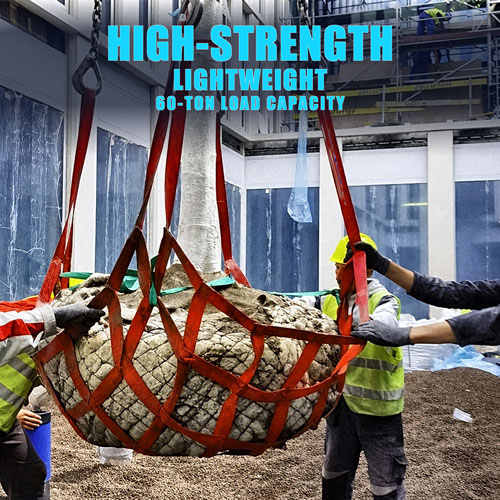
Cargo Webbing Net
-

Color changing nylon double buckle loop nylon braided rope
-

Two end buckle lifting rope, double buckle round lifting rope, double fork nylon lifting rope, non jointed nylon lifting rope
-

Emergency escape lifeline, fire escape rope, fire safety escape emergency rope, steel wire core fire rope

