 Language
 简体中文
简体中文
- On the 2018 National Day holiday, Lifet completed six 100 ton large tonnage lifting belts as a gift
- The role of suspension net in the transportation of goods turnover
- Cargo soft lifting net, lifting net, lifting net, lifting net, bag, climbing net
- Precautions for using Lifutiden elevator
- How to make circular lifting straps
Contact: Wang Lili
E-mail:18066002268
Phone:702461526@qq.com
Address: Lifute Industrial Park, Taizhou City, Jiangsu Province
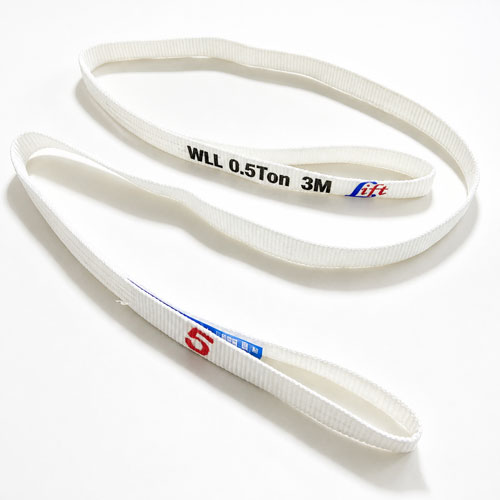
Lift Sling Rigging Co., Ltd manufacture Textile disposable slings for single use lifts for lifting loads,High Tenacity Single Use One Way Lifting Sling,Disposable One-Way Lifting Sling.A disposable pre-slung cargo sling is a one-trip webbing band fitted to a bundle, a pallet or a reel at the packing station, so the unit arrives at the crane already rigged and the hook has nothing to make up. Lift Sling Rigging Co., Ltd makes the white flat woven band to the slinging plan, fixes the round turn and the loop height, and prints the working load limit that travels with the load.
Hits: ℃
Release time:2026-09-25 08:25
Lift Sling Rigging Co., Ltd manufacture Textile disposable slings for single use lifts for lifting loads,High Tenacity Single Use One Way Lifting Sling,Disposable One-Way Lifting Sling.
Lift Sling Rigging Co., Ltd produce Disposable Pre-Slung Cargo Sling,Pr e-Slung Cargo Sling,Pre-Slung Sling,Disposable Pre-Slung Sling,Pre-Slung Steel Tube Sling,One Trip Pre-Slung Sling.
Disposable Pre-Slung Cargo Sling — Rigged at the Packing Station, One Trip to the Destination
A disposable pre-slung cargo sling is a one-trip webbing sling that is threaded through the load before the load becomes cargo. The band is fitted at the packing station, the mill or the quay apron; the tube bundle, the pipe bundle, the timber unit or the bagged-cement pallet then travels with its own sling already in place, and the crane that finally lifts it has noth ing to rig — it has only to hook on. That single change of timing is what the word pre-slung buys, and it is the whole subject of this page.
The three words in the title come from three different vocabularies, and only two of them describe the article. Disposable describes the commercial trip: the sling is not recovered . Pre-slung describes a cargo-handling technique — it belongs to the shipping industry's own vocabulary, alongside palletised and unitised, and it appears in port regulations as a cargo category in its own right. Cargo sling names the set of bands that carry one unit. A buyer who searches for a disposable pre-slung cargo sling is therefore not asking for a new kind of sling; they are asking for a known one-trip band to be fitted at a place and a moment in the transport chain that the other pages on this site do not discuss.

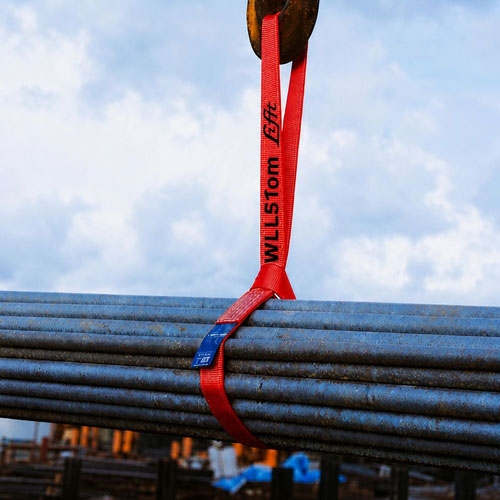
A pre-slung steel pipe bundle at the moment of the lift: the band is already round the load, the loop is already above the top p ipe, and the crane has only to enter the hook. Everything that decided this lift was settled at the packing station, not here.
1. What "Pre-Slung" Actually Means, and Why It Is Not in the Sling Catalogue
Start with the trade definition, because it is not the definition a lifting-equipment buyer expects. In freight and port usage, pre-slung cargo is cargo shipped already in a sling or a net — prepared and loaded in advance, ready for the arrival of the vessel and for the loading that follows. The handling literature treats pre-slinging as a technique, listed in the same breath as palletisation, and applies it to palletised goods, sawn timber, bales, steel products and reels of newsprint. It is common enough that pre-slung shrink-wrapped bagged cement is desc ribed as an ordinary market article rather than a special order. In some port regulations, pre-slung cargo appears as its own tariff line, next to palletised, break-bulk and heavy-lift cargo.
Two facts follow from that, and both matter to what is made for you. The first is that pre-slung is not a product name. You will not find it in the two documents that govern the ar ticle itself — EN 1492-1, which covers flat woven webbing slings, and DIN 60005, which covers the one-way sling used for a single journey. Those standards describe a band: its fibre, its factor, its l abel, its test. Neither of them contains a clause that says where the band is put on. The second fact is that pre-slung is nevertheless a specification, because it fixes four things the band cannot decide on its own: the effective length, the form of the attachment, the number and spacing of the bands, and where the loop presents itself for the hook. Those four are engineering decisions, and they are made by whoever fits the band, at the place where it is fitted.
That is why a disposable pre-slung cargo sling is sold as an agreed fitting rather than a catalogue part number. The band is a standard one-trip article. The slung condition is what the or der is really buying, and it has to be described in a drawing before it can be quoted. A pre-slung sling is therefore quoted from a drawing, and the drawing is the quotation: change the bundle and you change the sling, even though the webbing is the same roll.
2. The Three Words in This Title, and What Each One Settles
Buyers arrive at this page with at least four different phrases, and the phrases are not synonyms. A short table is the fastest way to separate them, because each one answers a different question a nd leaves the others open.
| The phrase | Which question it answers | What it leaves open |
|---|---|---|
| pre-slung pre-slinging | Where and when the band is fitted: at the packing station or mill, before the load becomes a cargo unit, so the unit arrives at the crane already rigged. | Everything about the band. A freight term is not a specification — the drawing still has to state length, form and factor. |
| disposable one trip single use | What happens at the end: the band travels with the load and is not recovered, so it is made for one journey rather than for a service life. | How many times the load may be picked up, and to what factor the band is made. The trip is a commercial fact, not a licence to lift carelessly. |
| cargo sling cargo set | The unit: the several bands that together carry one bundle or pallet, and where each of them sits along it. | Whether the lift is symmetrical, and whether the set is matched to a lifting rope. That is a separate decision, and it is made on the disposable cargo sling page. |
| steel tube sling pipe sling timber sling | The load's surface: what the band has to lie against, and the edges and finish it has to tolerate. | The fitting point. A tube sling can be supplied loose for the crane, or pre-slung at the works. Say which one your shipment ne eds. |
The practical conclusion is short. An enquiry that says disposable pre-slung cargo sling, 2 tonne, for steel tube has named a category and a load but has not yet described a slung condition, because it has not said where the band is fitted, how far up the loop sits, how many bands carry the unit, or what the receiving end is expected to do with it. §3 to §6 of this page deal wi th those four, in order.
3. Where the Sling Is Fitted, and Why the Fitting Point Changes the Order
A pre-slung cargo sling can be fitted at any of three points in the chain, and the choice is not cosmetic — it decides who ties the first knot, what tooling exists to tie it, and what the band has to survive before it is ever loaded. The three points are worth naming separately because buyers who say "pre-slung" often mean only one of them, and a supplier who assumes the wrong one will quote th e wrong length.
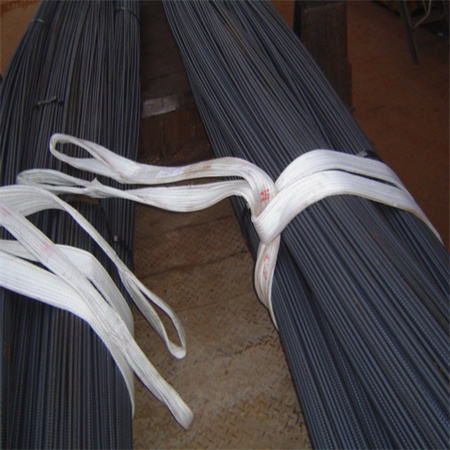
Pre-slung in the literal sense: the white bands are already round the bundle of steel bar, and the loops are already standing ab ove the top layer. This is the condition the crane should receive. Every round turn in this photograph was made earlier, by someone standing at the bundle rather than under a load.
| Fitting point | Who ties it, and with what | What it fixes for the order |
|---|---|---|
| the packing station or mill (the strict reading) | The producer's own packing line, working on a floor at a bench or on a strapping stand, with the bundle already formed and ban ded. | The length has to be settled against the bundle's finished circumference before the bundle is closed, because a compr ession band or a second strap may sit on top of the sling afterwards. |
| the quay apron or consolidation yard (the freight reading) | Port or stevedore labour, on the apron, in advance of the vessel — the arrangement the freight definition of pre-slung cargo d escribes. | The band is fitted to a bundle that is already complete, so the circumference is a known number, and the order can be split ac ross several cargo lots. |
| the vessel's gear, at the first lift (not pre-slung, strictly) | The crew or the stevedores at the hook, once the band is already in the ship's sling. The band is then only a one-trip band, n ot a pre-slung one. | Nothing, and the order should say so plainly. If the band is fitted at the hook it is a more ordinary article, and paying for pre-slung geometry is wasted. |
Two consequences are worth stating because they are the reason this page exists rather than a paragraph on another one. First, a pre-slung band is under load for longer than a band fitted at the ho ok: it is fitted, then the unit may be strapped, stacked, moved by forklift, stored in a yard, craned onto a lorry, driven to a port, stored again and finally craned aboard, before the lift it was bou ght for. Second, the band is under slack load for most of that, which is the wear case a loose band does not see — the round turn abrades against the bundle edge each time the unit is handled . A pre-slung cargo sling should therefore be ordered with the handling that follows the fitting in mind, and not only with the final lift in mind.
4. The Four Dimensions the Packing Line Has to Fix
Once the fitting point is settled, four numbers describe the slung condition completely. They are all measured on the load rather than on the crane, which is why they cannot be left to the lifting crew. A pre-slung sling that is wrong in any one of them will either arrive with its loop too low to enter the hook, or arrive with an angle at the legs that the factor was never bought for.
| Dimension | Measured against | What goes wrong if it is not stated |
|---|---|---|
| effective length of the band | The finished circumference of the bundle or pallet, plus the height the loop has to reach above the top layer. | The loop arrives below the top layer and has to be dug out by hand; or it arrives so long that the slack drags on the ground d uring every move. |
| eye height above the bundle | From the top of the load to the centre of the standing loop, with the band in its working position. | The hook cannot be entered without lifting the bundle, or the two bands cannot be gathered onto one hook by the crane alone. |
| form of the attachment | Whether the band makes a round turn round the bundle with both ends brought up, or a choke t hat tightens on itself as the load is taken. | A choke that was not intended grips the bundle and marks it, and tightens a turn that the packing line meant to stay slack. A round turn that was meant to choke lets the bundle slide. |
| number and spacing of bands | The length of the unit, and where its stiff points are — the middle of a long tube bundle is not where a band belongs if the b undle sags there. | The unit bows between two distant bands, or the bands gather at the centre and leave both ends unsupported. |

The printed length on the band is not the length of the slung condition. A 3 m loop measured round a bundle of known circumferen ce leaves a calculable height of loop standing above the top layer — and that height, not the printed figure, is what the drawing has to state.
There is one further dimension that belongs to the load rather than to the band, and it is the one most often left out: the angle the two legs make at the hook. A sling bought as a flat band has its capacity stated for a straight pull or for a stated angle; when a pre-slung bundle hangs in two loops gathered on one hook, the legs are inclined, and the load in each band rises ac cordingly. The packing drawings for a pre-slung sling order should therefore carry the angle as well as the spacing, so that the factor the bands were made to is the factor they are actually used at. Where a shipment is repeated monthly, this drawing is worth making once and keeping — it is the document that a replacement order is placed from, and the reason a pre-slung order can be repeated witho ut re-measuring anything.
5. What the Slinging Plan Has to State
Because the four dimensions above are fixed on the load, they have to live somewhere. In practice that document is a one-page slinging plan — a packing drawing with the slung condition drawn onto i t. It does not need to be elaborate. It does need to be complete, because it is the only place where the agreement between the buyer and the sling maker is written down, and because the bands are cut to it.
| Entry on the plan | An example, for a tube bundle |
|---|---|
| the unit | Bundled steel tube, 12 m, hexagonal pack, strapped with two steel bands, finished circumference 1,150 mm. |
| the bands and their positions | Two bands, at 2.5 m and 9.5 m from the leading end, both outside the steel straps and inside the end faces. |
| the attachment | Round turn under the bundle, both legs brought up the same side, loop standing 300 mm clear of the top layer. |
| the working load limit and the factor | 2,000 kg per band at the stated angle, made to a 5:1 series, band printed with the working load limit in figures. |
| the edge condition | Sawn tube ends and steel strap edges to be covered by a sleeve or a corner protector where the band crosses them. |
| what the band is not for | Not for lifting the bundle on the flat with both loops on one side; the packing line to fit and the receiver to lift, and no o ne else to re-rig it. |
| what travels with it | Packing list entry, band batch reference, and a copy of this plan, one per bundle or one per lot as agreed. |
A plan of this kind is short, and it does two things that no catalogue line can do. It lets the slings be cut in advance of the bundles being packed, and it lets a second person — the receiver, the surveyor, the port's own staff — read off how the unit is meant to be lifted without a telephone call. Where a shipment is regular, the same plan can be referenced by date and revision for every subs equent lot, which is why a pre-slung order placed from a plan can be repeated exactly, band for band, and why an order placed from an e-mail description usually cannot.
6. Rigger-Free Discharge: What the Receiving End Is Entitled to Expect
The commercial reason for pre-slinging is older than the word for it, and it is stated in the marine handling literature without embellishment: pre-slung goods have the advantage of quick loading a nd unloading. The saving is not mainly the cost of a sling. It is the cost of the people and the minutes that a loose load consumes at every point where it is lifted. A pre-slung unit is lifted as a u nit, and the rigging happens once instead of at each transfer.
That has a second effect that matters more in some trades than the time saved. When the bands are already fitted and the loops already stand up, the person who lifts the load does not have to climb onto it, reach under it or stand beside it while it is being made up. The rigging that carries the risk is done on the ground, on a bundle that is not yet suspended, by someone who is not under a loa d. Ports and terminals that receive unitised, pre-slung cargo are receiving an arrangement in which the load can be handled by a crane alone.
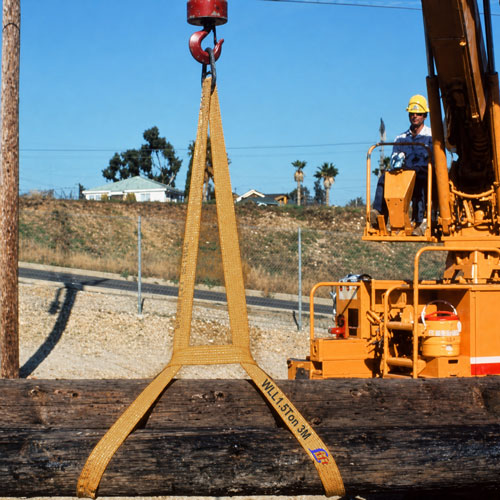
The discharge the pre-slung order is buying: the loops are standing, the hook is gathering them, and the lift happens without a rigger on the load. Note that the slings in this photograph are general purpose bands in a yard lift, not one-trip articles — the arrangement is what a pre-slung order is intended to reproduce, wherev er the fitting is done.
What the receiving port is entitled to expect from a pre-slung sling consignment is therefore worth writing into the order rather than leaving to the first lift. In outline: bands already fitted an d evidenced; loops standing clear of the top layer so that a hook can enter without the bundle being lifted to fetch them; the plan available so that the unit's intended angle and spacing are known; a nd the identity of the bands recorded so that the consignment can be described in the shipping documents. Where a port has its own rules about how long objects and non-pre-slung lifts are handled, the difference between a pre-slung unit and a loose one is not a technicality — it is the difference between one handling arrangement and another.
7. What Travels With a Pre-Slung Unit
A pre-slung consignment carries more paper than an ordinary sling order, and the reason is simple: the band is being handed over as part of the cargo rather than as a tool of the buyer's crane. The band will be fitted by one company, loaded by another, carried by a third and discharged by a fourth, and none of the four will speak to the others while the unit is in transit. Whatever they need to know has to travel on the unit or with the documents.
| Item | Why it is in the consignment |
|---|---|
| the marking on the band | The band is the only part of the consignment that stays with the load from the packing station to the destination, so the work ing load limit printed on it is the one figure that is always physically present. This is the same principle that governs the one-way article generally, and the label itself is described on the one way sling page. |
| the batch reference | It links the band in the yard to the record of the lot it came from, so a question about one bundle can be answered for the wh ole shipment. For a pre-slung order the reference should be written into the packing list line, not only into the sling maker's file. |
| the slinging plan | It is the only description of the slung condition, and therefore the only instruction a receiver can follow. One copy per lot is normally enough; one per bundle is sometimes asked for where a consignment is split at the port. |
| the fitting record | Who fitted the bands, on what date, at which station — a single line, but the line that answers the question a surveyor will a ctually ask, which is whether the band in the bundle is the band the plan specifies. |
| the disposal note | A one-trip band is finished with at the destination, and the destination is not the party that bought it. Saying on the plan t hat the band is to be withdrawn and destroyed rather than returned to service closes the one loop that pre-slung consignments most often leave open. |

Before it becomes part of a bundle, a pre-slung band is a printed article with a length and a working load limit. Once it is fit ted, the printing is the last part of it anyone will read — which is why the figures go on the band and not only on the paper.
8. Where a Pre-Slung Disposable Sling Is Used, and Where It Is Not
Pre-slinging is not restricted to one commodity. The handling literature applies it to palletised goods, sawn timber and bales, steel products and reels of newsprint, and describes pre-slung shrink -wrapped bagged cement as an ordinary market article. What those loads have in common is that each of them is a unit built by one party and lifted by another, several times, before it is consumed — wh ich is exactly the case where fitting the band early is worth doing.
| Load | Why it suits a pre-slung disposable band | What the order has to add |
|---|---|---|
| steel tube and pipe bundles | The bundle is formed, strapped and measured at the mill, so the circumference is known and the pack is stiff enough to hold a loop standing. | Edge protection where the band crosses the sawn ends or the steel straps, and a spacing that puts the bands over stiff points rather than between them. |
| sawn timber, bales, pulp and newsprint reels | Loose, awkward units that are slow and risky to rig at the hook, and which are handled many times between the mill and the cus tomer. | A band wide enough not to cut into the pack, and a fitting that survives compression as the packs settle or shrink in transit. |
| shrink-wrapped bagged cement and other palletised bags | The wrap is not a lifting medium, so the band has to be under the wrap or through it, and it is cheapest to place it before th e pallet is wrapped. | A decision, taken with the packer, on whether the loop is passed through the wrap or left outside it — and a length that match es that decision. |
| coils, crates and fabricated units | Suited only where the unit can be pre-slung without the band being crushed or cut by its own base or frame during the journey. | Often none — a splayed or fabricated unit may be better lifted by a beam, and a disposable band is then the wrong article. |
The negative case deserves its own sentence, because it is where a disposable band is most often misapplied. A pre-slung sling bought as disposable is bought for one journey of a unit that is lifted as a unit. It is not a substitute for a general purpose sling on a load that will be lifted repeatedly in the same works, it is not for lifting people or for any load carried under a person, and it is not for a slung condition whose angle keeps changing — a pre-slung arrangement is fixed by a plan, and a plan that has to be re-rigged at each lift has given up the advantage it wa s bought for. Where the load will be lifted with changing geometry, the right answer is a general purpose flat sling or a round sling, and this page's argument does not apply.
9. This Page and the Other Named Forms on This Site
"Pre-slung" is one of a handful of overlapping names in this category, and the site carries a page for each of them because they are asked for by different buyers. The distinctions are short and wo rth having in one place.
| The other page | What it settles that this page does not |
|---|---|
| One Way Sling | The article and its documents: the standard written for a single-journey flat sling, the label it requires and the colour of t hat label, the series behind the factor, and how a large batch is proved. |
| Single Use Lifting Sling | The word single use itself: that it describes a journey rather than a number of lifts, what the factor means as a lab elling decision, and what has to be looked at before each lift. |
| Disposable Sling | Why an article is disposable in a particular order, which jobs justify a one-way trip, and the arithmetic that decides whether disposability pays on a given lane. |
| Disposable Cargo Sling and Steel Pipe Sling | The matched set — band plus lifting rope — and the five points at which such a set is loaded and unloaded along a transport ch ain, with the geometry that has to hold at each one. |
| Threaded steel bundle sling | The steel plant case in its own terms: threaded bar bundles, the lashing that holds them, and what a plant order has to state. |
| Disposable circular sling | The round form and the fibre choice — polyester against nylon — for buyers who need a sleeved loop rather than a flat band. |
Read together, the six pages describe one category from six directions: the article, the word, the order, the transport chain, the plant case and the fibre. This page's own contribution is the one thing none of the others covers, namely the moment at which the band is fitted and what that moment decides.
10. The Band Itself: Fibre, Width and Factor for a One-Trip Article
The band used for pre-slinging is an ordinary one-trip flat woven webbing sling, and the general position on its fibre and its factor is set out elsewhere on this site, so only the parts that chang e when the band is pre-slung are given here.
| Choice | The usual answer | What pre-slinging changes about it |
|---|---|---|
| fibre | High-tenacity polyester, which is what most published specifications for a single-journey band name as standard. Polypropylene is also offered in this category and is a different fibre with a different chemical story; the comparison belongs to the circular sling page. | Little. The band spends the journey under slack load rather than at working load, so the fibre's behaviour at full load is not the deciding property; its behaviour against damp, sunlight and abrasion over weeks of storage is. |
| width | Wide enough that the band does not cut into the pack or mark a finished surface, and narrow enough that the loop can be gather ed easily on one hook. | A pre-slung band is seen by the customer as part of the product's packaging, so surface marking matters more than it does on a tool that never leaves the works. |
| factor and series | A single-journey band is normally supplied to a lower series than a general purpose sling, which is the whole point of the cat egory and is explained on the single use page. | The angle at the hook is the buyer's to fix, and it is fixed in the plan. The series is bought against a stated angle, not aga inst an assumed vertical pull. |
| colour and marking | White webbing is the usual supply for this category, with the working load limit printed on the band and identification on the label rather than in the colour of the webbing. | A white band in a bundle of white-wrapped product is hard to see; where the pack is white, say so, because the marking has to remain readable at the destination. |
One point on manufacture is worth adding for buyers who specify by standard. Lift Sling Rigging Co., Ltd organises production of these bands by reference to the safety factor and colour-code system of the EN 1492 series, and to the domestic series that governs flat webbing slings in our own market; the label and the single-journey provisions follow the documents described on the one way sling p age, which is where the numbering and the marking requirements are set out in full. If your market requires a particular document to be named on the packing list, tell us at the enquiry stage rather t han at the port.
11. What an Enquiry for a Pre-Slung Cargo Sling Has to Carry
Everything above reduces to a list. An enquiry that carries these eleven items can be quoted without a second round of questions, and the quote that comes back will be a quotation for a slung c ondition rather than for a length of webbing. Every pre-slung sling we cut starts from this list, and a list that arrives complete is the difference between one exchange of e-mails and four.
| Item | Why the quote needs it |
|---|---|
| 1. the load, and its finished dimensions | The circumference sets the length; the length and stiffness set the number and spacing. |
| 2. the mass of the unit, not of the consignment | The working load limit is per band and per unit, so the weight of one bundle is the relevant figure and the number of bundles is not. |
| 3. the fitting point | Mill, packing station, consolidation yard or port apron — §3 above, because it decides whether the band is cut before or after the bundle is closed. |
| 4. round turn or choke | These are different slung conditions with different lengths and different marking behaviour. |
| 5. the loop height required above the top layer | It is added to the circumference, and it is the number most often omitted from a first enquiry. |
| 6. the number of bands per unit and their positions | The order is placed in dozens against a bundle count, so this figure becomes the quantity ordered. |
| 7. the angle between the legs at the hook | The load in each band depends on it, so the working load limit cannot be confirmed without it. |
| 8. the edge condition at the crossing points | Sawn tube ends, steel straps and pallet corners decide whether a sleeve or a protector is needed, and that changes the price.< /td> |
| 9. the marking required on the band | Working load limit, length, batch reference and any customer mark; print is set once per order. |
| 10. what travels with the shipment | The plan, the fitting record and the batch note are §7, and they are produced with the order rather than afterwards. |
| 11. the destination and its rules | Some receivers handle pre-slung units under their own rules for long or unitised cargo; knowing the port lets us mark and docu ment the consignment for it. |
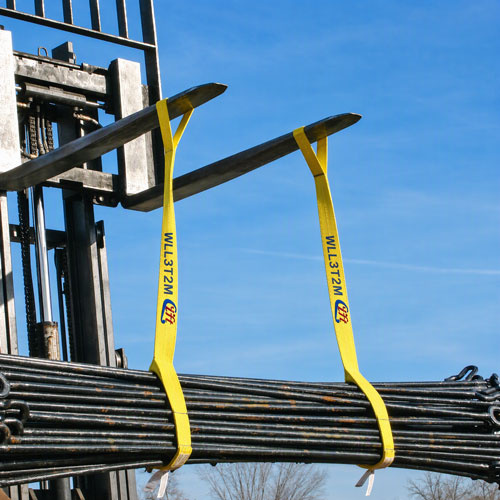
Spacing and hook angle, visible in a single photograph. A pre-slung drawing is an attempt to fix these two things in advance so that the same unit is lifted the same way at every point of its journey — including at points where nobody who made the drawing is present.
12. Frequently Asked Questions
Q1: What is a disposable pre-slung cargo sling?
Q2: Is "pre-slung" a standard term, or a catalogue word?
Q3: Who fits the sling, and who is responsible for it?
Q4: How do I work out the length of a pre-slung band?
Q5: Does pre-slinging change the working load limit I need?
Q6: What loads are normally pre-slung?
Q7: Can a pre-slung disposable sling be re-used?
Q8: How is a pre-slung band marked?
Q9: What should I ask a supplier for, beyond the price?
Q10: How does pre-slinging compare with simply buying bands and fitting the m at the port?
Contact
Lift Sling Rigging Co., Ltd manufactures the one-trip flat woven webbing band used for pre-slung cargo as well as the slinging plans that go with it. Send us the finished dimensions of the unit, th e mass of one bundle, the fitting point and the loop height you need, and we will work the band length back from them, confirm the marking that will be printed on the band, and quote the bands, the co rner protection and the documentation as one order. If you already have a drawing, send the drawing.
Telephone and WeChat — 18066002268
E-mail — 702461526@qq.com
Address — Lifute Industrial Park, Taizhou City, Jiangsu Province, China
HS code — 630790
- Previous:1 tonne round webbing sling 1000kg lifting sling
- Next:One-way synthetic webbing endless sling
-
Drone Anti-collision Net
-
Extra Large Capacity Cargo Net
-

Cargo Webbing Net
-

Color changing nylon double buckle loop nylon braided rope
-

Two end buckle lifting rope, double buckle round lifting rope, double fork nylon lifting rope, non jointed nylon lifting rope
-

Emergency escape lifeline, fire escape rope, fire safety escape emergency rope, steel wire core fire rope

