 Language
 简体中文
简体中文
- On the 2018 National Day holiday, Lifet completed six 100 ton large tonnage lifting belts as a gift
- The role of suspension net in the transportation of goods turnover
- Cargo soft lifting net, lifting net, lifting net, lifting net, bag, climbing net
- Precautions for using Lifutiden elevator
- How to make circular lifting straps
Contact: Wang Lili
E-mail:18066002268
Phone:702461526@qq.com
Address: Lifute Industrial Park, Taizhou City, Jiangsu Province
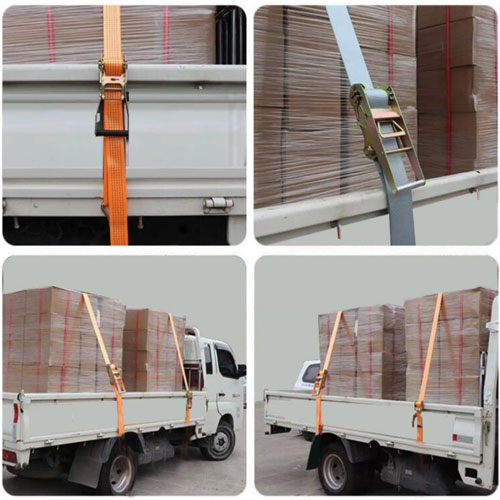
Lift Sling Rigging Co., Ltd. manufactures Ratchet Cargo Lashing Belt, Securing practice for steel coils, logs and intermodal containers follows, then the inspection regime, including the two different 10 percent rules and the published 5-year and 10-year age policy. A load restraint, not lifting equipment, and never to be used to lift. HS code 630790. Phone 18066002268.
Hits: ℃
Release time:2026-09-18 10:25
Lift Sling Rigging Co., Ltd. manufactures Ratchet Cargo Lashing Belt,Cargo Lashing Straps webbing, Ratchet Lashing Strap
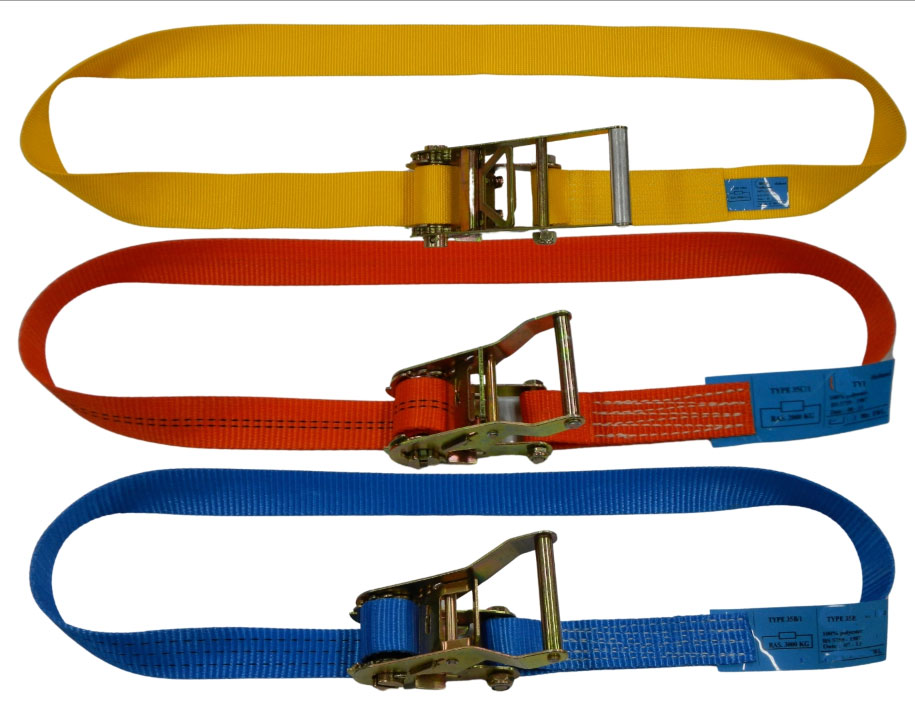
Ratchet Cargo Lashing Belt — the Belt, the Tensioner and the Fittings, and How to Specify Each
1. "Cargo Lashing Belt" Is a Trade Name — What the Standards Actually Call It
It is worth being precise about the vocabulary, because it is the first place where two quotations stop being comparable. In the course of preparing this page, one term was searched for in European standards-body catalogues, regulator texts and manufacturer documentation, and it was not found defined in any of them: cargo lashing belt. There is no standard that defines it, and no authority that uses it as a term of art. The nearest published industry wording is a product heading, cargo lashing strap, used by a European hardware supplier for a 50 mm ratchet strap.
What the standard does say is this. The scope of EN 12195-2, as published by two independent standards bodies, covers "safety requirements for web lashing made from man-made fibres with flat woven webbings for multi-purpose use and lashing combinations with webbings for the safe surface transport of goods on road vehicles". Note what is being named there: web lashing, and flat woven webbing. Note also what is not named: neither published scope statement mentions "ratchet", "cam buckle" or "tensioner" at all. That absence is worth knowing, because it explains a question buyers ask constantly — see the box below.
So does EN 12195-2 cover a cam buckle belt, or only ratchets? The scope text is written around the webbing and around "web lashing", and no retrievable clause sentence was found that names ratchet and cam-buckle tensioners as separate cases. What can be established from published documents is what manufacturers do: cam-buckle and over-centre straps are sold as EN 12195-2 products by major European makers. One catalogue lists a "cam buckle strap / two-part ... according to EN 12195-2 / LC 500 daN with straight tension", and another states that its cam-buckle and over-centre buckle lashing straps "have a security label according to EN 12195-2". If a specification question turns on this, ask the supplier for the label on the article and for the standard reference printed on it, rather than for a verbal assurance.
| Term | What it means | Status |
|---|---|---|
| web lashing | The standard's own term for the whole assembly: webbing plus tensioning device plus end fittings | The term used in the published scope of EN 12195-2 |
| lashing strap | Industry term for the same article, used across manufacturer catalogues | Widely used; no standards-body definition found |
| lashing belt | Industry term; used in reseller category headings such as "Lashing straps / belts" | Trade usage only; no standards-body definition found |
| cargo lashing belt | The term this page is written under | Not found defined in any standard, standards catalogue, regulator text or manufacturer document retrieved |
| belt | In common speech, the webbing element itself rather than the whole assembly | Not a defined term; ambiguous, so state which you mean |
| tie down | A method of securing (and the usual US term for the article); the US regulation calls it a tiedown | Defined in US regulation, not in EN 12195-2 |
| sling | Lifting equipment made to a different standard with a different design factor | Different product, different standard — see the warning above |
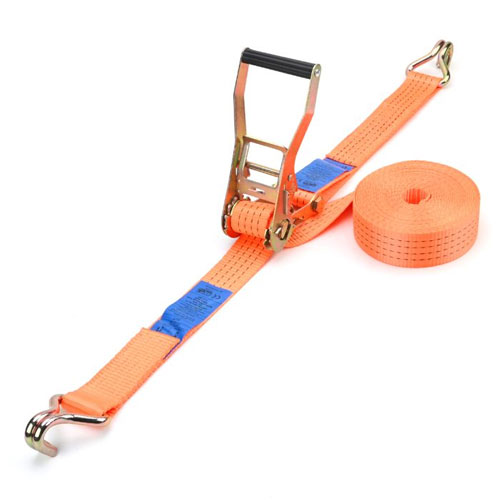
The parts themselves are described consistently by manufacturers even where the naming is not. One catalogue defines a one-piece strap as one that "is used for strapping the load and therefore does not need any end fittings such as eyes or hooks", and a two-piece strap as one that "consists of a fixed end (FE), an end fitting (EF), a tensioning device (TD) and an adjustable end (AE), which is also equipped with an end fitting". Another names the same two halves by their jobs: "The short piece and long piece are also known as the restraining element (ratchet) and connecting element (hook)."
2. Width Is Not a Capacity: Three Catalogues, Three Different Numbers
This is the single most useful thing on this page. Buyers very often specify a lashing belt by its webbing width — "a 50 mm belt" — on the assumption that width and capacity travel together. They do travel together in the sense that a wider belt can carry more, but the width does not determine the number, and the published catalogues do not agree with each other about what the number even is for a given width.
| Webbing width | Published LC range, catalogue A | Published LC range, catalogue B | Published LC, compliance document C |
|---|---|---|---|
| 25 mm (1 in) | 400 to 1,000 daN | 400 to 800 daN (cam buckle: 125 to 750 daN) | LC 2,500 daN |
| 35 mm | 1,000 to 2,000 daN | 1,000 daN | LC 4,900 daN |
| 50 mm (2 in) | 1,500 to 5,000 daN | 1,500 to 5,000 daN | LC 9,800 daN (heavy duty: 19,600 daN) |
| 75 mm (3 in) | 5,000 to 10,000 daN | 5,000 to 12,500 daN | LC 39,200 daN |
| 100 mm (4 in) | no EN-family data found | no EN-family data found | no data found |
Read the first two columns against the third. Two European catalogues covering the same product families agree with each other closely: 50 mm spans roughly LC 1,500 to 5,000 daN, and 75 mm starts around LC 5,000 daN. The third document — a distributor's compliance summary rather than a manufacturer's catalogue — gives figures three to five times higher for the same width: LC 2,500 daN on a 25 mm belt, and LC 39,200 daN on 75 mm. One of these is wrong for the articles it describes, or the articles are not the same articles. It is not possible to tell which from the documents alone, and this page does not average them: an average of two incompatible numbers is a third number that describes nothing.
How to use this table. Do not specify by width, and do not assume a wide belt is a strong belt until you have seen its label. Specify the LC you need, ask for the width, material and configuration that carries it, and then check the two against the label on the article. A 50 mm strap is a description of a webbing size; LC 2,500 daN is a description of a capacity.
Breaking force per width is published by almost nobody. Only the third document above offers a BF figure for each width, and that is the document whose LC figures disagree with everybody else — and it disagrees with itself as well: its table implies a breaking-force-to-lashing-capacity ratio of about 2.67, while its own label example prints "LC 500 daN" alongside "BF 1500 daN", a ratio of 3.0. No standards-body table of BF against webbing width was found. If a quotation offers you a BF figure, ask for the test report it comes from.
The last complication is that a single belt often carries two capacity values, and the notations for them differ between suppliers. One German supplier prints "Lashing capacity (LC): 2,500 daN straight / 5,000 daN in strapping". A second prints "LC direct" and "LC id" without explaining the second abbreviation. A third prints two LC values annotated against "1/2 LG" and "LG". A fourth explains the two label columns as "Lashing capacity: maximum force permissible in straight pull" and "Lashing capacity: maximum force permissible in round pull". The pair of values is real and standard; the wording is not. When you compare two quotations, compare like with like, and write the configuration into the enquiry.
3. The Belt Itself: Stretch Is the Number to Ask About
The webbing is the part that carries the load, and the number buyers ask about is its width — which, as §2 shows, decides very little on its own. The number that decides how a belt behaves over a journey is its elongation at LC, and it is published far less often. The limit under EN 12195-2 is reported by two independent suppliers in the same words: "The maximum elongation for lashing straps according to EN 12195-2 is 7% at LC", and "According to the standard, a lashing strap may have a maximum elongation of 7%". The standard's own clause sentence could not be retrieved for this page — the published limit is quoted here from manufacturer documentation, which is stated plainly rather than dressed up as a clause reference.
What products actually deliver sits below that ceiling, and the difference between products is real:
| Published figure | Product | Why it is quoted |
|---|---|---|
| Below 7% | Webbing heat-set during manufacture | "the heat setting reduces the stretch in the material to below 7%" |
| 5% at LC | Standard lashing straps from two suppliers | Stated as the normal figure for their standard ranges, against the 7% limit |
| 4% | A precision strap range, and a car-transport strap | Quoted as the reason the product suits vehicle transport: "particularly low webbing stretch (4%)" |
Why stretch is the number to worry about. A lashing belt holds a load by keeping tension in the webbing, and tension is what produces the friction that does the actual work. A webbing that stretches more under the same force loses tension as the load settles and the vehicle moves. That is why the low-stretch ranges are the ones marketed for carrying vehicles, where a slackening strap means a moving load. The same reasoning explains why polyester, the low-elongation fibre, is the default on this product rather than nylon.
Material and temperature. The belts in this family are high-tenacity polyester, marked PES. One compliance document lists the marking requirement for temperature range as –35 °C to +100 °C, citing clause 5.4 of the standard; the same range reappears in its list of retirement triggers (§9). Treat the figure as the marked range to check rather than as a design limit, and ask for the marked range on the article you are buying. Webbing is also finished in different ways: one manufacturer describes a treatment that "makes the straps less sensitive to wear and abrasion", which is worth asking about if the belt will cross abrasive loads.
Edges are where belts die, and there is a legal duty about them in one market. The US regulation is explicit: "Edge protection must be used whenever a tiedown would be subject to abrasion or cutting at the point where it touches an article of cargo. The edge protection must resist abrasion, cutting and crushing." The industry advice is the same but softer — one manufacturer's guidance is to avoid tightening a strap over a sharp edge, and to use protection angles where it cannot be avoided; catalogues list corner-protecting hoses in fixed webbing widths. What is not published anywhere that could be found is a figure for how much a sleeve preserves: no source quantifies how many daN or how many extra months a protector is worth. A sleeve removes a wear mechanism; it does not raise a rating.
Two honest limits on this section. No quantified UV-ageing limit for polyester webbing was found — no hours, no percentage of strength loss — only the instruction to inspect webbing for "cuts, abrasion, UV degradation, or chemical damage". And no standard-text sentence for the 7% elongation limit was retrievable, only manufacturer statements of it. Both are stated here as they stand, because a specification written on an invented figure is worse than a specification with a gap in it.
4. The Tensioner Decides How Much Force You Actually Get
The tensioner is the part that turns a person into a force. Two belts can share the same webbing, the same width and the same LC and still behave completely differently, because the handle design decides how much of the operator's pull reaches the strap. This is published, with numbers, and it is one of the clearest cases where paying for a different tensioner buys a measurable difference.
A European manufacturer describes the difference between its two ratchet families in these terms: standard pressure ratchets "are suitable for your simple load-securing requirements and are the standard in everyday load-securing... more suitable for light to medium-heavy loads. In comparison, long-lever ratchets are mainly used for heavier loads". And on the pull-action family: "Compared to the push ratchet, pull ratchets achieve more than double the pre-tensioning force value (up to 1,000 daN) with the same manual force. This is achieved by the longer ratchet lever, the principle of 'pulling instead of pushing' and the high transmission ratio (20 instead of 11 ratchet teeth)." A second manufacturer states that its ergonomic pull-down ratchet "has an STF of 750 daN, which is much higher than that of classic ratchets". Neither of these is a claim about strength; both are claims about how much tension the same hand can produce.
The published pre-tension values below are all STF, the residual force in the strap after the handle is released, and they are quoted with the webbing width they belong to. They should be read as examples of what a well-specified belt can claim, not as a table of what any particular belt will do.
| Tensioner | Webbing | Published STF |
|---|---|---|
| Standard ratchet, three suppliers | 50 mm | 350 daN, 320 daN and 300 daN on their standard ranges |
| Short-lever ratchet | 50 mm | 300 daN |
| Ergonomic pull-down ratchet, three models | 50 mm | 350 daN, 440 daN and 750 daN, depending on the model and the fixed-end fitting |
| Ergonomic pull-down ratchet (second maker) | not stated | 750 daN |
| Long-lever pull ratchet | not stated | "up to 1,000 daN" |
| Ratchet, light 25 mm range | 25 mm | 100 daN |
The hand force that produces all of this is fixed, not chosen. Every STF figure above is determined at the standard hand force, SHF 50 daN, and the sources are consistent about it: "the standard still expressly stipulates that 50 daN of hand force be used to determine the STF", and "50 daN is a universal standard and used to determine the STF value of a device in combination with the webbing", and, in plain terms, "a weight of approx. 50 kg attached to the ratchet causes the ratchet and lashing strap to be tightened". The consequence is that STF is a property of the tensioner-and-webbing combination, not of the tensioner alone: change the webbing and the same ratchet will produce a different STF.
A published compliance trap in small belts. One manufacturer sets out what happens when the fixed 50 daN hand force is applied to a light system: "The STF of a light-weight lashing system with an LC of 400 daN and a webbing width of 25 mm is determined with 50 daN hand force in the same test assembly. Here the standard makes no distinction. As a result, these lashing systems attain STF values that are more than 50% of the LC. This means that they no longer comply with the standard and, among other things, would not be awarded a GS." The same source records the workaround and its price: for light systems the certification bodies "reduced the hand force... to 25 daN", which allows the mark again, "however, the product must be labelled with the endorsement 'based on the standard', as the standard still expressly stipulates that 50 daN of hand force be used". So on a small belt, a very high STF relative to LC is not a selling point; it can be the mark of a non-compliant test.
Cam buckles and clamp locks are a different tool, and they are sold under the same standard. A European catalogue ranges cam-buckle lashing straps at LC 125 daN, 250 daN and 750 daN in 25 mm webbing, and states that "the strongest of our cambuckle lashing straps can hold loads of up to one tonne in check". Their published uses are domestic and light-industrial rather than transport-critical: "Fixing, bundling, securing, transverse and diagonal lashing — all these are no problem for the light-weight, all-purpose tools", including "securing gas canisters in mobile homes or roller containers in retail outlets, bundling together various construction materials or securing luggage in the boots of cars". Two things follow for a buyer. First, a cam buckle is not a cheap ratchet; it is a lighter device for lighter work, and its capacity is roughly an order of magnitude below a 50 mm ratchet belt. Second, no STF figure for a cam-buckle tensioner was found in any of the sources reviewed — the catalogues publish LC for these products and stop there. If a quotation puts a cam buckle into a frictional lashing calculation, ask which STF it used.
Put STF in the enquiry. On a belt that will go over the top of a load, STF is the number the securing force depends on, and it varies by a factor of several between tensioner designs at the same 50 daN hand force. Ask for the STF and for the hand force it is determined at, and you can compare two quotations that are otherwise identical.
5. The Anchor Decides the Hook, Not the Catalogue
Hook names are the least standardised vocabulary in this product, and the lists prove it. One European manufacturer's catalogue prints end-fitting keys running from "triangle hook" and "claw hook" through "rave hook", "flat J hook", "flat snap hook", "low profile claw hook" and "track hook" to "delta hook" and "pallet hook". A second lists "J-Hook, S-Hook, anchor-bar fitting, bord clamp, car J-hook, claw hook, double-stud fitting, double j hook with keeper, end-link, eye-hook, flat hook with keeper, flat snap hook". A third offers "crown hook, deflection fitting, rail fitting, twisted snap hook, delta-ring hook, triangle pointed hook". Almost none of these names is defined in a standard. That is why the useful question is not "which hook?" but "what is your anchor point?" — the anchor decides the fitting, and the fitting has to be named against it.
| The anchor point | What catalogues publish for it | Where that comes from |
|---|---|---|
| Container lower corner casting, on a chassis | Securement devices or integral locking devices on all lower corners | US regulation, 49 CFR 393.126(b)(1) |
| Lashing track / airline rail on a trailer | "Track hook", "rail fitting", "end fitting for airline lashing tracks" | Manufacturer catalogues |
| Side rail or board wall | Board-wall clamp, listed as a "bord clamp" end fitting | Manufacturer catalogue |
| Perforated deck plate (car transport) | "The moveable swivel hook that can be rotated through 360° or the traditional claw hook can be selected for attachment to the perforated plate" | Manufacturer catalogue |
| D-ring or recessed anchor ring | "Forged hook with D-Ring", "grade 80 eye hook with D-Ring" | Manufacturer catalogue |
| Any anchor on a vehicle in motion | The fitting must not release on its own while the vehicle is in transit | US regulation, applying to every tiedown |
The published functions of the individual hook shapes are worth reading, because each one exists to solve a specific failure. On one maker's range: the wire hook "can be fixed to the attachment point quickly and easily"; the S hook carries a plastic coating that "helps to avoid scratches on vehicles" and also fixes quickly; on the carabiner hook "the latch prevents the carabiner from sliding off the attachment point"; and on the triangle hook, "the latch prevents the carabiner from sliding off the attachment point, and the triangle enables the carabiner to be fixed to the attachment point flexibly and conveniently". Three different answers to the same problem — a hook that leaves its anchor — and a plain hook has none of them.
The question with no standard answer: how strong must the fitting be? A distributor's compliance summary states that end fittings "must be rated to withstand forces at least equal to BF" — that is, at least the breaking force of the assembly. A manufacturer, on the same subject, writes only that "the lashing capacity of a strap is determined by the weakest link in the assembly". Those are two different requirements: one asks the fitting to match the belt's breaking force, the other says simply that whatever is weakest sets the rating. A search of retrievable standard texts for a sentence fixing the required end-fitting strength relative to the webbing found none. In practice the safe course needs no clause: ask the supplier for the rating of the fittings, not only of the belt, and ask which of the two ratings is the lower. On a quotation that lists only one number, you do not know which component you are buying.
One further distinction belongs to this section because it is a fitting decision rather than a webbing one. A hook with a keeper or a latch, and a plain open hook, are not interchangeable even where they are the same shape. Catalogues print them as separate items — "claw hook" and "claw hook and keeper" — and the keeper is the difference between a fitting that can bounce clear of a rail in a pothole and one that cannot. On a load that must arrive secured, that is not an accessory.
6. One-Piece, Two-Piece and Loop: Configurations and How Length Is Measured
There are three shapes in this family, and they are not variations on a theme; each one suits a different job. The two-piece strap is the transport article: a fixed end carrying the tensioner, and a loose end, with an end fitting on each. The one-piece strap is a single length with no end fittings, used by wrapping it around or over the load and tensioning it against itself. The loop, or endless, form goes over the top of the load and back to the vehicle, which is the shape behind the US regulation's description of tiedowns used as "wrappers that encircle the entire load at locations along the load that provide effective securement".
A manufacturer's own guidance on which to take is unusually direct: "One-piece ratchet lashing-straps are also suitable for strapping, even if clamp lock lashing-straps are often used for this. The two-part version is suitable for direct lashing and tie-down lashing." In other words, if the belt is going to be anchored to the vehicle at both ends, it is a two-piece strap; if it is only going to hold things together, one piece is enough and cheaper.
Length is where quotations go wrong, because "length" means three different things. The industry uses a small set of codes, defined in an industry guide as follows:
| Code | What it is | Measured from | Measured to |
|---|---|---|---|
| LG | Total length of a one-piece lashing strap | The outer turning radius of the attached tensioning element | The end of the webbing |
| LGF | Length of the fixed end of a two-piece strap | The load-bearing point of the attached end fitting | The outer turning radius of the connection between strap and tensioning element |
| LGL | Length of the loose end of a two-piece strap | The load-bearing point of the attached end fitting | The end of the strap |
Those definitions come from an industry guide and are corroborated by catalogue practice rather than by a quotable clause: one catalogue prints "two-part ratchet lashing strap standard length LGF = 0,4 m + LGL = 7,6 m"; another uses "nominal-length LG", "nominal-length long part LGL" and "nominal-length short part LGF" as product filters; a third uses a different pair of abbreviations for the same two halves ("SE 1.0 m + LE 4.0 m"); and a fourth describes the same parts in words — the fixed end as "the length of the tensioning device, a part of webbing, and the hook", and the loose end as "the length of the long part with the hook". The standard's own definition text could not be retrieved, so the definitions above are the industry's, and they are given here as such. The practical point survives the ambiguity: a two-piece strap has two lengths, and a quotation that gives one number is not yet a specification.
One-piece lashing straps: a single length with no end fittings, tensioned against itself. The loop form is the shape used for strapping and bundling, not for anchoring a load to a vehicle.
How to write the enquiry so the length is unambiguous. Give the distance between the two anchor points, the type of anchor at each end (track, rail fitting, D-ring, corner casting, perforated plate), whether you want a one-piece or a two-piece strap, and then the lengths you want as LGF and LGL if two-piece. Add the LC you need and the STF you expect. Four lines of that will settle what twenty lines of catalogue description will not.
7. Which Belt for Which Job: Strapping, Bundling, Tie-Down and Direct Lashing
The numbers that govern the two ways of using a belt — direct lashing and frictional (tie-down) lashing — are set out on the ratchet tie down strap page, together with the label values each one uses. What belongs on this page is the purchasing decision underneath it, because the four jobs below need four different belts, and buying a belt from the wrong row is the most common expensive mistake in this product.
| The job | Configuration | Tensioner it needs | What the job depends on |
|---|---|---|---|
| Bundling, fixing, holding things together | One-piece strap, no end fittings | Cam buckle or clamp lock is often enough | Nothing but webbing tension. Light loads, short journeys, internal handling |
| Strapping down a load on a deck | One-piece or two-piece, over or around the load | Ratchet, for the tension it can hold | Friction between load and deck. Published guidance: "At least two straps must be used when strapping down loads" |
| Frictional (tie-down) lashing to the vehicle | Two-piece, both ends anchored to the vehicle | Ratchet with the highest STF you can justify | The STF the strap develops, and the friction it creates |
| Direct lashing against movement | Two-piece, each end anchored so the belt works along its length | Ratchet, sized on LC | The LC of the assembly and the lashing angle, not STF |
Two published statements explain why the first row and the second row are genuinely different products rather than a price ladder. The first is about what "strapping down" means: "When strapping down a load, the aim is to press it so firmly onto the loading area that, by means of friction alone, the load does not slide during transport... Strapping down loads is a friction-locked process." The second is about the one-piece strap's natural job: it "is used for strapping the load and therefore does not need any end fittings such as eyes or hooks". Neither statement is about strength. Both are about the geometry of the job, which is decided before the belt is chosen.
A single question sorts the four rows. Ask whether the belt's ends will attach to the vehicle, the load, or each other. Vehicle at both ends: tie-down or direct lashing, so a two-piece ratchet strap and its LC or STF on the label. Load only, looping back on itself: strapping or bundling, so a one-piece strap and a cam buckle will often do. That answer decides the configuration, and the configuration decides the price.
8. Steel Coils, Logs and Containers: What the Rulebook Actually Prescribes
Most of the world leaves the arrangement of a lashing to the operator. One market writes it down, in a level of detail that is worth reading whatever country you drive in, because it spells out the geometry that the rest of us are expected to work out. The quotations below are from the US cargo securement rules, and they are presented as what they are: a national rule for its own roads, not a European standard.
Metal coils are treated as two different problems, depending on which way the eye is facing. With the eye vertical, the rule asks for at least one tiedown attached diagonally from the left side of the vehicle across the eye to the right side, at least one from the right across to the left, at least one tiedown attached transversely over the eye, and either blocking and bracing, friction mats or tiedowns to prevent forward movement. With the eye crosswise it asks first for a means of preventing rolling — "a means (e.g., timbers, chocks or wedges, a cradle, etc.) to prevent the coil from rolling", which "must support the coil off the deck" and must not be capable of becoming unfastened in transit, with nailed blocking or a nailed wood cradle as the sole means prohibited — and then for at least one tiedown through the eye restricting forward motion and one restricting rearward motion, "whenever practicable, making an angle no more than 45 degrees with the floor". It also forbids one specific arrangement outright: "Attaching tiedowns diagonally through the eye of a coil to form an X-pattern when viewed from above the vehicle is prohibited."
Logs are a cradling problem before they are a lashing problem. The vehicle must be "fitted with bunks, bolsters, stakes or standards, or other equivalent means, that cradle the logs and prevent them from rolling". The load itself is then specified in terms of contact: logs must be solidly packed, the outer bottom logs must rest solidly against the bunks or stakes, and "each outside log on the side of a stack of logs must touch at least two stakes, bunks, bolsters, or standards". Anything not held by contact "must be held in place by a tiedown", and additional tiedowns are required "when the condition of the wood results in such low friction between logs that they are likely to slip upon each other". The capacity rule for this cargo is also a different one from the general rule: the aggregate working load limit of the tiedowns "must be at least one-sixth the weight of the stack of logs".
A container on a trailer is secured at its corners, not over its roof. Where a container sits on a chassis, "all lower corners of the intermodal container must be secured to the container chassis with securement devices or integral locking devices that cannot unintentionally become unfastened while the vehicle is in transit", the movement allowed is a centimetre-scale tolerance — no more than 1.27 cm in any horizontal direction and 2.54 cm vertically — and "the front and rear of the container must be secured independently". Where the container is carried on a vehicle that is not a chassis, the options narrow to two: chains, wire ropes or integral devices fixed to all lower corners, or crossed chains fixed to all upper corners.
| Cargo | What the rule prescribes | Where the belt works |
|---|---|---|
| Steel coil, eye vertical | Tiedowns diagonally across the eye from each side, plus one transversely over the eye, plus blocking, bracing or friction mats against forward motion | Over the coil and across the eye |
| Steel coil, eye crosswise | A rolling-prevention means that supports the coil off the deck, plus a tiedown through the eye forward and one rearward, at no more than 45° where practicable. Crossing tiedowns through the eye is prohibited | Through the eye |
| Logs on a frame or flatbed vehicle with bunks or stakes | Aggregate working load limit at least one-sixth the weight of the stack; each outside log touching at least two stakes; extra tiedowns where friction is low | As wrappers over the stack |
| Intermodal container on a chassis | All lower corners secured with locking devices; movement within 1.27 cm horizontally and 2.54 cm vertically; front and rear secured independently | Container corner castings |
The transferable lesson, for any market. In three of these four cases the rule does not start with the belt at all. It starts with a bearing — chocks, a cradle, bunks, a twist lock, a corner casting — and then uses the belt to stop what the bearing cannot. A coil that has been given a cradle needs the tie-down through its eye only to stop motion along the deck; a log stack in good bunks needs wrappers, not a stronger belt. When a lashing keeps working loose, the usual cause is not the belt; it is that the load was never given a bearing.
9. Inspection, Records and Retirement: Two Different 10 Per Cent Rules
The inspection requirement for this product is not a general good practice; it is written into the standard as a duty on the manufacturer and the user. A manufacturer's own note on the subject is specific about where it lives: the standard obliges manufacturers "to provide operating instructions with each strap. These instructions specify that straps must be inspected regularly", and "Annex B.11 of EN 12195-2 details the requirements for inspection. If safety-relevant defects are found — such as cuts, frayed webbing, damaged stitching, or defective ratchets — the strap must be immediately withdrawn from service and replaced with a fault-free product."
How often, and who keeps the record. The same source is unusually frank about the intervals, and about the gap between two regimes: "The European standard itself does not stipulate fixed inspection intervals. However, it explicitly recommends an inspection after each use." Against that, the German VDI Guideline 2700 Sheet 3.1 "provides stricter requirements: At least one inspection per year by a qualified expert; Depending on frequency of use and load, shorter intervals may be necessary" — and, in the same paragraph, "A written record of inspections is mandatory". For a fleet, the distinction matters: the standard asks for frequent eyes on the strap, the guideline asks for a documented expert review. Both are described here because they are both published, and a buyer choosing a regime should know which one is being quoted.
Two rules with the same number and different meanings. Both are published, both use 10 per cent, and they are not the same rule. The first is a retirement threshold: webbing must be retired when it has "cuts penetrating more than 10% of cross-section". The second is a strength statement: "10 % tear = up to -50 % of the permitted tension force". The first tells you when to take the belt out of service; the second tells you what a small amount of damage costs while it is still in service. Reading the second as permission to keep working up to the first is exactly the mistake the two sentences exist to prevent.
| Retirement trigger | Published in |
|---|---|
| Label missing, defaced or illegible — retire immediately | Distributor compliance summary of EN 12195-2 |
| Cuts penetrating more than 10% of the cross-section | Same |
| Webbing knotted, twisted or severely compressed and not correctable by use | Same |
| Corrosion or deformation of the ratchet mechanism or the hooks | Same |
| Exposure to temperatures outside the marked range, given as –35 °C to +100 °C | Same |
| Any known overload event, where the load exceeded the LC | Same |
| Age: with regular use "destroyed after 5 years from date of first use", and an "ultimate life span of 10 years from date of manufacture, even if never used" | Manufacturer product-life policy |
Two habits from the operator's side. The first is a re-check early in the journey: the published advice is to check the strap and tighten if necessary "after a short distance", which is the cheap cure for a load that settles and takes the tension out of the webbing. The second is a check before release: "Check the load before releasing the strap (is it hanging from the strap?)" — a question that catches the case where the belt, not the load's own bearing, is holding everything up. And one prohibition that belongs with them: ratchet straps are "not permitted to be used in the case of sharp edges (protect them!)".
10. Frequently Asked Questions
Is a cargo lashing belt the same thing as a ratchet tie down strap?
Can I specify the belt by its width?
My quotation shows two LC values. Which one applies to me?
Should I take a ratchet or a cam buckle?
Why does a long-lever ratchet cost more than a standard one?
Which hook should I ask for?
How do I state the length of a two-piece belt?
One-piece or two-piece?
How often must a lashing belt be inspected?
When is a belt scrap?
Contact
This is a made-to-order lashing belt, and the four answers that decide it are the job, the load, the anchor and the destination market. Send those and the specification comes back complete rather than as a price per metre.
Telephone and WeChat — 18066002268
E-mail — 702461526@qq.com
Address — Lifute Industrial Park, Taizhou City, Jiangsu Province, China
HS code — 630790
What to include in an enquiry — the LC or load weight, the anchor point at each end, the distance between anchors, one-piece or two-piece, the destination country, and the marked standard you need
- Previous:Ratchet Tie Down Strap
- Next:Heavy Duty Lifting Sling
-
Drone Anti-collision Net
-
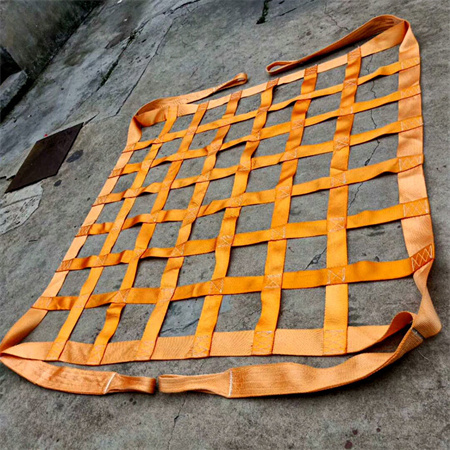
Extra Large Capacity Cargo Net
-
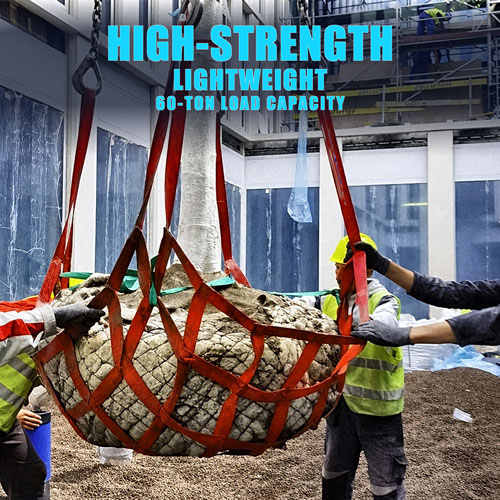
Cargo Webbing Net
-

Color changing nylon double buckle loop nylon braided rope
-

Two end buckle lifting rope, double buckle round lifting rope, double fork nylon lifting rope, non jointed nylon lifting rope
-

Emergency escape lifeline, fire escape rope, fire safety escape emergency rope, steel wire core fire rope

