 Language
 简体中文
简体中文
- On the 2018 National Day holiday, Lifet completed six 100 ton large tonnage lifting belts as a gift
- The role of suspension net in the transportation of goods turnover
- Cargo soft lifting net, lifting net, lifting net, lifting net, bag, climbing net
- Precautions for using Lifutiden elevator
- How to make circular lifting straps
Contact: Wang Lili
E-mail:18066002268
Phone:702461526@qq.com
Address: Lifute Industrial Park, Taizhou City, Jiangsu Province
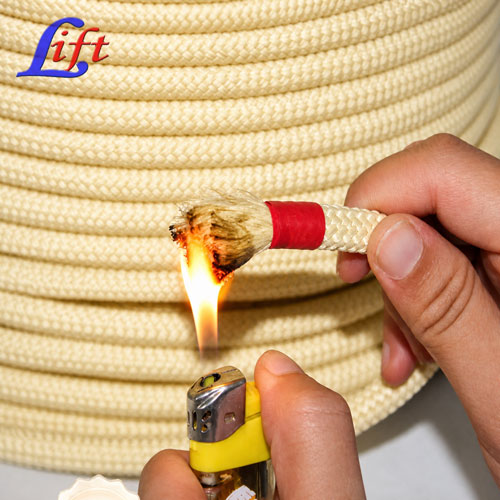
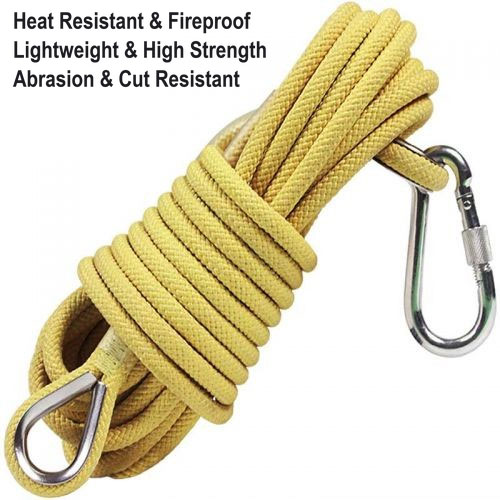
Lift Sling Rigging Co., Ltd manufacture Aramid Escape Rope,Kevlar double braided sleeve rope,Kevlar aramid rope strongest fireproof cord,Aramid Guide Rope.Kevlar aramid rope built to the specification your order names: para-aramid core, custom construction, diameter and ends. Ask for the figures.
Hits: ℃
Release time:2026-09-26 14:39
Kevlar Aramid Rope, Strongest Fireproof Cord — Three Claims in One Name
This product carries the name Kevlar aramid rope, strongest fireproof cord, and all three of the claims in it are worth stopping on. Kevlar is a trade name rather than a material, so a buyer who asks for it may be naming a fibre family, a grade or a brand, and the three are not the same thing. Strongest is a comparison with no second term attached to it, and a comparison without a second term cannot be checked. Fireproof is a word no textile rope has a right to: para-aramid does not melt and does not support combustion, and it still decomposes rather than resisting heat forever. This page keeps the three names, because buyers search for them, and takes each one apart rather than repeating it.
The page does five things. It takes the three claims apart and says what each can and cannot carry (Section 1). It sorts the four names this product line carries, because they describe four different articles (Section 2). It separates the fibre family from the trade name, and gives the fibre-level data as the fibre maker publishes it for the two standard grades, labelled as fibre data rather than as figures for any rope this factory has made (Sections 3 and 4). It gives the ten parameters an order has to define, with the column that says which of them a buyer can check on the coil that arrives and which can only be settled by a test (Section 5). And it sets aramid against the glass fibre, ceramic fibre and steel wire ropes this factory also makes, because on a heat duty the honest question is not whether aramid is good but whether aramid is the right one of the four (Section 8).

1. Three Claims in One Name, and What Each One Actually Carries
A product name is not a specification, and this one carries three claims of different kinds: a brand, a comparison and a material property. Each of them fails in a different way when a buyer tries to use it as a specification, and each of them can be turned into something usable by adding one thing.
| The word in the name | What kind of word it is | Why it cannot be used as it stands | What to add to make it usable |
|---|---|---|---|
| Kevlar | A trade name | It names a maker's brand for grades inside a fibre family, so it fixes neither the fibre chemistry nor the grade. Two Kevlar aramid ropes can differ in tenacity and in extension | The fibre family (para-aramid) and, where the duty depends on it, the grade |
| Strongest | A comparison | A comparison needs a second term. Strongest of what, per unit of weight or per unit of diameter, dry or wet, and measured on the fibre or on the finished rope? | The set being compared, the basis of comparison, and the construction of the test piece |
| Fireproof | A material property claim | No textile rope is fireproof. Aramid chars and decomposes rather than melting, and its strength falls with temperature and with time | A temperature, a duration, and the share of strength retained afterwards |
| Aramid | A fibre family | The only one of the four that is a material word, and the only one that can be checked against a document | Nothing. This is the word to build an order on |
A buyer who arrives with the phrase in the product name and leaves with the word aramid has gained something. A buyer who orders on the phrase alone has ordered a brand, a comparison and a property that does not exist as stated, and will have to settle all three after the rope is delivered.
2. Four Names on This Product Line, and the Four Duties Behind Them
The line that came with this product names four articles in one sentence: Aramid Escape Rope, Kevlar double braided sleeve rope, Kevlar aramid rope strongest fireproof cord and Aramid Guide Rope. Read them together and they look like one product with four descriptions. Read them separately and each of the four is answering a different question: one names a duty, one names a construction, one names a set of claims, and one names a job on a construction site.
| The name on the line | What it actually names | The question it forces | Where this catalogue argues it |
|---|---|---|---|
| Aramid Escape Rope | A duty | Who is on the rope, and what the rope has to survive being stored for years and then used once | Emergency escape lifeline and fire escape rope |
| Kevlar double braided sleeve rope | A construction | How the load-bearing part is built, and whether the sleeve carries anything or only protects | This page, Section 9 |
| Kevlar aramid rope strongest fireproof cord | A set of claims | Which of the claims the buyer actually needs, and what figure stands behind it | This page, Sections 1 to 7 |
| Aramid Guide Rope | A job on a construction site | What the rope is being pulled through, over and around, and what the route does to it | Power guide rope and cable laying rope |
The four names are not wrong, and they are not interchangeable. A guide rope and an escape rope built from the same fibre are two different articles, because one is judged by what it survives being dragged through and the other by what it does on the single occasion it is used. The word aramid is the only part the four have in common, which is why this page is about the fibre.
3. What Aramid Is, and What "Kevlar" Is: a Fibre Family and a Trade Name
Aramid is a family of synthetic fibres built from aromatic polyamide. The branch this product belongs to is the para-aramid branch, chemically PPTA, and it is the branch that produces the stiff, high-tenacity fibre the rope trade uses. The other branch, meta-aramid, is the one that goes into protective clothing, and a buyer who has been told "aramid" by a clothing supplier and "aramid" by a rope supplier has been told two different things.
Kevlar is one maker's trade name for grades within the para-aramid family, and Twaron is another. Neither word names a material. This matters at the point of order rather than in a textbook: the grades inside the family differ in tenacity, in stiffness and in extension at break, and a rope built from a high-modulus grade behaves differently from a rope built from a standard grade, in a way a buyer can feel in the hand and measure on a test bed. This factory buys fibre to the specification on the order and does not make a claim about the brand of the fibre in any rope unless the order names it.
Two consequences follow, and they are the reason this page exists. First, an order that names a brand has not yet named a material; an order that names the fibre family has, and the grade is the next question. Second, because the family contains several grades, any claim that begins "aramid is" has to end with a figure and a grade, which is what Section 4 sets out.
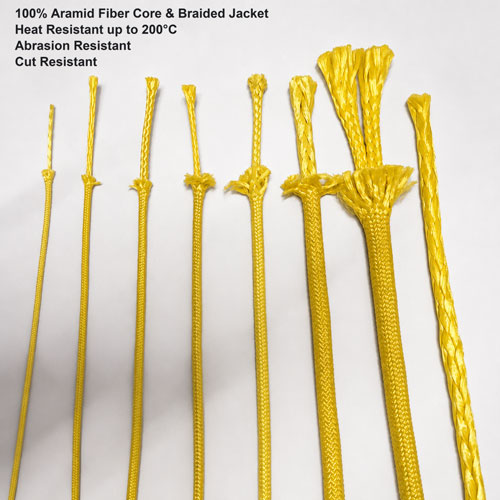
4. The Fibre Data: What Belongs to the Fibre and What Belongs to the Rope
Every figure below is a property of the fibre as the fibre maker publishes it for the two standard grades of para-aramid yarn. Not one of them is a figure for a Kevlar aramid rope this factory has made, and the distinction is the whole reason the table carries two columns on the right rather than one: a rope is a construction, not a fibre, and its figures are lower than the fibre's at every point where something has been done to the fibre to turn it into a rope.
| Fibre property | Unit | Standard grade (Kevlar 29 class) | High-modulus grade (Kevlar 49 class) |
|---|---|---|---|
| Density | g/cm³ | 1.44 | 1.44 |
| Breaking tenacity | g/d (cN/tex) | 23.0 (203), about 2,920 MPa | 23.6 (208), about 3,000 MPa |
| Tensile modulus | g/d (GPa) | 555 (about 70) | 885 (about 112) |
| Elongation at break | % | About 3.6 | About 2.4 |
| Melting point | °C | None — the fibre does not melt | None — the fibre does not melt |
| Decomposition temperature | °C | Quoted in the region of 427 °C in the fibre maker's technical guide, and above 450 °C in other published references. The figure belongs to the grade and to the source, so quote it with both [确认] | |
| Moisture regain, as shipped | % | About 7.0 | About 3.5 |
Two lines in that table decide more orders than the strength line does, and they are the two a buyer rarely asks about. The elongation at break tells you how much a rope will move under load, and the two grades differ by a third on it: about 3.6% against about 2.4%. And the moisture regain tells you that this fibre takes up water, in the region of 7% of its mass as shipped in the standard grade, which is an order of magnitude more than polyester. A rope cut to length dry is not that length wet, and a rope sold by mass is not that mass wet either.
What the fibre figures cannot tell you is what the finished Kevlar aramid rope will hold. The cover, the braid pattern, the number of strands, the splice at each end and the way the rope is loaded all sit between the fibre and the article, and they are why Section 5 is written as a list of things an order has to define rather than as a table of figures this page is prepared to state.
5. Technical Parameters: the Figures an Order Defines, and Which Can Be Checked on Delivery
Ten parameters, and for each one the column that decides whether a quotation can be checked at all: whether the buyer can verify the figure on the coil that arrives, or whether it can only be settled by a test. On a Kevlar aramid rope this split matters more than usual, because the two properties the buyer is paying for, what it holds after heat and what it holds after use, are both in the right-hand column.
| Parameter | Unit | How the figure is established | Checkable on a delivered coil, or only by test |
|---|---|---|---|
| Fibre family, and the grade where it matters | none | Named by the maker: para-aramid, and the grade if the duty depends on extension or stiffness [确认] | On a delivered coil, from the label. What is inside can only be confirmed by taking a sample apart |
| Construction, and the number of strands | none | Named: double braided, or a core held in a sleeve; how many strands in the braid; whether the cover carries any load [确认] | On a delivered coil, by eye and by hand. It is the figure the four product names on this line do not contain |
| Diameter | mm | Measured at more than one point under a stated tension, because a rope that is not under tension is not round | On a delivered coil, but only against the same tension |
| Diameter tolerance | mm, or a percentage | Stated as a band, because a rope is built to a construction rather than turned to a size [确认] | On a delivered coil. Without a band, a rope that is right and one that is wrong cannot be told apart |
| Mass per metre | grams per metre | Weighed on a known length at a stated moisture content. It is not calculated from the diameter [确认] | On a delivered coil, with a scale and a tape, and it is the cheapest check there is. On an aramid rope it has to be weighed dry, or the figure moves with the weather |
| Extension at a stated load | percent | Measured between two marks on a sample as the load is applied, so the load has to be named beside the figure or the figure means nothing | Only by test. It is the figure that separates the two grades in Section 4, and the one that decides how a rope behaves in a controlled descent |
| What the rope keeps after heat exposure | percent of original | Measured by holding a sample at a stated temperature for a stated time and testing it afterwards | Only by test, and it is the only honest form of the word fireproof. A temperature without a duration, or a duration without a temperature, is not the figure |
| Change in length, dry to wet | percent | Measured, not assumed, because aramid takes up moisture and the change depends on the construction as well as the fibre | Only by test, and it is worth having: on a fixed installation the difference is a fitting that no longer reaches |
| Length, and length tolerance | metres, percent | Measured under a stated tension and at a stated moisture content, and stated as a band [确认] | On a delivered coil, and it is the second cheapest check after the mass |
| Ends, marking and what travels with the coil | none | Named end by end, plus what is marked on the rope and which documents accompany it | On a delivered coil, visibly. A rope that cannot be traced to a batch cannot be retired on evidence |
Half of those figures can be checked by whoever opens the crate and half cannot, and the half that cannot is the half a heat-resistant rope is bought for. That is not a reason to avoid the fibre; it is the reason the order has to name the temperature and the duration rather than the word.
6. "Strongest" and "Fireproof": the Two Claims Rewritten
Both words can be used honestly, and both have to be rebuilt before they can be. The table below takes the two as they stand in the product name and writes the version that survives a technical question.
| As the name has it | What it says when tested | The version that holds |
|---|---|---|
| Strongest | Nothing, because there is no second term. Para-aramid outperforms steel wire for the same weight and loses to it for the same diameter; it beats polyester on tenacity and loses to ultra-high molecular weight polyethylene on the same measure; every splice and knot takes a further share | Higher tenacity than the named alternatives, for a stated construction, measured dry on a stated test piece, at a named splice efficiency |
| Fireproof | Nothing, because no textile is fireproof. Aramid does not melt and does not support combustion, and it still decomposes, still chars, and still loses strength as temperature and time go up | Does not melt; does not support combustion; retains a stated share of its strength after a stated temperature for a stated time, measured per a named test |
The word that can be used without qualification is non-combustible, and even that belongs to a test rather than to a material: it is a statement about how a sample behaved in a specified test, not a promise about what will happen on a site. A buyer who needs the word fireproof for a tender document can have the sentence in the right-hand column printed on the delivery paperwork, which satisfies a reviewer and can be checked.
7. The Limits: Ultraviolet, Moisture, Heat Ageing and Cost
Four things shorten the life of an aramid rope, and three of them are properties of the fibre rather than faults in a rope. They are set out here because a page that lists only the advantages is a page a buyer cannot use to decide anything.
Ultraviolet light. Para-aramid is affected by sunlight, and the effect is cumulative. A rope that lives outdoors has to be covered, and a cover is not decoration on this fibre: it is the part that takes the light so the load-bearing part does not. In store, the same rule applies in reverse, which is why a rope should be coiled, dry and out of direct sun rather than hung on a wall beside a window for a year.
Moisture. The fibre takes up water, in the region of 7% of its mass as shipped, and it gives it back. Two practical consequences: the rope weighs more and measures longer wet than dry, and water carried into the rope carries whatever was in the water with it. A rope used around seawater, fire run-off or process chemicals has had something done to it that no inspection of the cover will reveal, and the record is the only place that fact survives.
Heat ageing. Heat is not only an event that happens to a rope; it is a process. A rope held for a long time below the temperature that would visibly damage it still ages, and the loss accumulates. This is why the honest form of the heat claim in Section 6 names a time as well as a temperature, and why a rope that has spent a season near a heat source is judged against its history rather than its appearance.
Cost. Aramid costs several times what polyester or nylon costs for the same length, and there is no sense in paying for it on a duty that does not need low extension, heat resistance or cut resistance. Where the duty does need them, the comparison is not against a cheaper rope but against the failure the cheap rope would have caused, which is the calculation the buyer is really making.
8. Aramid Against the Other High-Temperature Ropes This Factory Makes
On a heat duty the question is not whether aramid is good. It is whether aramid is the right one of four, and the other three are made in this factory as well. The table below compares them on the properties that decide the choice, not on strength alone.
| Article | Strength and load bearing | Temperature | Handling and flexibility | Where it belongs |
|---|---|---|---|---|
| Para-aramid rope and cord | High tenacity, takes tension, can be spliced and used as the load-bearing part | No melting point; decomposition quoted in the region of 427 °C and above [确认] | Flexible, low extension, comfortable to handle but stiff in the hand compared with nylon | Heat duties that also have to hold a load, and duties where low extension matters |
| Glass fibre rope and glass fibre square rope | Lower, and not intended as the load-bearing element of a lifting system | Higher than aramid, up to the region of 600 °C in this factory's own product line | Brittle; abrasive to handle; irritates the skin | High-temperature sealing, insulation and lagging where nothing is being lifted |
| Ceramic fibre rope and ceramic fibre square rope | Lower still, and the most brittle of the four | The highest of the four | Brittle and dusty; not a handling article | Furnace and kiln sealing, expansion joints, insulation |
| Steel wire rope | The reference for strength per unit of diameter, and the least forgiving of misuse | Unaffected by high temperature in the range these fibres work at | Heavy, stiff, sharp where it has been damaged, and it marks anything it touches | Loads where wire is specified, and duties where heat and strength are both extreme |
The line that decides most of these choices is in the third column of the first row: only one of the four is built to carry a load and survive heat. Glass and ceramic fibre ropes go hotter and cost less, and they are not load-bearing articles. Where a job needs both properties the choice is between aramid and wire, and it is usually settled by whether the article has to be soft, light and handled by hand.
9. Construction: Double Braid, Sleeve, Core and Ends
The product line names a construction as well as a material, and the construction is where the fibre figure is turned into a figure for the finished Kevlar aramid rope.
Double braided. A braided cover over a braided core. The core carries the load and the cover takes the wear, the dirt and the light, and on an aramid rope that division of labour is the point: the fibre is the expensive part, and the cover is what keeps it out of the sun. A double braid also holds its shape and resists the flattening that a single braid takes at a bend.
Sleeved. A separate protective sleeve over the working section, which is how a rope is built for one known abrasion point rather than for general wear. A sleeve can be replaced, which means the expensive part survives the cheap part being worn out.
Core and cover named separately. Where the cover is a different material from the core, both have to be named on the order. A rope whose cover and core are one material and a rope whose cover was chosen for grip or for wear look identical in a photograph, and they behave differently in use and age differently in store.
Ends. A splice keeps the rope's own fibre doing the work and leaves a section that can be inspected; a knot costs a substantial share of the rope's strength and leaves a bend radius inside a stiff fibre, which is the worst place to put one in aramid; a whipped end is a finish and nothing more. The ends are named end by end, because the two ends of a working rope frequently do different jobs.
10. What the Order Has to Say Before a Figure Can Be Quoted
| The item | What the order has to say |
|---|---|
| Duty | What the rope is for, in words a fitter would use: escape, rescue, guide rope, sling, sealing, insulation |
| Fibre, and the grade where it matters | Para-aramid, and the grade if extension or stiffness decides the job |
| Construction | Double braided, single braid, sleeved or cored, and the number of strands |
| Core and cover, named separately | Both materials, whenever the two differ |
| Diameter | The figure and its tolerance band |
| Temperature and duration | The temperature the rope has to survive, and for how long, so the heat claim has a basis |
| Extension | The percentage and the load it is measured at |
| Length | The length, the tension it is measured under, the moisture state, and the tolerance |
| Ends | Named end by end: eye, finish or fitting, and how each is formed |
| Marking and documents | What is marked on the rope, the batch reference, and what has to travel with the coil |
Send those ten items and the answer is a specification. Send the three words from the product name and the answer is a question, because Kevlar, strongest and fireproof do not name a fibre, a comparison basis or a temperature between them.
11. Which Part of This Subject Is Argued Where
This factory argues heat-resistant and life-safety ropes across several pages, and each of them takes a different part of the question.
- This page — the material: what para-aramid is, what the trade name does and does not name, and what the fibre figures do and do not cover.
- Fire rescue rope — the rescue duty, the system around the rope, and the standards that classify this class of rope.
- Firefighting rope — the working line a crew carries while a fire is being fought, and what a fire leaves on a rope.
- Emergency escape lifeline and fire escape rope — the escape duty, where the untrained user is the constraint on the article.
- Fire safety rope, static safety rope and dynamic safety rope — the three trade names, and what the cover and the core each do.
- Life Safety Rope — the category word itself, and the full parameter table for a rope of a stated construction.
- Power guide rope and cable laying rope — the construction-site duty, where the route decides the rope rather than the fibre.
- UHMWPE round sling — the opposite trade-off: strength for weight bought by giving up temperature range.
The glass, ceramic and fibreglass ropes that Section 8 compares against are collected under the fiberglass rope range, which also carries the flame retardant fibre rope, the 600 °C glass fibre rope, the fire resistant filling rope and the insulated sealing fibre rope. Around the ropes themselves, the nylon rope range, rope ladders and safety harnesses cover the rest of what a rescue or maintenance team buys from this factory.
12. What This Page Has Deliberately Not Said
Four omissions, each a decision rather than an oversight, and each stated so that a buyer does not have to infer it from the shape of the page.
It does not state a breaking strength for this Kevlar aramid rope. The fibre figures in Section 4 are the fibre maker's; a rope figure belongs to a construction, and the construction is named on the order. A rope figure published without the construction would be a number that no delivered coil could be checked against.
It claims no brand of fibre. Kevlar and Twaron appear on this page as trade names for grades within a fibre family. This factory buys para-aramid fibre to the specification on the order, and it does not claim a brand unless the order names one.
It does not claim conformity to any outside document. There are documents that define rope classes for life-safety and heat duties, and they are named where the duty is argued, which is the page linked in Section 11 rather than this one. Conformity is a matter for the order.
It does not repeat the word strongest. The word is in the product name because buyers search for it, and it is argued rather than asserted for the reason set out in Section 1: with no second term it cannot be checked, and a claim that cannot be checked is not a specification.
13. Frequently Asked Questions
Is Kevlar the same thing as aramid?
Kevlar is a trade name, not the name of a material. The material is para-aramid, a family of fibres, and Kevlar is one maker's brand for grades within that family. Twaron is another. Two ropes made from fibres in the same family can still differ in tenacity, modulus and extension, which is why an order names the fibre family and, where it matters, the grade.
What does strongest mean on a product like this?
It means nothing until three things are attached to it: strongest of what set of materials, in which construction, and measured how. A synthetic fibre can be stronger than steel for the same weight and weaker than steel for the same diameter, and a rope loses strength at every splice, knot and end. A figure that names the construction and the test is a fact; the word strongest on its own is a comparison with no second term.
Is an aramid rope fireproof?
No textile rope is fireproof. Para-aramid does not melt and does not support combustion, and it keeps useful strength at temperatures where nylon and polyester would already have failed, but it decomposes rather than resisting indefinitely, and its strength falls with temperature and with time. The usable form of the claim names a temperature, a duration and the strength retained.
What temperature can a Kevlar aramid rope work at?
The figure belongs to the duty rather than to the word aramid. The fibre itself has no melting point and its decomposition temperature is quoted in the region of 427 °C by the fibre maker, but a rope is a construction, not a fibre, and the cover, the splice, the load and the exposure time all shorten what the article will take. Give us the temperature and the duration and the answer is a specification rather than a number.
What is the difference between aramid rope and glass fibre rope?
Glass and ceramic fibre ropes go hotter and cost less, and they are brittle, abrasive to handle and not built to carry a person. Aramid goes high enough for most industrial heat duties, and it is a load-bearing fibre: it takes tension, it flexes, and it can be spliced into a rope or a sling. The choice between them is decided by whether the article has to hold a load or merely survive a temperature.
Does aramid rope lose strength in sunlight or in water?
Both matter, and they matter differently. Para-aramid is affected by ultraviolet light, so a rope that lives outdoors needs a cover or a sleeve and should be kept out of direct sun in store. Aramid also takes up moisture, in the region of seven percent of its mass as shipped, so a wet rope is heavier and longer than the same rope dry, and a rope that has been wet and dried repeatedly should be inspected for what the water carried into it rather than assumed unchanged.
What has to be on the order for an aramid rope?
The duty, the construction, the fibre family and the grade where it matters, the cover where the cover is a different material, the diameter with its tolerance band, the length with the tension it is measured under and its tolerance, the mass per metre, the end finish, and the temperature the rope has to survive with the duration attached. Section 5 lists these as the parameters an order defines, and Section 10 lists what the order has to say in words.
How should an aramid rope be inspected and retired?
Inspect before and after use and formally at the interval your own procedure sets. Look for glazing, fusing and discolouration on the cover, feel along the whole length for a flat or soft section where the core has been damaged, check both ends for a slipped splice or a damaged whipping, and check for grit, soot and chemical contamination. Retire on any heat exposure, any chemical contact, any shock load and any damage that reaches the core, because an aramid rope can lose a large share of its capacity without showing it on the outside.
Request a quotation for a Kevlar aramid rope
Send us the ten items in Section 10, or as many of them as you already know, and we will confirm the specification with you before the rope is made. If what you have is a duty rather than a specification — a temperature, a load, a route, a person to lower — send that instead, and we will say which of the articles in Section 8 is the right one, including telling you plainly when the answer is glass fibre, ceramic fibre or wire rather than the rope on this page.
Send an enquiry | Contact us | Contact information
Lift Sling Rigging Co., Ltd — Contact: Wang Lili | Tel / WhatsApp: +8618066002268 | E-mail: 702461526@qq.com | Address: Lifute Industrial Park, Taizhou City, Jiangsu Province, China