 Language
 简体中文
简体中文
- On the 2018 National Day holiday, Lifet completed six 100 ton large tonnage lifting belts as a gift
- The role of suspension net in the transportation of goods turnover
- Cargo soft lifting net, lifting net, lifting net, lifting net, bag, climbing net
- Precautions for using Lifutiden elevator
- How to make circular lifting straps
Contact: Wang Lili
E-mail:18066002268
Phone:702461526@qq.com
Address: Lifute Industrial Park, Taizhou City, Jiangsu Province
Lift Sling Rigging Co., Ltd manufactures durable 1 tonne round webbing sling, also known as 1000kg lifting sling, widely applied in construction, logistics, machinery installation and general material‑handling operations. Constructed from high‑toughness polyester material, this 1 ton round lifting sling features flexible round sleeve design to disperse load pressure effectively, preventing damage to painted, polished or fragile load surfaces.Our 1000kg lifting sling delivers excellent tensile strength, wear resistance and anti‑abrasion performance for daily hoisting tasks. Multiple standard lengths are available, and custom sizes can be offered to fit different onsite lifting requirements. Fully tested to meet international rigging safety standards, each 1 tonne round webbing sling undergoes strict load inspection before delivery. Lightweight, easy to store and manoeuvre, it serves as a practical lifting accessory for factories, warehouses and freight yards. Choose Lift Sling Rigging Co., Ltd for dependable factory‑supplied 1000kg round webbing lifting slings.
Hits: ℃
Release time:2026-09-24 14:20
Lift Sling Rigging Co., Ltd manufacture 1 tonne webbing sling,1 tonne round webbing sling,1000kg lifting sling,1Ton Webbing Sling,1000kg Flat Duplex Webbing Sling,
1 Tonne Round Webbing Sling, 1000 kg Lifting Sling — the Sling You Buy by the Dozen, and How to Manage the Dozen
1. Why the smallest class is the one bought in quantity
A one tonne sling is a light lift. Most light lifts are made often, by more than one person, at more than one place in a works: a pump set, a jig, a bundle of tube, a pallet of finished parts. So the order for this capacity is rarely for one. It is for five, for twenty, for a hundred, with spares, because the alternative — going to find the one sling that exists — costs more time than the sling costs money.
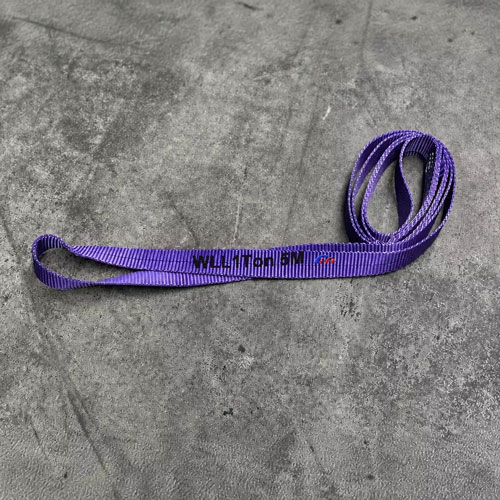
Two facts follow from that, and both of them are about quantity rather than about capacity.
| The fact | What it changes |
|---|---|
| The article is cheap relative to the time it saves | Nobody spends an hour deciding where a small sling is stored, so it gets stored wherever it was put down last. Storage is the first thing that goes wrong with a set, and it is free to fix. |
| The article is cheap relative to the cost of inspecting it | The same examination takes the same time on a one tonne sling as on a ten tonne one, so the inspection cost of a small sling is a larger share of its value. That is an argument for organising the inspection, not for skipping it. |
| It is the right size for jobs that are not lifts | A one tonne band is exactly the size of band that also fits a lashing, a tie, a temporary restraint. It will be used for those, and that is where most of them die (section 4). |
| It is the capacity people buy bigger than they need | A one tonne band looks thin next to a five tonne one, so a buyer who is unsure buys up. That is not a safety problem, it is a handling and hook-fit problem: the bigger band, the bigger eye, the same small load. |
The band itself, its width, its colour, the hitches it may be used in and how it fits a small hook are the subject of the 1 ton endless webbing sling page, and this page does not repeat them. What follows is what changes when there are twenty of them.
2. The set, not the article, is what has to be managed
A single sling is managed by looking at it before you use it. A set is managed by three things that have nothing to do with the band: it has to be identified so that a worn one can be named rather than described, it has to have a place so that the worn one is not the one that happens to be on top, and it has to have a route out so that a rejected article leaves the set instead of going back in the bucket.
| What the set needs | The cheap version | Why the cheap version is enough |
|---|---|---|
| Identification | The maker's marking already does it: the rated capacity per hitch, the material and the length are on the article. Adding one thing — a set number or a month of issue on a tag or a paint mark — is what turns a description into a name. | It is the difference between "one of them is frayed near the eye" and "number four is out". Only the second one can be acted on. |
| A place | A hook or a rail at the point of use, and a bin for the ones waiting to be examined. Both are cheaper than one sling. | Hanging keeps a band off the floor, out of oil and away from the traffic of a yard; and a bin gives the doubtful article somewhere to go that is not back on the hook. |
| A route out | One named person who takes the bin away and disposes of what is in it, with the marking made unreadable before it goes. | A rejected sling with an intact marking is the thing that gets picked up again next month by somebody who was not there when it was rejected. |
| A number | A minimum count at the point of use, so the set is topped up before it runs out. | Running out is what produces the two failure modes nobody plans: using the wrong capacity because it was the one left, and using a sling that was already doubtful because it was the one left. |
3. Where a small sling dies: the four mechanical deaths
Small slings rarely fail from overload. They die mechanically, and the four ways are recognisable at a glance. Knowing which death each mark belongs to is what makes the pre-use check fast enough to actually happen on a one tonne article.
| The death | What it leaves behind | What prevents it |
|---|---|---|
| Dragged | Abrasion along one face, often with a polished look where the band has been pulled across concrete or steel. It appears in the middle of the band far more often than near the eyes. | Carrying it. The whole reason a small sling survives is that it is light enough to carry, and the habit of dragging it is what costs it. |
| Used as a tie | A tight, narrow crease or a set in the band where it has been pulled round a sharp-cornered bundle, and damage localised at that corner. | Keeping a lashing belt for lashing. Section 4 is about the temptation, because banning it without offering the alternative does not work. |
| Left on the load | Cut ends, a partly severed eye, or a band that went into a machine or under a fork truck because it was still wrapped round something. | A rule that is easy to keep: the sling comes off when the load is set down, and the set lives on its hook rather than on the load. |
| Run over, or stored wet | Flattened, glazed or stiff bands; a musty, stained band that has sat in a puddle; contamination that hides the damage underneath it. | The hook or rail from section 2. Storing a textile article off the floor is the single cheapest thing in this whole page. |
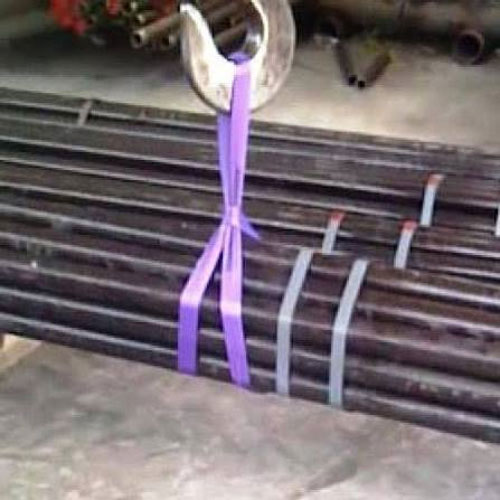
The photograph is the configuration that produces two of those deaths and prevents a third. The band is wrapped round a bundle of tube and taken up to a hook, which is a normal and correct use of a small sling; what matters is that the bundle's cut ends are protected where the band crosses them, that the band is not left on the bundle after the lift, and that the wrap itself is read as what it is — a choked configuration with a different rated capacity from a straight vertical lift. The edge question, and what protection actually changes, is set out on the circular lifting straps page.
4. The tie-down temptation
A one tonne band is the right width, the right length and the right strength to hold a bundle together on a truck, to keep a gate closed, to pull a machine into position. It is also the article that is nearest to hand when somebody needs a tie, because there are twenty of them hanging on a hook. No rule survives that combination on its own; what survives it is having an alternative within arm's reach.
The distinction worth putting in front of the person who is about to do it is not that one use is safe and the other is not. It is that a lifting sling and a lashing are rated and marked for different things, and the moment a sling is used for lashing it stops being a lifting accessory in practice while still looking like one in every respect that matters.
| What is different | A lifting sling | A lashing |
|---|---|---|
| What its figure means | The load it may carry, per hitch, at a stated safety factor | The restraint it can hold against a force that is calculated for the journey |
| What it is built for | Repeated lifts, inspected before each use | Being tensioned once and left tensioned, often in weather and road spray |
| What ends its life | The condition it is in when you pick it up | The rating of the assembly and the tension it has been under |
| What it is not | A restraint | A lifting accessory |
The practical answer is therefore a physical one: keep a few lashing belts of the same width where the slings are kept, and make the rule "the sling is for lifting, and here is the thing that is for tying" rather than "do not use the sling". The economics of a consumable one tonne article are covered on the disposable sling page, and they explain why a site may deliberately buy cheap ones for the rough jobs — but a sling that has been used as a lashing belongs in the set's reject bin afterwards, not back on the hook.
5. What to specify so that a set works
The specification for a set is slightly different from the specification for one sling, because four of the decisions are made once for the whole set rather than per article. They are listed here in the order in which getting them wrong costs the most time.
| The decision | What to settle | Why it is a set decision |
|---|---|---|
| The length | One length for the common lift, and a note of how it is measured, so that a replacement is the same article | A set with three lengths in it will be sorted through every time somebody needs a short one, which is how the wrong one gets used |
| The marking | A marking that survives being handled in bulk and read at arm's length, and the same marking on every article in the set | The rated capacities per hitch and the material have to be legible for the article to be usable at all; on a set, they also have to be comparable at a glance |
| The identity | Whatever number, tag or paint mark the site uses, plus the same treatment across the whole set | It is what turns a found article back into a known article, and what makes the set's record possible |
| The eye size against the hooks in the works | The eye opening against the smallest hook, shackle and pin that will actually be used | An eye that does not sit properly on the hook is the failure that looks like a rigging problem and is really a specification one |
| How many, and the spare | The number at the point of use, plus a spare position that is filled rather than borrowed from | The count is what stops the set being stretched until somebody reaches for a doubtful article |
6. Issuing and returning: the thirty-second check
The pre-use check has to be short enough that a person doing it at the end of a shift does not skip it. On a one tonne band it can be, because the band is small enough to look at in one movement and the four deaths in section 3 are all things the hand finds as quickly as the eye.
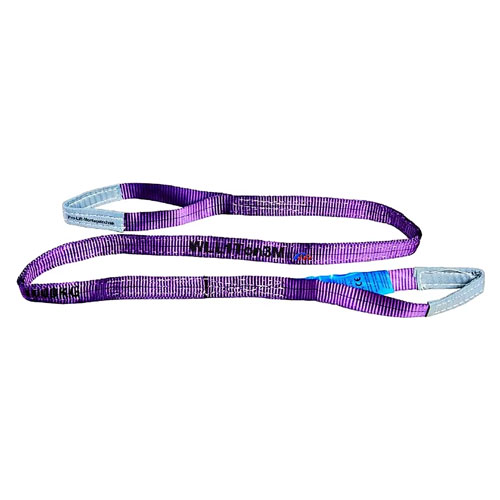
Run the band through the hand, both faces. Abrasion, glazing and stiffness all read through a gloved hand faster than through the eye, and the hand finds the place where a band has been dragged without looking for it.
Look at the two eyes and the stitching. A cut eye, a pulled stitch or a distorted eye is the end of the article, and on a small sling the eye is the part that has been over the smallest hook.
Read the marking. A marking that has become unreadable takes the article out of service by itself, whatever the band looks like.
Feel for contamination and damp. Oil, grit and a wet band are how a textile article is stored badly, and a contaminated band hides the damage it is carrying.
Return it to the hook, not to the floor. The check is only half of the routine; the other half is putting the article where the next person will find it sound.
If any of those five finds something, the article goes in the bin in section 2 and does not go back on the hook. Where the article is repairable, the repair belongs to a sling manufacturer or an equivalent entity and is followed by a proof test to twice the rated capacity, with the certificate kept; temporary repairs are prohibited, and a sling must not be used without affixed and legible identification markings. Those duties, and the wider regime of examination intervals and records that a site runs around them, are set out on the steel plant lifting sling page rather than repeated here.
7. Two units in one name: 1 tonne and 1000 kg
The name of this listing states the same capacity twice, once in tonnes and once in kilograms, and that is useful rather than redundant: it is the pair that tells a buyer the two notations are the same article. What the name still does not state is everything else the order needs.
| The name states | The order still has to add |
|---|---|
| 1 tonne, which is 1000 kg | Nothing; the two notations are the same quantity, and a tonne is 1000 kg exactly. What matters is that the figure is the working load limit for the hitch being used, not a breaking strength. |
| Round webbing sling, flat webbing sling | The length and how it is measured, because two suppliers measure the same nominal length differently and the difference shows up at the first lift. |
| Lifting sling | The width and the ply, which decide how the load is spread and how the band sits in the eye, and which are what a set has to keep consistent. |
| (nothing) | The marking and the certificate, the identity treatment for a set, and how many are wanted. |
One clarification that belongs on this page because the two notations invite it: the kilogram figure on a label is a mass, and the article resists a force. The convention of publishing a limit in kilograms is what lets a sling be compared directly with a weighed load, and it works because the lift is static and the geometry is accounted for separately. Where the angle between legs or a choked configuration is involved, the figure being compared is no longer simply the mass. That subject is treated on the flat webbing sling page. What the order settles once for a whole set instead — the length and how it is measured, the marking, the identity treatment, the eye against the smallest hook, and the spare — is the list in section 5.
8. What a set costs over its life
The honest arithmetic for a small sling is that the article is the cheapest part of owning it. A set of twenty one tonne bands costs less than the time somebody spends over a year looking for them, losing them, inspecting and replacing them. That is worth stating plainly, because it is the argument that funds the three cheap things in section 2.
The article. Bought in quantity, it is a consumable, and the price reflects it.
The time. Looking for a sling that is not where it should be; checking a doubtful one twice; stopping a lift because the right capacity is not on the hook. This is the dominant cost, and it is the one the hook and the count in section 2 remove.
The replacement rate. A set whose members die from dragging, tying and being left on loads has a visible replacement rate. If a site knows that rate, a change in it is information: a rate that doubles after a new process starts is telling you something about the process.
The inspection. The same examination takes the same time whatever the capacity, so on a small article it is a large share of the value. That is an argument for examining in batches at a set level rather than arguing that a cheap sling does not need examining.
9. Frequently asked questions
Q1: Is a 1 tonne sling the same as a 1000 kg sling?
Yes. A tonne is 1000 kg exactly, so the two notations in this listing describe one capacity. The figure is the working load limit for the hitch being used, which is a different thing from the breaking strength behind it.
Q2: Why would a site buy the smallest capacity in quantity?
Because most lifts are light and most light lifts happen often. Buying the capacity in tens means never having to fetch one, which is the whole reason the set exists. The consequence is that the set, not the article, is what needs managing.
Q3: Should a small sling be inspected as carefully as a large one?
Yes, and for a reason that has nothing to do with the capacity: the examination takes the same time either way, so the small article is where the cost of inspecting is a large share of the value. The right answer is to organise the inspection, not to skip it.
Q4: Can I use a 1 tonne sling as a lashing or a tie?
It will fit the job, which is exactly why the temptation exists. But a lifting sling and a lashing are rated for different things, and once a sling has been used as a lashing it belongs in the reject bin rather than back on the hook. The workable rule is to keep a lashing belt where the slings are kept.
Q5: What kills most small slings?
Mechanically rather than by overload: being dragged across a floor, being pulled round a sharp corner as a tie, being left on a load that then gets moved, and being run over or stored wet. All four are visible in the condition of the band, which is what makes the pre-use check worth doing.
Q6: The band looks thin. Should I buy a 2 tonne instead?
Buying up is not a safety problem on a light lift, but it changes the handling: a wider band, a bigger eye and more bulk for the same small load, and an eye that may not sit as well on a small hook. If the eye fits the hooks in the works, the one tonne article is the one the job asked for.
Q7: The sling is wrapped round the load rather than used vertically. Does the capacity change?
Yes. A wrapped sling is in a choked configuration, and the rated capacity for a choke is taken from its own row of the rated table rather than assumed to be a fixed fraction of the vertical figure. This is the most common way a correctly sized small sling is overloaded.
Q8: What is the single cheapest improvement to a set of small slings?
A place to hang them, off the floor, at the point of use. It keeps the bands out of oil and traffic, it makes the set visible so somebody notices when it is short, and it gives the doubtful article somewhere to be put aside instead of back on the hook.
Q9: How do I identify the members of a set?
The maker's marking already carries the rated capacities per hitch and the material. Adding one further mark of your own - a set number, a tag, or the month of issue - is enough to turn a description into a name, which is what a record needs.
Q10: Can a damaged sling be repaired?
By a sling manufacturer or an equivalent entity, followed by a proof test to twice the rated capacity with the certificate kept; the rule as it applies to a small article is stated in section 6. Temporary repairs are prohibited, and stitching is not a task for the user. An article that has been stitched by somebody else has no rating anybody can rely on.
Contact
Tell us how many you need, the length and how you measure it, the width and ply you want kept consistent across the set, and the smallest hook or shackle the eyes have to sit on. We will supply the marking per hitch, the certificates that identify each article, and the same specification repeated across the set so that a replacement is the same article as the one it replaces.
Telephone and WeChat — 18066002268
E-mail — 702461526@qq.com
Address — Lifute Industrial Park, Taizhou City, Jiangsu Province, China
HS code — 630790
- Previous:5Ton Webbing Sling
- Next:Disposable Pre-Slung Cargo Sling
-
Drone Anti-collision Net
-
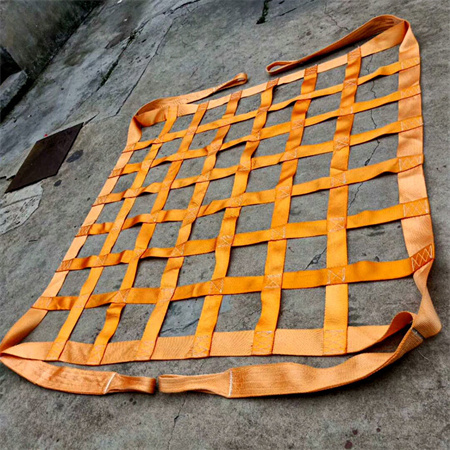
Extra Large Capacity Cargo Net
-
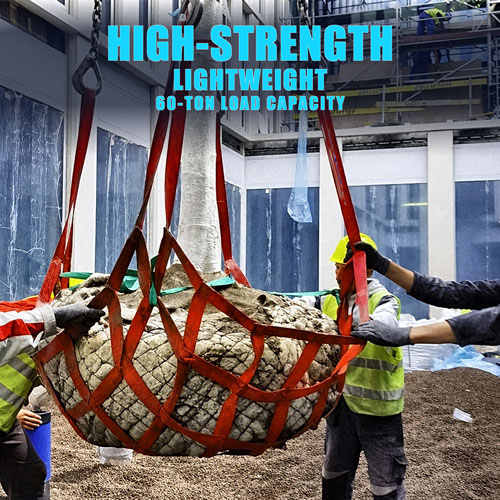
Cargo Webbing Net
-

Color changing nylon double buckle loop nylon braided rope
-

Two end buckle lifting rope, double buckle round lifting rope, double fork nylon lifting rope, non jointed nylon lifting rope
-

Emergency escape lifeline, fire escape rope, fire safety escape emergency rope, steel wire core fire rope

