 Language
 简体中文
简体中文
- On the 2018 National Day holiday, Lifet completed six 100 ton large tonnage lifting belts as a gift
- The role of suspension net in the transportation of goods turnover
- Cargo soft lifting net, lifting net, lifting net, lifting net, bag, climbing net
- Precautions for using Lifutiden elevator
- How to make circular lifting straps
Contact: Wang Lili
E-mail:18066002268
Phone:702461526@qq.com
Address: Lifute Industrial Park, Taizhou City, Jiangsu Province
Lifute Hoisting Co., Ltd. 18066002268 produces lifting belts, lifting nets, nylon ropes, soft ladders, steel wire rope rigging, paper ropes, safety belts, safety nets, lifting chains, steel coil hoists, crossbeam hoists, flat lifting belts, circular lifting belts, electric traction ropes, high-altitude safety belts, and anti fall safety nets
Hits: ℃
Release time:2026-09-24 15:16
Lift Sling Rigging Co., Ltd. +8618066002268 produce Disposable polyester lifting ring, circular sling, circular sling, nylon lifting rope
Disposable Polyester or Nylon Circular Sling: One Name, Two Fibres, and the Conditions That Choose Between Them
1. One name, three articles, two fibres
The name of this listing puts four phrases together: a disposable polyester lifting ring, a circular sling named twice, and a nylon lifting rope. Only one of those four is a question about the article itself. The rest is a question about which article you are ordering at all.
| The phrase | What it actually describes | Is it a different article? |
|---|---|---|
| Disposable polyester lifting ring | A circular sling bought to make one trip and not come back: an endless band, no eyes, no fittings to inspect, and no better reason to retrieve it than to abandon it. | This is the main article on the page. |
| Circular sling (named twice) | The same article under its everyday name. How the band is built, whether it is a woven tube, a seamed one, or a sleeve over a core, is a separate subject, and it is dealt with on the circular sling page rather than here. | No. It is the article above, described a second time. |
| Nylon lifting rope | A rope rather than a band — strands laid or braided into a line, terminated with a splice or a knot rather than closed into a loop. It is a different article, made on different equipment, and it has its own page. | Yes. If the answer you need is a rope, this is not the page to buy from; see the nylon lifting rope page. |
| Polyester, and nylon | Two different fibres, with opposite chemical profiles and a threefold difference in stretch between them. This one is a real question, and it is what the rest of this page answers. | Yes, and it is the decision that most often gets made by accident. |
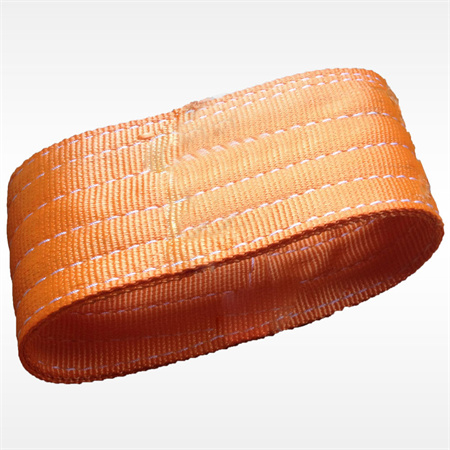
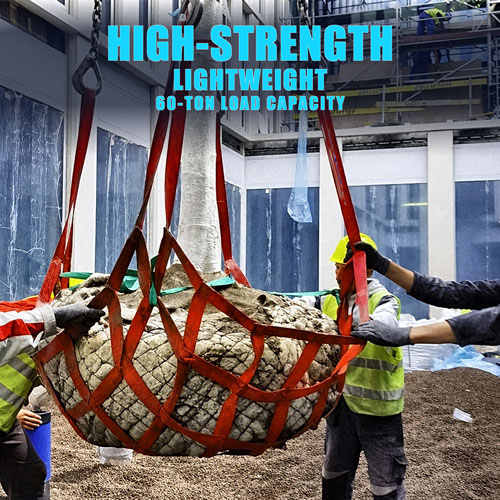
The photograph is the form this listing sells: an endless loop of woven webbing, the band closed on itself so that there is no eye to feed onto a hook and no fitting to lose, with the stitching running along its length. Two things about it are worth pointing out before anything else, because both of them are decided before the sling is made.
First, the band has no ends, so it has no weak point at an eye, but it also has no fixed pick-up point. That means the part of the band doing the work can be moved and the wear spread along the whole loop. It is the property that makes a circular sling last in a choker hitch, and it is why this form suits a one-way lift in the first place.
Second, and less obviously: the colour is the capacity. It is not the fibre, and it is not a quality grade. Under the EN 1492 colour system that a product of this kind is organised to, the band colour carries the working load limit, and orange, as in the photograph, is the colour that system reserves for the 10 t class and above. The colour has to be read together with the label rather than instead of it, and section 1 has already separated the three articles the name lists. What follows is the distinction between colour and fibre, because confusing the two is the most common way a buyer ends up with the wrong material.
2. The colour band states the capacity, and never the fibre
It is worth being blunt about this, because the intuition runs the other way. Two slings of the same colour, the same size and the same rating can be made of different fibres, and the published ratings say so: a green polyester sling and a green nylon sling carry the same rated capacity, dry and at room temperature. Colour is a capacity code, and it is deliberately blind to material.
| What the band tells you | What it does not |
|---|---|
| The class of the working load limit, which is why a colour-coded store room can be worked in without opening a label | Whether the band is polyester or nylon, because the two fibres share the code |
| That the article was made to a defined colour and safety-factor system, the EN 1492 series on a product of this class | Which environment the band may be used in, because that follows from the fibre |
| That the article exists in a graded range, so the next capacity up is recognisable at a glance | Anything at all about the band's condition, which is what the pre-use check is for |
So the only place the fibre is stated is the marking, and the marking is therefore the thing to read when the order is placed and again when the article arrives. How the colour system itself is laid out, and what to do about a sling whose colour is not in the table, is the subject of the circular lifting straps page. The point this page needs from it is narrower: colour answers the capacity question and leaves the material question open.
There is a second reason the fibre has to come off the label rather than out of the colour, and it is a practical one for a disposable article. A band that is going to be used hard and left behind will be read by people who did not buy it. If the fibre exists only in the buyer's memory, the person at the far end has a band of unknown material and a set of conditions that may contradict it. The marking is what travels with the load; the colour is only what holds it up.
3. Polyester and nylon side by side, in the figures that are published
The two fibres are best compared on the numbers rather than on adjectives, because every one of these figures is checkable and every one of them changes a decision. The stretch figures are the ones the material-selection literature publishes at rated capacity, and the chemical and temperature figures come from the standard industry guidance for synthetic slings.
| At rated capacity | Polyester | Nylon |
|---|---|---|
| Stretch under load | About 3 per cent | About 8 to 10 per cent, roughly three times as much |
| What that stretch is for | Nothing; it is the price of stiffness. It gives load control, so a load does not drift or bounce while it is being set | Absorbing shock. The elongation cushions sudden stops and dynamic lifts, and reduces the peak force the load and the crane feel |
| Water | Does not absorb water to any significant degree and dries quickly; it does not become heavy when rained on | Absorbs and retains moisture, gains weight and stretches further when saturated. How much capacity that costs is the one figure the sources disagree on — see the note below |
| Acids | Good. Suitable for acidic environments — battery areas, pickling lines, acidic cutting fluids | Poor, and this is a rule rather than a preference: nylon web slings are not to be used where acid or phenolic fumes, vapours, sprays, mists or liquids are present |
| Alkalis | Poor against strong alkalis, and degraded by them at raised temperature. The same rule applies in reverse: polyester slings are not to be used where caustics are present | Good. This is why nylon is the fibre that survives uncured concrete, cement dust and high-pH floor cleaners |
| Sunlight | Better of the two, and it keeps its strength longer outdoors. It still degrades, so outdoor storage is still a retirement consideration | Degrades markedly faster in sunlight, showing discolouration, hardening and loss of flexibility earlier in service |
| Heat | Melting point around 250 degrees C (about 480 degrees F) | Melting point around 212 degrees C (about 414 degrees F), so it is the more heat-sensitive of the two |
| Where capacity has to be reduced | Derating begins at 82 degrees C (180 degrees F) for both fibres; the standard requires the manufacturer's chart below that ceiling | The same 82 degrees C starting point, with a lower melting point behind it |
| Conductivity when wet | Remains non-conductive | Can conduct, because it holds the moisture that makes it conductive. The non-conductive property of a synthetic sling is only true while it is clean and dry |
The one figure the sources disagree on. On how much capacity nylon loses when saturated, the published positions do not match. One widely used rigging reference puts the loss at 10 to 15 per cent and says a wet nylon sling must be derated for the lift; a major distributor states the opposite, that retained moisture adds stretch but does not affect capacity. Both agree on the part that matters operationally: the capacity tag lists the working load limit for the dry condition, and manufacturer documentation governs the wet case. So the honest instruction to a buyer is not a number. It is: if the sling is going to be wet, either take the figure from the maker of the sling in your hand, or remove the question by taking polyester.
Two other figures are worth carrying into a store room, because they apply to both fibres and they are what actually retires a sling, which is the subject of section 5. Capacity has to be derated from 82 degrees C. And the temperature ceiling that the guidance gives for round slings, 90 degrees C (194 degrees F), is higher than the 82 degrees C (180 degrees F) ceiling that applies to synthetic web slings — so the same two fibres have two different published ceilings depending on which form the rule is written for. Neither number is a comfortable working temperature; both are limits.
4. Which one your site selects: four conditions
Reduced to practice, the choice is made by four conditions, and in most works only one of them is actually in dispute. Read them in this order, because the first that applies settles the answer, and the figures behind them are the ones section 3 set out side by side.
| The condition | The fibre it selects | Why |
|---|---|---|
| 1. Something chemically active on the load or the floor | Acid or phenolic, polyester. Caustic or strongly alkaline, nylon. Mixed, neither of these | This is the only condition that is written as a prohibition rather than a preference, so it is checked first. A chemical burn is also an immediate removal criterion, so getting it wrong does not degrade the sling gracefully |
| 2. Water, or the open air | Polyester | It does not absorb water, so it neither loses capacity, gains weight, nor holds the moisture that makes a band conductive. It is also the more UV-stable of the two, and outdoor storage is normal for a sling that is not coming back |
| 3. A dynamic lift, or a load that must not move | Nylon for shock absorption. Polyester where the load has to arrive precisely, or where there is no headroom for 8 to 10 per cent of stretch | Stretch is the whole difference here, and it cuts both ways: the same elongation that cushions a sudden stop is the elongation that lets a load drift while it is being set, or bounce under a low beam |
| 4. None of the above | Either — so let stock and price decide, and write the answer down | Neutral, dry, indoor and static is the case where the two fibres genuinely do not differ for the job. It is also the case where the fibre gets chosen by accident, and the accident is then carried into a job where it matters |
The fourth row is the one that needs a warning attached, because it is the row most orders fall into. A sling chosen because it was the one in the stores is fine until it is taken somewhere else, and a disposable article is precisely the article that travels: it is bought cheaply, used away from the person who bought it, and not brought back. Whatever was decided in the store room is therefore the specification for every lift it makes. Writing the fibre down, on the order and on the marking, is what stops a decision made for convenience from being applied to a job that contradicts it.
5. What ends a sling's life, and which ending arrives first for each fibre
A disposable sling is not a sling that has been excused the rules; it is a sling whose owner has already decided not to bring it back. What retires it is the same list either way, and the list is where the fibre choice shows up a second time — because the fibre decides which entry on the list arrives first.
| What retires it | Which fibre gets there first | What it looks like |
|---|---|---|
| The marking becomes illegible or comes off | Neither — this one is a race against dirt in both cases | A missing or unreadable identification is an immediate removal criterion on its own, whatever the band underneath looks like. It is also the entry that retires more serviceable bands than any other |
| Permanent elongation beyond 5 per cent | Nylon, by a wide margin | The band is measurably longer than it was, which on a life of 8 to 10 per cent stretch under every lift is a much shorter route than on a band that begins at 3 |
| Brittle or discoloured fibres from sunlight | Nylon, and much sooner | Hardened, discoloured cover that cracks when flexed. On a covered sling the outer fibres are attacked first, so the damage is on the surface before it is in the core |
| Chemical burns | Whichever one met the chemical it cannot take — nylon in acid, polyester in caustic | Localised discolouration, stiffness or a change in texture where the band touched the substance. Both are immediate removal criteria |
| Cuts, snags or broken stitching exposing the core | Neither — a property of the cover and of the edge it met | Damage you can see through to what is carrying the load. The edge rules that produce it are on the circular lifting straps page |
| Heat damage, melting or charring | Nylon, whose melting point is about 38 degrees C lower | Glazing, hardening or a scorched patch. Both fibres are out of their depth long before either melts, which is why the derating point matters more than the melting point |
Read down that third column and the practical consequence for a disposable article is plain. Which of the four conditions put the band on this job in the first place is section 4; this section is what happens to it afterwards. On a wet, outdoor, sunny job, a nylon band does not fail more dangerously than a polyester one; it simply arrives at three or four of those criteria sooner, and a sling that retires early is a sling that is not there for the lift it was bought for. The wear-out rate is the specification, not an afterthought.
Two duties go with the list and are not affected by the fibre. Anything that has been repaired goes back into service only after a proof test to twice the rated capacity with the certificate kept, and temporary repairs are prohibited. And a sling must not be put to work without affixed and legible identification markings. The wider regime of examination intervals, competent persons and records that a site runs around those duties is set out on the steel plant lifting sling page, and the economics of buying an article that will not return, including when the one-way trip is the cheaper answer, are on the disposable sling page.
6. What the word "disposable" leaves off the order form
There is a recognisable pattern in what gets omitted when a sling is bought to be left behind. The four omissions below are the ones worth putting a line against, because each of them is a decision that gets made by default rather than by the buyer. They are the same four questions section 2 raised about the label and section 4 raised about the site, asked once more at the point where the order is written.
| Usually left off | What fills the gap if it is not stated |
|---|---|
| The fibre | Whichever the supplier has in stock, because the name of the listing offers both and neither is wrong on its face |
| The colour, or rather the capacity class | The colour of the photograph, which may be a different class from the one the job needs. The colour and the letter of the rating should appear on the order together |
| The length and how it is measured | The supplier's own convention. On an endless band the difference between the inside circumference and the laid-flat length is a real gap, and it shows up at the first lift |
| The marking and the certificate | Whatever the maker's standard marking is, which may not name the material in the language or the format the receiving site reads |
None of those four is expensive to state. Stated together, they turn a listing that offers two fibres and two forms into an order for one article, and they are the reason a replacement delivered six months later is the same article as the one it replaces rather than a plausible neighbour of it.
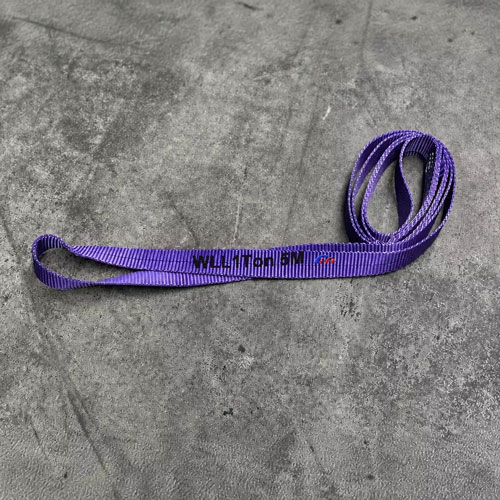
The two photographs on this page are the whole argument in one picture. The orange band above and the violet band here are two colours, because they are two capacity classes; and neither colour tells you which fibre the band is made of. That is not a shortcoming of the photograph — it is the state of the code itself, and it is the reason this page is organised the way it is: colour apart from fibre, fibre apart from condition, and the marking over all three, and it is why the material has to be read from the marking, from the order, and from the certificate rather than inferred from what you can see.
7. Frequently asked questions
Q1: Does this listing sell polyester or nylon?
Both names are in the title, and the two are different fibres rather than synonyms. Tell us which environment the sling will work in — acid or alkali, wet or dry, indoor or in the sun, static or shock-loaded — and the fibre follows from that. If you do not tell us, we will ask.
Q2: The colour is the same. How do I know which fibre I have been sent?
From the marking, because the colour code is blind to material: a sling of a given colour carries the same rated capacity whether it is polyester or nylon. If the marking does not state the material, treat the fibre as unknown and do not put the band into a job where the fibre decides the outcome.
Q3: How much does nylon stretch, and does it matter?
Published figures put nylon at roughly 8 to 10 per cent at rated capacity against about 3 per cent for polyester. It matters in both directions: that elongation absorbs a shock load, and it also lets a load drift while it is being positioned or bounce under a low beam. Stretch is a specification, not a quality.
Q4: Can a nylon sling be used in the rain?
It can, but it is the wrong choice for a wet site. Nylon absorbs water, becomes heavier, stretches further when saturated, and can conduct electricity once it is holding moisture. Published figures also disagree on how much capacity saturation costs, so on a wet job the simpler answer is polyester.
Q5: And a polyester sling near concrete?
Care is needed. Polyester is the fibre that acids do not trouble, and it is the fibre that strong alkalis attack, so uncured concrete, cement dust and high-pH cleaners are against it. Nylon is the one that is at home in that environment. Both statements are written as prohibitions in the industry guidance rather than as preferences.
Q6: For a lift that will not come back, which fibre is the better buy?
Whichever one the site conditions select, and only then the cheaper of the two. Buying nylon for a wet outdoor trip because it costs less is a false economy: the band arrives at its elongation, UV and marking limits sooner, so it retires before it has earned its price. The order of the decision is conditions first, price second.
Q7: Is a circular sling the same thing as a round sling?
The two names are used for the same family of endless band, and this page uses them interchangeably, as section 1 notes. What actually differs is how the band is built, whether it is a woven tube, a seamed band, or a sleeve over a separate load-bearing core, and that is a subject in its own right rather than a naming question.
Q8: The title also mentions a nylon lifting rope. Is that this product?
No. A rope and an endless band are different articles made on different equipment, and a rope is terminated by a splice or a knot rather than closed into a loop. If what you need is a rope, ask for the rope; the listing groups them because they are used side by side, not because they are the same thing.
Q9: What temperature can one of these take?
The capacity begins to be derated at 82 degrees C (180 degrees F) for both fibres, and the ceiling published for round slings is 90 degrees C (194 degrees F), below minus 40 degrees C at the other end. Melting points are far higher and irrelevant to the decision: about 250 degrees C for polyester and about 212 degrees C for nylon.
Q10: What actually retires one of these slings?
An unreadable or missing marking, permanent elongation beyond 5 per cent, brittle or discoloured fibres from sunlight, chemical burns, cuts or snags that expose the core, broken load-bearing stitching, or heat damage. The fibre does not change the list; it decides which entry on it arrives first.
Contact
Tell us the environment before you tell us the price. Acid or alkali, wet or dry, indoor or in the sun, static or shock-loaded: those four answers select the fibre, and the capacity class, the length and how you measure it, and the marking you need to read at the far end are settled from there. We supply both fibres on the same endless form, marked per hitch, with the certificates that identify each article.
Telephone and WeChat — 18066002268
E-mail — 702461526@qq.com
Address — Lifute Industrial Park, Taizhou City, Jiangsu Province, China
HS code — 630790
- Previous:Disposable cargo sling, steel pipe sling, matching lifting rope, loading and unloading sling for transportation
- Next:Steel plant lifting threaded steel disposable export lifting
-
Drone Anti-collision Net
-
Extra Large Capacity Cargo Net
-
Cargo Webbing Net
-

Color changing nylon double buckle loop nylon braided rope
-

Two end buckle lifting rope, double buckle round lifting rope, double fork nylon lifting rope, non jointed nylon lifting rope
-

Emergency escape lifeline, fire escape rope, fire safety escape emergency rope, steel wire core fire rope

