 Language
 简体中文
简体中文
- On the 2018 National Day holiday, Lifet completed six 100 ton large tonnage lifting belts as a gift
- The role of suspension net in the transportation of goods turnover
- Cargo soft lifting net, lifting net, lifting net, lifting net, bag, climbing net
- Precautions for using Lifutiden elevator
- How to make circular lifting straps
Contact: Wang Lili
E-mail:18066002268
Phone:702461526@qq.com
Address: Lifute Industrial Park, Taizhou City, Jiangsu Province

Lifute Hoisting Co., Ltd. 18066002268 produces lifting belts, lifting nets, nylon ropes, soft ladders, steel wire rope rigging, paper ropes, safety belts, safety nets, lifting chains, steel coil hoists, crossbeam hoists, flat lifting belts, circular lifting belts, electric traction ropes, high-altitude safety belts, and anti fall safety nets Hand woven nylon lifting rope, seamless nylon lifting rope. Lift Sling Rigging Co., Ltd manufactures this rope against the tension table printed on the page: thirty-two diameter rows from 3 mm to 100 mm, and for each row an ultimate tensile strength and a use tension given separately for polyester fiber, for Vinylon and for a third fibre group. The two words in the name are treated as two separate questions.
Hits: ℃
Release time:2026-09-29 10:57
Lift Sling Rigging Co., Ltd manufactures Hand woven nylon lifting rope, seamless nylon lifting rope — one name, and a range that runs from three millimetres to one hundred. That range is the subjec t of this page. The two words in the name do not mean the same thing at Φ5-6 as they do at Φ59-60, and the tension table printed on this page says so before anyone argues it: its own rows stop steppin g two millimetres at a time after Φ59-60, and the last three rows cover ten millimetres, five millimetres and then a single diameter. A table that changes how finely it divides the range is telling yo u the article itself changes across it. This page follows that change, band by band, and places the two words in the name at the sizes where they actually do work.
Hand Woven Nylon Lifting Rope, Seamless Nylon Lifting Rope — One Name Across Thirty-Two Sizes, and Four Places Where the Article Changes
1. Five Bands, Thirty-Two Rows, and Four Changes of Character
The customer's own table gives thirty-two diameter rows. Laid out in order they fall into five bands, and the boundaries between them are not arbitrary: they are where something about the article s tops being true.
| Band | Rows | Ultimate strength, first fibre group, from the low end of the band to the high end | What the article is at this scale |
|---|---|---|---|
| Φ3-4 to Φ7-8 | 3 | 0.28 to 0.80 T | A hand tool. A line a person carries, ties and pulls. Nothing on it is engineered. |
| Φ9-10 to Φ13-14 | 3 | 1.1 to 2.5 T | The point where the end starts to matter more than the body: it is now attached, not held. |
| Φ15-16 to Φ31-32 | 9 | 3 to 11.5 T | The working range of this product. Most orders land here and most of the specification is decided here. |
| Φ33-34 to Φ59-60 | 14 | 12 to 31 T | An article that no longer behaves like a coil of rope. Handling, and the end, overtake the body. |
| Φ70-80 to Φ100 | 3 | 45.5 to 60.5 T | Three bands rather than steps, and an engineered article: the end is designed, not improvised. |
Read the third column downward and the shape of the product appears. The strength grows roughly fortyfold from the bottom band to the top, but the number of decisions a buyer has to make grows fast er than that, because the decisions move from the body of the rope to the places where it is joined. That is the single most useful thing this page can say about the range, and every section below is one band of it.
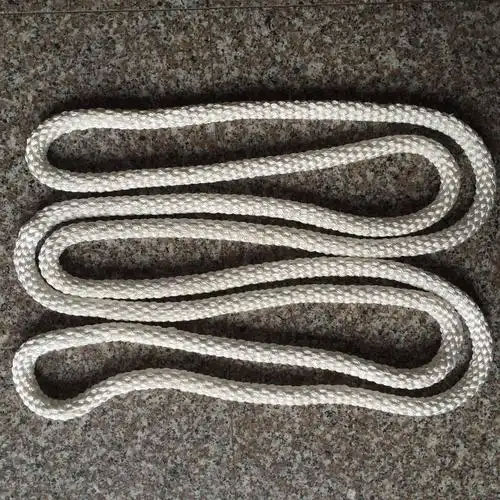
2. Φ3-4 to Φ7-8: the Range Where the Rope Is a Hand Tool
Three rows, and the first group's ultimate strength runs 0.28, 0.50 and 0.80 tonnes. These are figures a person produces without machinery, and the article at this size is used the way a line is us ed: it is carried in the hand, passed through something, tied off, pulled, and coiled again.
Two consequences follow from that, and they explain why a page about a lifting rope has to start here.
| What is true here | Why it matters to the order |
|---|---|
| The end is not a piece of engineering. A line this size is finished by a return and a tuck, or by a knot tied by the user, and the figure in the table is about the rope rather than about the join. | At these three rows, an order that specifies only a diameter, a length and a fibre has specified everything that matters. Aski ng for a rated end at Φ3-4 is asking for something the table does not describe. |
| Both words in the product name are doing very little. Below Φ7-8 nobody distinguishes a hand-finished end from any other end, because there is nothing to distinguish. | The name is quoted as it stands and the two words are not the deciding factor. This is the one part of the range where that is true. |
The third thing worth saying about this band is what is not in it. The table's smallest row is Φ3-4, so a buyer who wants a two-millimetre line has no printed row to read, and the correct answer to that question is that the table does not cover it rather than a figure derived by scaling down the Φ3-4 row.
3. Φ9-10 to Φ13-14: Where the Rope Stops Being Held and Starts Being Attached
The second band is three rows and the first group runs 1.1, 1.6 and 2.5 tonnes. Nothing about the construction changes at Φ9-10; what changes is the way the article is used. A line at this size is long enough and strong enough that a person stops holding it and starts attaching it — to a load, to a structure, to another line.
That single shift moves the whole specification. Once the rope is attached, the end is the place where the load is transferred, and the end is the one part of the article the tension table says not hing about. The table gives the strength of the rope; it does not give the strength of a join, and at Φ9-10 the join has become the thing the buyer is really choosing.
| Row | First group, ultimate strength | What has to be said on the order that was not needed one band down |
|---|---|---|
| Φ9-10 | 1.1 T | The end form. This is the first row at which leaving the ends unspecified leaves a real question open. |
| Φ11-12 | 1.6 T | Which side is attached to what — because the two ends of one rope rarely take the same form. |
| Φ13-14 | 2.5 T | Whether the rope is the deliverable, or a finished article with a rating of its own is. |
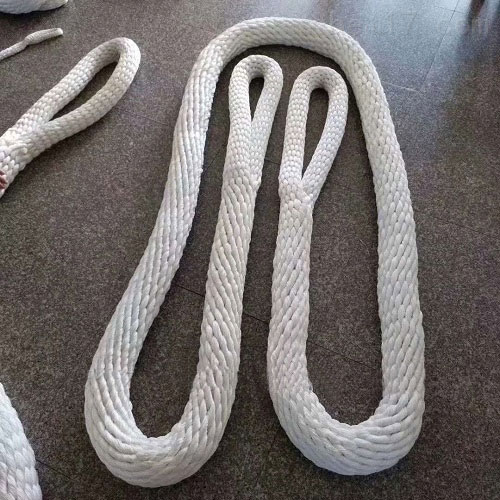
4. Φ15-16 to Φ31-32: the Working Range of This Product
Nine consecutive rows, from 3 tonnes to 11.5 tonnes in the first group, and this is where most orders for this product will land. It is also the band in which the specification is most completely d ecided, because everything that affects the article is now in play at once: the fibre, the diameter, the length, and both ends.
| Row | First group | Polyester group | Vinylon group |
|---|---|---|---|
| Φ15-16 | 3 T | 2.8 T | 1.5 T |
| Φ21-22 | 5.8 T | 5.2 T | 2.9 T |
| Φ27-28 | 9 T | 8.4 T | 4.5 T |
| Φ31-32 | 11.5 T | 10.8 T | 5.7 T |
The four rows above are a sample, not the band: all nine rows from Φ15-16 to Φ31-32 are in the parameter table printed on this page. What they show is the one design decision that the name in the t itle cannot settle, and cannot even hint at. At every row, three different figures are available for the same diameter, and they are not close to each other: at Φ31-32 the third group offers 5.7 tonne s where the first offers 11.5, a factor of two. So in the working range the fibre is not a preference, it is the first line of the specification — and because the table's first group is not named in i ts own header, that line has to be written by the buyer rather than read off the column.
The provider's own tension table is restated below in full. It is not an illustration of a point made elsewhere on this page: it is the evidence for the five bands, because the bands are the table' s own way of dividing the range. Every figure is unchanged, and the column heads are the ones the source gives.
| Diameter (mm) | Fibre group 1, not named in the source table | polyester fiber | Vinylon | |||
|---|---|---|---|---|---|---|
| Ultimate tensile strength (T) | Use tension (T) | Ultimate tensile strength (T) | Use tension (T) | Ultimate tensile strength (T) | Use tension (T) | |
| Φ3-4 | 0.28 | 0.07 | 0.25 | 0.06 | 0.14 | 0.04 |
| Φ5-6 | 0.50 | 0.13 | 0.48 | 0.12 | 0.25 | 0.06 |
| Φ7-8 | 0.80 | 0.20 | 0.75 | 0.19 | 0.40 | 0.10 |
| Φ9-10 | 1.1 | 0.28 | 1.04 | 0.26 | 0.55 | 0.14 |
| Φ11-12 | 1.6 | 0.40 | 1.45 | 0.37 | 0.8 | 0.20 |
| Φ13-14 | 2.5 | 0.63 | 2.3 | 0.58 | 1.25 | 0.31 |
| Φ15-16 | 3 | 0.75 | 2.8 | 0.7 | 1.5 | 0.4 |
| Φ17-18 | 3.7 | 0.93 | 3.4 | 0.86 | 1.85 | 0.46 |
| Φ19-20 | 4.8 | 1.2 | 4.4 | 1.1 | 2.4 | 0.6 |
| Φ21-22 | 5.8 | 1.5 | 5.2 | 1.3 | 2.9 | 0.72 |
| Φ23-24 | 7 | 1.8 | 6.4 | 1.6 | 3.5 | 0.87 |
| Φ25-26 | 8 | 2 | 7.6 | 1.9 | 4 | 1 |
| Φ27-28 | 9 | 2.2 | 8.4 | 2.1 | 4.5 | 1.1 |
| Φ29-30 | 10.1 | 2.5 | 9.6 | 2.4 | 5 | 1.25 |
| Φ31-32 | 11.5 | 2.9 | 10.8 | 2.7 | 5.7 | 1.4 |
| Φ33-34 | 12 | 3 | 11.2 | 2.8 | 6 | 1.5 |
| Φ35-36 | 14 | 3.5 | 13.2 | 3.3 | 7 | 1.7 |
| Φ37-38 | 16 | 4 | 14.8 | 3.7 | 8 | 2 |
| Φ39-40 | 17.5 | 4.4 | 16.4 | 4.1 | 8.8 | 2.2 |
| Φ41-42 | 19 | 4.7 | 17.6 | 4.4 | 9.5 | 2.4 |
| Φ43-44 | 20 | 5 | 18.8 | 4.7 | 10 | 2.5 |
| Φ45-46 | 22 | 5.5 | 20.4 | 5.1 | 11 | 2.75 |
| Φ47-48 | 23 | 5.7 | 21.2 | 5.3 | 11.5 | 2.9 |
| Φ49-50 | 25 | 6.3 | 23.2 | 5.8 | 12.5 | 3.1 |
| Φ51-52 | 26 | 6.5 | 24.4 | 6.1 | 13 | 3.3 |
| Φ53-54 | 27.5 | 6.9 | 25.6 | 6.4 | 13.7 | 3.4 |
| Φ55-56 | 29 | 7.3 | 26.8 | 6.7 | 14.5 | 3.6 |
| Φ57-58 | 30 | 7.5 | 28 | 7 | 15 | 3.7 |
| Φ59-60 | 31 | 7.8 | 28.8 | 7.2 | 15.5 | 3.9 |
| Φ70-80 | 45.5 | 12.5 | 40.5 | 9.2 | 20.2 | 4.5 |
| Φ90-95 | 55 | 14.2 | 45.5 | 10.2 | 25.5 | 5.5 |
| Φ100 | 60.5 | 16.5 | 50.4 | 12 | 30.5 | 6 |
5. Φ33-34 to Φ59-60: Where the Rope Outgrows the Coil
Fourteen consecutive rows, and the longest band in the table: from 12 tonnes at Φ33-34 to 31 tonnes at Φ59-60 in the first group. Two-millimetre stepping still holds all the way up to Φ59-60, which is the table saying that this part of the range is still quoted in the same way as the bottom of it. What changes is not how the article is specified; it is what the article does to the people and th e equipment around it.
| What changes in this band | Why the order notices |
|---|---|
| Length stops being free. The table gives strength per row and says nothing about length, but a rope at the top of this band is heavy enough per metre that the length quoted is a handling decision as much as a reach decision. | State whether the length is per piece or in total, because at this size the two produce very different coils and very differen t numbers of ends. |
| The end is now the largest single item of work on the article. A return that has to be tucked and covered at Φ59-60 is a piece of work in its own right, and it is the part of the article the table cannot describe. | Describe each end separately, with its form and the length of the eye or tail, and say whether the returned part is covered. |
| The coil becomes an object. A rope at Φ59-60 arrives as a bundle that has to be moved, stored and lifted into place before it does any work. | Packing and marking come onto the order at this point rather than at the end of the enquiry. |
6. Φ70-80 to Φ100: Three Rows, Three Bands, and a Change of Character
The table's last three rows are different in kind from the twenty-nine before them. Φ70-80 covers ten millimetres of the range, Φ90-95 covers five, and Φ100 is a single diameter. The stepping has s topped. A buyer who has been reading this table one two-millimetre row at a time reaches the top of it and finds that the last three lines are territories rather than points.
| Row | First group | Second group, polyester fiber | Third group, Vinylon | Span the row covers |
|---|---|---|---|---|
| Φ70-80 | 45.5 T | 40.5 T | 20.2 T | Ten millimetres |
| Φ90-95 | 55 T | 45.5 T | 25.5 T | Five millimetres |
| Φ100 | 60.5 T | 50.4 T | 30.5 T | One diameter |
Two things about the top band deserve to be said plainly, because both of them are places where a reader is likely to assume rather than read.
The row is the answer. A question about a diameter of eighty-five millimetres has no printed row of its own anywhere in this table. It falls inside Φ70-80 in the sense that it is not Φ90-95 and not Φ100, but the figure for Φ70-80 is the figure for the band, and there is no printed figure for eighty-five. The honest form of the answer is to quote the band and say which band it is.< /p>
The habit of dividing by four is least reliable here. Across the whole table the ratio of ultimate strength to use tension clusters on four, and in the polyester group it sits exactly on four in twenty-four of the thirty-two rows. At Φ100 the Vinylon group's ratio is 5.08, the highest in the table, and the first group's lowest ratio in the whole table, 3.64, is at Φ70-80. The two columns separate most at the sizes where the consequences of a wrong number are largest, so at the top of the table the printed use tension should be used and nothing should be recomputed from it.
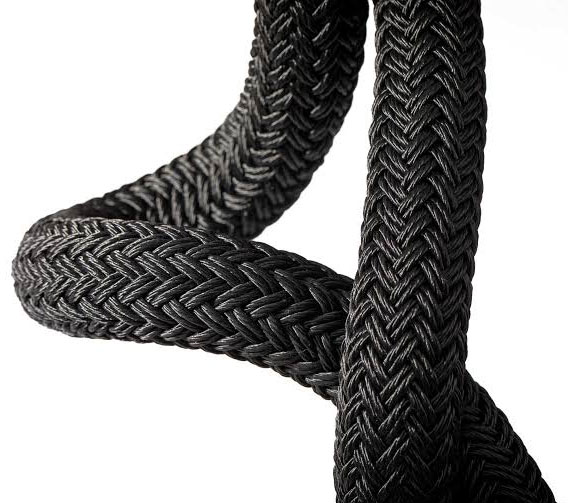
7. The Fibre Question, at Every One of Those Sizes
One thread runs through all five bands and does not change: at every row there are three figures for the same diameter, and the article is defined as much by which column was read as by which row. The column, not the diameter, is what the two buyers who ask for the same thing most often disagree about without knowing it.
| What the table says about the columns | What follows for an order at any size |
|---|---|
| There are three groups and only two of them are named: the second reads polyester fiber, the third reads Vinylon< /em>, and the first group's head cell repeats the words Diameter tolerance, which is the label of the left-hand column. | The fibre is a line the buyer writes, not a column the buyer can point at. Until the header is corrected, name the fibre in wo rds and give the figure with it. |
| The unnamed group is the strongest of the three at every one of the thirty-two rows: about 1.04 to 1.21 times the polyester gr oup and about 1.98 to 2.25 times the Vinylon group. | The ordering — strongest, middle, lowest — is stable across the whole range, so a buyer who knows which column is which can co mpare any two rows directly. |
| The proportions between the groups are not fixed: the polyester group runs from 0.83 to 0.96 of the unnamed group across the r ange, and the Vinylon group from 0.44 to 0.50 of it. | A figure for one fibre cannot be converted into a figure for another by proportion. If the required fibre has no printed row f or the required diameter, the answer is that it has no printed row. |
The page names nylon in its title, and the strength ordering across the three groups is the ordering that nylon, polyester and Vinylon normally take. That is consistent with the unnamed gr oup being the nylon one. It is also an inference from the figures and not a statement in the table, and this page keeps the two apart: the inference is offered, the table is quoted.
8. What Changes Across the Range, and What Does Not
Putting the five bands together produces a short list of things that are true at every size and a shorter list of things that are true only above a certain one. Both lists are worth having, because an order written from the wrong one is either too vague at the top or unnecessarily complicated at the bottom.
| True at every size, from Φ3-4 to Φ100 | True only from a certain size upward |
|---|---|
| A diameter is a printed row, never a computed one. The table has thirty-two of them and no formula. | From Φ9-10 upward, the end is a decision. Below it, the end is a way of finishing the line. |
| The two strength columns are not linked by one constant, in any group. Take the printed figure. | From Φ15-16 upward, the fibre column is the first line of the specification, as the spread between the three groups is too wid e to be a preference. |
| The fibre has to be named, because one of the three columns has no name in the header. | From Φ33-34 upward, length and coil weight become handling decisions, not only reach. |
| The table rates the rope. It does not rate a made-up article, and it says nothing about the ends. | From Φ70-80 upward, the last three rows are bands, and the end is designed rather than improvised. |
The two columns of that table are the reason this page is organised by size rather than by feature. Almost every feature of this product — the fibre, the end, the length, the packing, the marking — behaves differently depending on where in the range you are standing, and a page that lists the features without the sizes would describe the product as if Φ5-6 and Φ100 were the same object.
9. Where the Two Words in the Name Sit in That Range
The two words in the product name are not equally useful across the thirty-two rows. Each of them does work over part of the range and very little over the rest, and placing them is the last thing this page has to do.
| The word | Where in the range it does work | Where it does not, and why | What the order must then say |
|---|---|---|---|
| Hand woven | From the working range upward. At Φ15-16 and above the finishing of an end is a real piece of work, so saying that it is done by hand separates two suppliers in a way the buyer can inspect. | In the bottom two bands. At Φ5-6 there is no end work to distinguish, so the phrase adds nothing to an order and cannot be che cked on delivery. | Which end, and what the hand work consists of. Written on its own the phrase has two readings, and the cheapest one gets quote d. |
| Seamless | Only once it names a place. A seamless eye, or a rope supplied as a rope rather than as a made-up article, are both real requi rements, at any size. | As a description of the body, at every size. A braided rope body is made in one continuous run and has no seam at any row of t he table, so the word is true everywhere and therefore distinguishes nothing. | The place: a seamless body, a seamless eye, or a rope supplied as a rope. Attached to nothing, the word will be read as the le ast demanding option. |
| Nylon | From Φ15-16 upward, where the gap between the three fibre columns is wide enough — a factor of about two at Φ31-32 — that the fibre decides what the article can be used for. | Nowhere as a word on its own, because the table's strongest column has no name in its header. The word cannot be matched to a column by reading. | The fibre by name together with the figure, so that the figure can be found in the table. |
Read as a single instruction, the section says this: at the bottom of the range the name is the specification, and at the top of the range the name is only a heading — everything that decides the a rticle sits underneath it, in the fibre, the row, the length and the two ends. The phrase hand woven does not appear anywhere else on this site, which is worth knowing before it is used in an order: a word with no precedent has no shared meaning to fall back on, and it will be read in whichever way costs least.
10. Which Part of This Subject Is Argued Where
The subject this page belongs to is larger than the page. The rest of it is already argued elsewhere on the site, at length and with its own figures, and none of it is repeated here.
| The part of the subject | Where it is argued | Why it is not repeated here |
|---|---|---|
| What nylon does to a lifting article: wet, warm, chemically loaded, and the band range it is off ered in | the nylon woven flat sling page | It is argued there at length and with figures. Here the fibre matters only as a column of the table, at whichever row the buye r is standing on. |
| Choosing between a polyester article and a nylon one, and the colour band that states capacity | the disposable polyester and nylon circular sling page | That page already carries the side-by-side figures and the four conditions that decide between them. |
| A seam, and the difference between a woven tube and a tube that has one | the circular sling and cylindrical sling page | The seam question is a real one for an article closed from a flat body. This page takes the same word to a rope, where it poin ts at an end rather than at a closing line. |
| How a made-up article is assembled: splicing, threading and wrapping | the splicing, threading and wrapping sling page | Those are the operations by which an end is made. This page only says at which sizes an end is a decision and at which it is n ot. |
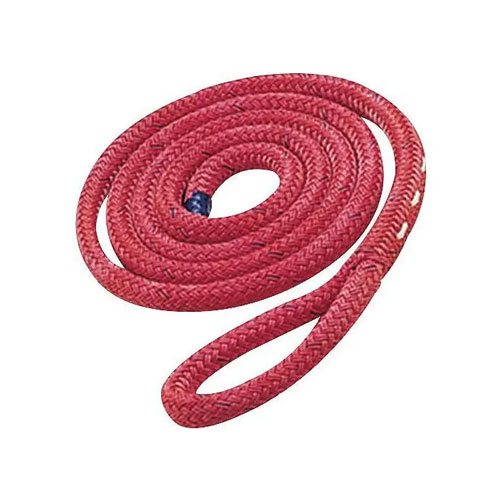
| A rope as a working line rather than as a lifting article: running, guiding, splicing to length< /td> | the DuPont nylon paper guiding carrier rope page | That page's rope is not a load-bearing article in the sense of this table, and its service conditions are its own. |
| A rope ordered together with a sling, as one set for one lift | the disposable cargo sling and matching lifting rope page | The question there is how the two are chosen as a pair. This page prices a rope on its own. |
Frequently Asked Questions
What sizes does this table cover?
Thirty-two diameter rows, from Φ3-4 to Φ100. The rows step two millimetres at a time from Φ3-4 up to Φ59-60, and the last three rows cover Φ70-80, Φ90-95 and Φ100.
Why does the table step two millimetres and then jump to ten?
Because the article changes character at the top of the range. The last three rows are bands rather than points, and they are read as bands: Φ70-80 covers ten millimetres of the range, Φ90-95 cover s five, and Φ100 is a single diameter.
At what size does the end start to matter more than the body?
Around Φ9-10. Below that the article is used the way a line is used, held in the hand or tied off. From Φ9-10 upward it is attached, and the place it is attached is the part of the article the tens ion table says nothing about.
Which column of the table is the nylon one?
The table names two of its three groups, polyester fiber and Vinylon. The first group's head cell repeats the words Diameter tolerance instead of naming a fibre. Its figures are the highest at ever y row, which is the ordering nylon, polyester and Vinylon normally take, but that is an inference and not something the table states. Ask for the identification in writing.
Can the strength of one fibre be converted into another?
No. The proportions are not fixed across the range: the polyester group runs from 0.83 to 0.96 of the unnamed group, and the Vinylon group from 0.44 to 0.50 of it. A converted figure is not a figur e from this table.
Is the use tension one quarter of the ultimate strength?
In the polyester group it is exactly four times lower in twenty-four of the thirty-two rows, but not in the rest. Across the whole table the ratio runs from 3.50 in the Vinylon group at Φ3-4 to 5.0 8 in the same group at Φ100. Take the printed figure rather than dividing.
Does hand woven mean anything at the smaller sizes?
Very little. Below the working range there is no end work for the phrase to describe, and it cannot be checked on delivery. From Φ15-16 upward it can separate two suppliers in a way a buyer can ins pect, provided the order says which end and what the hand work consists of.
What does seamless mean on a rope?
As a description of the body, nothing at any size: a braided rope is made in one continuous run and has no seam. The word only does work when it names a place — a seamless body, a seamless eye, or a rope supplied as a rope rather than as a made-up article.
How many ends does a delivery have?
One per piece, so the answer depends on whether the length on the order is per piece or in total. At the larger sizes this stops being an accounting question and becomes a handling question, becaus e the coil is heavy enough to be moved in its own right.
What can a surface inspection show on a large rope?
Flattening, glazing, local wear and a change of colour along the length, and at the ends whether the return is still tucked and the cover has not moved. It cannot show how much of the structure ins ide has been weakened, or what the rope has already been through — that is what the record is for.
What should I send with an enquiry?
The fibre by name together with the figure, the diameter as a printed row or band, the length and whether it is per piece, both ends described separately, and whether a rope or a rated article is b eing bought. Say which band of the table you are standing on, and the quotation can be read row by row.
- Previous:Emergency escape lifeline, fire escape rope, fire safety escape emergency rope, steel wire core fire rope
- Next:Fire safety rope, static safety rope, dynamic safety rope
-
Drone Anti-collision Net
-
Extra Large Capacity Cargo Net
-
Cargo Webbing Net
-

Color changing nylon double buckle loop nylon braided rope
-

Two end buckle lifting rope, double buckle round lifting rope, double fork nylon lifting rope, non jointed nylon lifting rope
-

Emergency escape lifeline, fire escape rope, fire safety escape emergency rope, steel wire core fire rope

