 Language
 简体中文
简体中文
- On the 2018 National Day holiday, Lifet completed six 100 ton large tonnage lifting belts as a gift
- The role of suspension net in the transportation of goods turnover
- Cargo soft lifting net, lifting net, lifting net, lifting net, bag, climbing net
- Precautions for using Lifutiden elevator
- How to make circular lifting straps
Contact: Wang Lili
E-mail:18066002268
Phone:702461526@qq.com
Address: Lifute Industrial Park, Taizhou City, Jiangsu Province
An eye and eye type webbing sling is classified by its ends, and the type number is the part of the name that does the work: in the United States numbering the article with a flat eye sewn at each end is a Type III, and the same sling with its eyes turned at right angles to the band is a Type IV, while the European standard files the shape under a letter instead. The band behind the eyes is specified by width, ply and webbing class - Class 5 at 6,800 lb per inch of width or Class 7 at 9,800 - and the rating is built from those figures and the factor the market asks for: 5:1 in the United States, 7:1 in Europe. HS 630790. Phone 18066002268.
Hits: ℃
Release time:2026-09-21 07:48
Lift Sling Rigging Co., Ltd produce Eye & Eye Type Webbing Sling,Eye and Eye Web Sling,Flat Webbing Sling With Eyes,Eye-to-Eye Flat Webbing Slings.
Eye & Eye Type Webbing Sling — Type III or Type IV, and the Two Numbers the Band Is Rated From
A webbing sling with a soft eye sewn at each end<
/strong> is the commonest synthetic sling in general lifting
, and the two words in its name that decide what actually ar
rives are the two most often left out of a quotation:
Nothing here is inferred from the product's name. The six numbered types are quoted from the definitions the trade pu blishes for them; the widths, ply counts and sewing figures come from a sling fabricator's own description of how these slings are made; the strength per inch of width comes from t he two webbing classes that the American sling standard and the Web Sling & Tie Down Association define; and the fac tors, the hitch figures and the label requirements are given as each market states them. Where the two markets disagree the page says so instead of choosing for you — and on one po int they disagree by an entire factor (§5 and §6).

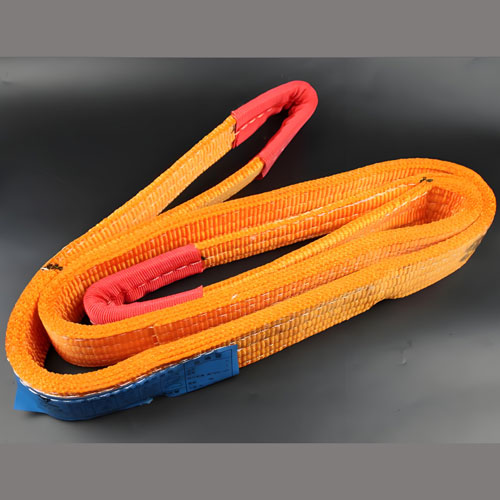
This page's own photograph. The band is orange, both sewn eyes are covered by protective red sleeves, and th e blue strip is the identification label; §6 reads what each of those three things tells you, and §9 sets the two photog raphs of this product side by side.
1. What an Eye & Eye Type Webbing Sling Is, and the Three Words in Its Name
Read the name as three specifications rather than one, be
cause each of them is settled on a different line of a drawi
ng. Eye and eye describes the ends: the ban
d is turned back on itself, overlapped and stitched, so that
each end forms a loop of webbing with no metal in it.
Two consequences follow from reading it that way. The fir st is that the words "eye and eye type" do not fix the artic le on their own, because the same two eyes and the same band can be made in either configuration; the type number has to be said out loud, and §3 gives the one sentence to say. The second is that a quotation which describes the ends and sto ps there has said nothing about capacity, because capacity i s a property of the band, and the band is specified in numbe rs that never appear in the product's name.
The joint at each end is the part buyers most often take for granted here, and it gets one sentence rather than a sec tion: it is a load-bearing splice in the in spection language, which is why it may not be repaired and w hy worn stitching in it is a removal criterion. That argumen t — the splice, the geometry of the eye, the one-third rule and the hook seating — is made in full on this site's eye an d eye sling page, and it is deliberately not repeated he re. What belongs on this page is the other half of the same article: the band, the type number in front of the words "we bbing sling", and the arithmetic that turns a woven strip in to a rating.
< td style="padding:9px 12px;border:1px solid #e6e6e6;vertical -align:top;">Whether the eye opening lies in the plane of th e band or is turned at right angles to it. That is the type number, and it is not in these three words.One further word is worth having ready, because it arrive s from the other direction. The European standard for flat w oven webbing slings classifies them by their ends ra ther than by their material, so the same eye-and-ey e shape carries a letter rather than a number there; that fi ling, its four letters and the designation rule that goes wi th them are set out on the eye and eye sling page. A buy er who reads both documents needs both vocabularies, and §2' s table is the mapping between them.
2. Where the Name Comes From: the Six Types in the Numbe ring
Six configurations of synthetic web sling are defined in the American sling standard, and the article on this page is the third and the fourth of them. Type III is a web sling made with a flat loop eye on each end with t he loop eye opening on the same plane as the sling body, and the definition adds, in the standard's own words, that this type of sling is sometimes called a flat eye and ey e, an eye and eye or a dou ble eye sling. Type IV is the same article with the loop eyes turned so that the opening stand s at a right angle to the plane of the body, and it is commo nly referred to as the twisted eye sling. Those two definiti ons are the reason the phrase "eye and eye type" in this pro duct's name is not decoration: it is a type designation that a works can be held to, and on this shape it resolves into one of two diagrams.
The rest of the list is worth knowing because it is what
a purchase order drifts into when the ends are described loo
sely. Type I puts a triangle fitting on one end and a slotte
d triangle choker fitting on the other, and it works in a ve
rtical, basket or choker hitch. Type II puts a triangle on b
oth ends and is for vertical and basket hitches only, becaus
e two triangles cannot be choked through one another. Type V
is the endless web sling, sometimes called a grommet, forme
d by joining the ends of the webbing together with a load-be
aring splice — the site's endless sling page and its ton
nage-specific 8 ton endless webbing sling page cover that form. Type VI is the reversed or return eye
sling, built from several widths of webbing held edge to edg
e with a wear pad attached to the body and the eyes. In the
trade each of these arrives abbreviated to two letters on a
quotation, which is why it is worth being able to read the a
bbreviation back: EE is eye and eye,
| The word in the name | What it settles | What it leaves open |
|---|---|---|
| Eye and eye< /td> | The ends: a soft, sewn loop at each end, n othing metallic on the article, and a sling that can be hung on a hook, taken round a load or joined to a shackle. | |
| Type | Which numbered configuration of the six the artic le is — on this shape, III or IV — and therefore how it beha ves in a choker and on a hook (§3). | Nothin g at all about the band. Two slings of the same type can dif fer eightfold in width and fourfold in ply, and therefore ma ny times over in rating. |
| Webbing | The material the load is carried in: woven syn thetic fibre, sold by width and ply, in one of the two stren gth classes the rating is built from (§4 and §5). | The hitch, the length and the hardware the eyes must accept. None of those is a property of the band, and each i s a separate line on the order (§8). |
| The type | What the standard calls it | What is o n the ends | Hitches it is made for |
|---|---|---|---|
| Type I (TC)< /td> | Triangle fitting one end, slotted triangle choker fitting the other. | Two fittings, o ne of which passes through the other. | Vert ical, basket or choker. |
| Type II (TT) | Triangle fitting on both ends. | Two fittings that cannot choke through each other. | Vertical and basket only. |
| Type III (EE ) | Flat loop eye each end, opening on the < strong>same plane as the body. The flat eye and eye sling of this page. | Two soft eyes, sewn, with nothing metallic. | All three: vertical , choker and basket. |
| Type IV (EE) | As type III, with the loop eyes turned to stand at a right angle to the plane of the body. The twisted eye sling of this page. | Two soft eyes, sewn with a twist, with nothing metallic. | All three, and the better choker of the two (§3). |
| Type V (EN)< /td> | Endless web sling, or grommet: a continuou s loop formed by joining the ends of the webbing with a load -bearing splice. | No ends at all, and no ey es to hang on a hook. | All three, with a di fferent length convention. See the endless sling page. |
| Type VI (RE) | Return eye or reversed eye: several width s of webbing held edge to edge, with a wear pad sewn on the body and the eyes. | Two reinforced eyes at right angles to the body, over a doubled width of band. | Where a wider, stiffer and more protected band is wanted. |
Reading across the table gives the reason this page is po ssible at all. Types III and IV are the only configurations in the list whose ends are made of the webbing itself; every other line changes the ends into hardware, into a closed lo op or into a doubled width. That makes the band on this arti cle unusually exposed: it is the outermost thing on the slin g at every point except the two sewing patterns, and it is w hat a buyer is really buying a specification of.
3. Type III and Type IV: the Flat Eye and the Twisted Ey e
The two configurations differ by one fold, and the publis hed guides are unusually specific about what that fold buys and costs. In type III the webbing is folde d over flat and sewn, so the eye opening lies in the same pl ane as the band — the flat eye. In type IV the webbing is folded over with a twist, so the eye opening stands at a right angle to the band — the twisted eye. The p ublished advantages of the twisted eye are that it f orms a better choker hitch with less strain on the sling, because the band can sit flat in the choke instead of being forced into a twist, and that its eyes nest b etter on the crane hook. The published advantage of the flat eye is the opposite end of the same question: flat -eye slings are easier to remove from beneath the lo ad than the twisted-eye and fitting-ended types, wh ich is a real cost in a shop where slings are pulled out fro m under billets all day.
There is also a supply convention that catches buyers out , and it is stated plainly in the same guide: unless a type 4 is requested, a type 3 is what will be supplied as the standard eye and eye sling. So the flat eye is the default, the twisted eye is the option, and a buyer wit h a choker application who writes only "eye and eye webbing sling" on an enquiry should expect the flat eye to be quoted back. If the twisted eye is wanted, it has to be named — as a type number, as "twisted eye", or as the two-letter abbre viation, and all three mean the same thing.
What the type does not change is the rat ing. The capacity of the sling is a property of the band, an d both configurations are made from the same band in the sam e widths and ply counts; the type decides access, seating an d the quality of the choke, not the tonnage. That is worth s aying explicitly because the type number sits in front of th e words "webbing sling" in the product's name and invites th e assumption that it is a strength grade. It is a shape grad e.
< td style="padding:9px 12px;border:1px solid #e6e6e6;vertical -align:top;">Nests better on the hook, according to the same guide, because the opening faces the hook's own plane.| The question | Type III — flat eye | Type IV — tw isted eye |
|---|---|---|
| How the eye is formed | The webbing is folded over flat and sewn, giving a loop opening that lies in the plane of th e band. | The same fold, made with a 90-degr ee twist in the eye, giving an opening at a right angle to t he band. |
| In a choker hitch | Works, but the band is forced to twi st at the choke point, which the guides call unneeded strain . | The eye the twisted form exists for: the band sits flat in the choke and the hitch forms better. |
| On the crane hook | Hangs in the plane of the band, whic h is what makes it easy to lift off a load afterwards. | |
| Getting it b ack out | Easier to remove from beneath the load than any other end configuration in the numbering. | Less convenient in this respect, and that is t he price of the choker. |
| What a suppl ier sends if you do not say | This one. The flat eye is the standard EE sling and the default of the tra de. | Nothing, unless the twist is requested by name or by type number. |
| Working load limit | The band's rating, unchanged by the type. | The same band's rating, unchanged b y the type. |
Seating on hardware is the third thing the eye decides, a nd the rules for it belong to the eye rather than to the ban d: how much of the eye an object may occupy, where the load should sit in a hook, and why an eye must never be constrict ed or bunched are all set out on the eye and eye sling page< /a>. What this page adds to that is only the type: on a twis ted-eye sling the opening faces a different way, so the hard ware that seats properly in one type may not seat the same w ay in the other. Match the fitting to the eye you actually o rdered, not to the eye you pictured.
4. The Band: Width, Ply and How the Webbing Is Woven
A webbing sling is a textile, and it is worth being concr ete about that before quoting figures, because a textile fai ls in ways metal does not. The band is manufactured from syn thetic fibre interwoven so that the fibres create the strength, and in a sling every one of those fibre s is described as a load-bearing fibre — there is no binder yarn doing an ornamental job, and no part of the cross-secti on that is only there to hold the rest together. That single fact explains two things a buyer meets later: why a cut red uces the rating in proportion to the fibres it severs, and w hy the same band in the same width can be sold at two very d ifferent ratings according to the class of weave it is (the class is §5's subject, and it is the largest single variable in this article).
The two dimensions that appear on every enquiry are
The ply count has a visible consequence at the ends, and it is the kind of detail that tells a buyer what he has been sent. On a two-ply sling, the point where the ends overlap and are sewn is three plies thick — the bod y's two layers plus the folded-back layer — and that overlap is what the fabricator calls the sewing pattern. Its length is not arbitrary either: published figures give sewing patterns from 9 to 16 inches, depending on the width of the material. So the length of the stitched overlap grows with the band, and a sling whose pat tern looks short for its width is a sling whose specificatio n is worth questioning before the lift rather than after it.
| What is being specified | The range the trade publis hes | What changing it changes |
|---|---|---|
| Width | Strength and bearing area together: the wider the band, the stronger the sling and the larger the share of the load it touches. Also the weight and the bulk in the rigger's hand. | |
| Ply | One to four layers of webbing on the body, sewn in to the eyes as well as the body. | Strength in proportion to the number of plies, and stiffness out of p roportion to it. More plies hold a rating in a narrower band , and make the band less willing to bend over a small radius . |
| Sewing patte rn | 9 to 16 inches of overlap at each eye, according to the width of the material. Three plies thick on a two-ply sling. | The length of the joint through which the whole rating passes. It also sets where th e sling's stiffest section sits, which is the section most r iggers handle least carefully. |
| Fibre | Stretch and chemical resistance, not the rating: the two materials are published with the same worki ng load limits. Polyester stretches least and suits the load that must not move; nylon stretches most and suits the load that must not be shocked. | |
| Weave class< /td> | Two classes of webbing, defined by a minim um certified tensile strength per inch of width. | Everything: this is where the rating comes from befor e the factor is applied. A whole section is given to it belo w, because it is the most misunderstood figure on the articl e. |
Two practical notes close this section. First, width and ply are the two things a buyer can check on a delivered slin g with a tape and a thumbnail, and they are worth checking: the width is measurable in a second, and the ply count is vi sible at the sewing pattern, where the overlap multiplies th e thickness. Second, not every combination the trade publish es is sensible for every width — a four-ply 1 inch band and a single-ply 12 inch band are both available in principle, a nd they are bought for entirely different reasons, one for a narrow slot and high rating, the other for a wide, soft cra dle under a finished surface.
5. The Two Numbers a Rating Is Built From: Webbing Class and Design Factor
A working load limit is not a property of the cloth, and
it is not a figure a maker chooses for convenience. The publ
ished definition is a piece of arithmetic with three inputs:
the sling's minimum breaking strength, whi
ch is the force at which it fails in a straight-line pull un
der laboratory conditions, divided by a safety facto
r. The relationship as the guides state it is
So the real question for a buyer is where the breaking st rength comes from, and on a synthetic web sling it comes fro m the webbing. The American sling standard and the Web Sling & Tie Down Association define the webbing by cl ass, each class being a minimum certified tensile s trength per inch of width, and the rated lo ads of the finished slings are then based on that figure. Tw o classes are met with in ordinary trade:
Class 5 webbing is the standard-tensile class, certified at a minimum of 6,800 lb per inch o f width, and it is the general-purpose everyday web bing. Class 7 webbing is the high-tensile c lass at 9,800 lb per inch of width, a 44 pe r cent stronger weave that is published with better abrasion resistance and is described for heavy-duty lifting in rugge d environments. Both figures are for stuffer weave construction, which is the weave the definition name s. That difference of 3,000 lb per inch of width is the sing le largest lever on this article after the width itself, and it is invisible on the finished sling: the two look alike, weigh nearly alike and are separated only by the class the m aker paid for and the label the maker prints.
| Webbing class | Certified strength per inch of width | One ply | Two ply | Three ply | Four ply |
|---|---|---|---|---|---|
| Class 5 | 6,800 lb | 6,800 lb | 13,600 lb | 20,400 lb | 27,200 lb |
| Class 7 | 9,800 lb | 9,800 lb | 19,600 lb | 29,400 lb | 39,200 lb |
Read the table as a set of figures per inch of wi dth, and the rest of the arithmetic is one multipli cation and one division. Multiply by the width of the band t o get the breaking strength of the sling; divide by the mark et's factor to get the working load limit in a straight lift . A two-inch band of two-ply Class 7 webbing therefore carri es 9,800 × 2 × 2 = 39,200 lb of breaking strength, which at the American 5:1 factor is a working load limit of 7,840 lb and at the European 7:1 factor is 5,600 lb. The same sling i n Class 5 webbing carries 27,200 lb and rates 5,440 lb or 3, 886 lb respectively. Nothing about that arithmetic is a secr et, and every line of it can be checked by a buyer who knows the class, the width, the ply and the factor — which is exa ctly the argument for putting all four on the order rather t han two of them.
One caution, and it matters more than the arithmetic. The calculation shows how a rating is built; i t is not the rating. The figure that may be used on a lift i s the one on the sling's own label, derived by the maker fro m the certified webbing actually used and the splice actuall y sewn, and the label is what the inspection regime treats a s the article's identity. A buyer who works back from a clas s and a width to decide what a sling in his store is good fo r has confused the basis with the certificate. Ask for the c lass on the order, check the class on the label, and use the capacity on the label.
6. Reading the Band: the Stitch, the Stripes and the Tag
A synthetic band carries more information on its surface than a steel one ever did, and the information is of two dif ferent kinds: marks that are conventions of one market and m arks that are the manufacturer's own identification. Keeping them apart is the whole skill, because they overlap on the same surface and one of them contradicts the other.
The stitch that names the fibre. On a po lyester sling the fabricator's own description is that you k now the webbing is polyester by the blue identificat ion stitch running through the middle of the webbing, and that nylon does not have any lines at all. This is the quickest material check on the article, a nd it is the reason two slings of identical colour and width can have different behaviour under load: polyester stretche s least, nylon stretches most, and the two are published wit h the same working load limits, so the stitch is telling you about stretch and chemical resistance rather than about capacity.
The colour and the stripes. In the Europ ean code the colour of the band is an entry for a straight-l ift capacity — green for two tonnes, yellow for three, grey for four, red for five, brown for six, blue for eight, orang e for ten tonnes and above — and the black lines woven into the webbing each typically read one tonne, so a yellow three -tonne sling carries three black lines. That pairing of colo ur and tonnage is a rigger's shorthand and it works. What it does not do is survive a change of convention: in the Ameri can trade the ply count of a multi-ply sling is sometimes ma rked instead by red stripes woven into the edge of t he webbing, one stripe to a ply. Two conventions, o ne surface, both using stripes — which is why the only safe instruction is the one at the end of this section.
The tag is the authority. For slings in the American market the standard and the safety regulation t ogether require a permanently attached tag showing the manufacturer's name or trademark, the manufactur er's code or stock number, the rated capacity for ea ch hitch type, the material and the number of plies. The same body of guidance adds that a sli ng with a missing or illegible tag must be removed from serv ice immediately, without exception. That is the sentence to carry away from this page: the colour is a convenience, the stripes are a convention, the stitch is a clue, and the tag is the specification.
| What you can see on the band | What the convention s ays | What it cannot tell you |
|---|---|---|
| A blue ident ification stitch down the middle | Polyester . The stitch is the fabricator's marker for the fibre, and i t runs the length of the band. | The class, the rating, the ply count or the length. It names the fibre and stops there. |
| A band with no lines at all | Nylon, on the same convent ion. The absence of the stitch is itself the identification. | How much it will stretch: nylon is publis hed at six to ten per cent at its rated load, against about three for polyester. |
| The colour o f the band | In the European code, an entry for the straight-lift capacity: green two tonnes, yellow thr ee, grey four, red five, brown six, blue eight, orange ten a nd above. | The ply count, and the class; an d in the American market the band's colour on a flat web sli ng is a maker's convention rather than a standard. |
| Black lines along the band | Each line typically reads o ne tonne of capacity, so the line count repeats the colour's tonnage entry. | Which hitch the figure app lies to. A choker figure is about four fifths of it (§7). |
| Red stripes at the edge | On one published convention th is is the ply count: one stripe for one ply, two for two, an d so on. | Whether it is a ply count or a to nnage, because the same word describes both conventions. The tag settles it. |
| The identifi cation tag | The article's identity: maker, maker's code, rated capacity per hitch, material and ply cou nt, permanently attached. | Nothing that mat ters. And if it is missing or illegible, nothing on this pag e saves the sling: it comes out of service. |
For the two neighbouring cases where the band is doing so mething other than carrying a rating in colour — the white b and that a one-way sling is made in, and the orange label th at identifies it — the site's one way sling page and its single use lifting sling page cover the labe lling in detail, because in those products the label rather than the band is the identification. This page's own bands a re the coloured kind, and the photograph at the top of the p age shows one: an orange band, which is the code's entry for ten tonnes, with the blue label that carries the figure act ually to be used.
7. Three Hitches, Three Numbers, and the Angle That Redu ces Them
An eye and eye sling can be used three ways, and each way
has its own figure on the label, because the sling is doing
a different mechanical job in each. In a vertical h
itch the sling hangs straight from the hook with th
e load on the lower eye, and that is the baseline: the ratin
g is stated at 100 per cent. In a choker hitchthe band is passed round the load and one end is drawn t
hrough the other, so the sling chokes itself and is both pul
ling and bending at the choke point; the published reduction
is to approximately 80 per cent of the vertical fig
ure, which the same sources express the other way r
ound as a choker figure reduced by about 20 per cent.
Every one of those three figures assumes a geometry, and the geometry is the part that is lost in the retelling. The vertical figure assumes the sling is straight; the choker fi gure assumes the choke has closed on the sling body; the bas ket figure assumes the two legs are at 90 degrees to the loa d, which is the position in which they share evenly. As soon as the legs are at an angle the basket figure falls, and th e reduction is the same arithmetic that applies to any two-l eg arrangement — worked through with its own tables on this site's endless sling page, which is where the angle belo ngs. This page states only the consequence: a basket figure quoted without its angle is a figure that may be double the vertical or barely above it, and the label's number is the o ne for the ideal case.
The labelling rule that goes with all this is worth stati ng because it is a minimum rather than a maximum: a tag is r equired to carry a rated capacity for at least one h itch. A sling labelled for one hitch only is not de fective, it is simply restricted, and the restriction has to be respected by riggers who are used to reading three figur es. The slings made to this specification are normally label led with the ratings for all three hitch types, and the numb er a rigger should be reading before a lift is the one for t he hitch he is about to form.
| The hitch | What the sling is doing | Its publish ed figure | The catch on this form |
|---|---|---|---|
| Vertical hit ch | Hanging straight, one eye on the hook a nd the load in the other: the sling supports the load in a s ingle vertical line. | 100 per cent of the w orking load limit, and the figure every other hitch is measu red against. | The eye at each end is carryi ng the whole load through its sewing pattern, so both patter ns are the places to look. |
| Choker hitch | Wrapped round the load and choked against itself, one end drawn through the other. | Approximately 80 per cent of the vertical figure — the guide s put the reduction at about 20 per cent — and steeper choke angles reduce it further. | The choke must close on the body, never on an eye or a sewing pattern, whic h means a choker sling has to be long enough for the job. Th e eye and eye sling page sets out that rule and its excl usions. |
| Basket hitch at 90 degrees | Passing under the load with both eyes brought up to the hook, so two legs share the wei ght equally. | Double the vertical capacity at 90 degrees, which is the position the doubling assumes. | Both eyes are on the hook together, which i s the arrangement the guides warn about when they tell you t o protect the eyes where centring is not possible. |
| Any hitch at an angle | The legs leaving the load at les s than 90 degrees, which introduces a reduction on top of th e hitch figure. | Reduced by the angle facto r for that geometry, which is treated with its own tables on the endless sling page. | The label's f igures are the ideal-geometry figures. A quotation that prom ises a basket lift without asking about the angle has not qu oted the lift. |
| The label it self | Carrying the rated capacity for each hitch type the maker has rated the sling for. | At least one hitch is the requirement, and the trade's s lings are normally labelled for all three. | A single-hitch label is a restriction, not a fault. Read th e label for the hitch actually being formed, not for the one that gives the biggest number. |
8. Length on This Form: Bearing to Bearing
Length is the field on an eye and eye sling that causes t he most expensive misunderstandings, because the eyes are pa rt of the article and the buyer is usually thinking about th e distance between two points on a load. The published conve ntion settles it in one sentence: a web sling is measured from the bearing point of one eye to the bearing point of the other, which the same source calls the pull -to-pull measurement. The fabricator's own description of th e eye and eye style says the same thing in plainer words — t he length is measured inside the eye to inside the e ye, because those are the two points at which the s ling makes contact at either end.
What that convention excludes is the eyes themselves, and the exclusion is where quotations go wrong. A sling quoted as two metres is two metres between bearing points, so the a rticle delivered is longer than two metres overall; an enqui ry written as "2 m including the eyes" is asking for a sling that will be short at both ends, and on a choker it is aski ng for trouble, because the choke has to close on the band a nd not on an eye. The practical fixing of this is small and worth doing on every order line: state the length, state tha t it is bearing to bearing, and where a set of slings is being bought for one lift, say that they are t o be measured the same way, because a set that is assembled from slings measured by two conventions is a set that will n ot share a load evenly.
The neighbour form is the reason this convention has to b e written down at all rather than assumed. An endless sling has no ends and therefore no bearing points, so its length i s quoted by a different convention again — and because a clo sed loop can be described either as the length of the loop o r as its circumference, the two readings differ by a factor of about two. That is a subject for the endless sling page, and it is mentioned here only so that a buyer comparing this article with that one knows the numbers on the two quot ations are not the same kind of number.
| The measurement | How it is taken | What goes wro ng if it is left vague |
|---|---|---|
| Bearing to b earing | From the bearing point of one eye t o the bearing point of the other, with the band laid flat — the pull-to-pull figure the trade quotes. | The sling may be measured eye tip to eye tip instead, which delivers a shorter article than the lift needs. The differen ce is two eye lengths, which on a wide band is not small. |
| Inside eye t o inside eye | The same figure in a fabricat or's words: the inside of one eye opening to the inside of t he other. | Nothing, if the two descriptions are understood as one measurement. It is worth saying which words your own inspection uses. |
| The eyes the mselves | Not part of the length figure, but part of the article: size the eye to the hardware it has to accept, not to the lift. | A sling whose le ngth is right and whose eyes are too small for the hook is t he wrong sling. The eye dimension is a separate line on the order (§11). |
| A set of sli ngs | Every sling in the set measured the sa me way, and the convention written on the order. | Two slings of nominally equal length, measured by two conventions, will not share a load evenly — and uneven shar ing is what the second sling was bought to avoid. |
| A sling with no ends | Quoted differently again, because a closed loop has no bearing points and can be described as a length or as a circumference. | Reading o ne quotation against the other without noticing the conventi on gives a difference of about a factor of two. See the endl ess sling page. |
9. The Two Photographs on This Page, Read as Evidence
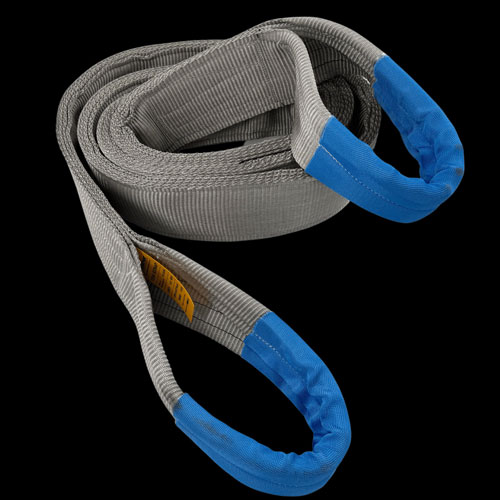
Both photographs on this page are the product's own, and both are worth a second look, because between them they show the two things a band can be given that the type number doe s not describe: protection over the eyes an d the identification label.
The first photograph is the one printed above this sectio
n and it shows the article working colour. The band is orang
e, which in the colour code this site builds to is the entry
for ten tonnes; both sewn eyes are covered by prote
ctive red sleeves; and the blue strip is the
That protection is a real part of the specification rathe
r than a cosmetic one. A manufacturer of synthetic slings de
scribes imported slings of this style as coming with a
| The photograph | What it shows | What a buyer can read from it |
|---|---|---|
| The first: a n orange band in loose folds | A flat woven band with a soft, sewn eye at each end, both eyes covered by red protective sleeves, and a blue identification label sew n near one end. | That the article is flat w ebbing rather than rope or a round sling, that both ends are soft eyes with no hardware, that the label is present and s ewn rather than printed on, and that protection over the eye s has been supplied as part of it. |
| The second: a silver grey band, coiled | The same constr uction in a different band colour, with blue sleeves over bo th eyes and a yellow label. | That the sleev e colour follows the order rather than the band, and that tw o slings of one family can look unrelated at a glance. Read the label, not the sleeve. |
| What neither photograph can show | The rating, the class of webbing, the ply count, or the length. None of those is legible in a photograph of this size. | That a picture is not a specification. Ask for the label's figur es in writing, and for the class if the class matters to the lift (§5). |
10. Where the Flat Band Is Chosen: Flat Web, Round, Wire Rope or Chain
A flat woven band is chosen for a particular combination of reasons and given up for another combination, and the hon est version of this section is short. The band wins where th e load has a finished or easily marked surface, because it s preads the load over the whole width of the band instead of concentrating it at a single contact point; where the sling has to be carried, stored and handled by hand, because webbi ng is the lightest of the four families; and where the stret ch has to be predictable, because polyester is published at about three per cent elongation at its rated load, which is the lowest of the synthetic fibres. It also wins on flexibil ity at the eye, which is what makes a soft eye usable on a h ook, a shackle or a lifting point that would refuse a rigid fitting.
It loses on three things, and a buyer who does not ask ab out them will meet them. The first is cutting and ab rasion: a band is a textile, and an edge with a rad ius smaller than the sling's width will cut it, which is why edge protection is a published requirement rather than an a ccessory. The second is heat: the same guid ance that gives the fibre's working temperature also warns t hat contact with a hot load damages the fibres where the sli ng touches it, so a band is the wrong family for anything le aving a furnace, and the site's wire rope slings and lifting chains are th e families that answer that. The third is the mirror image o f its first virtue: a band spreads the load, so where the li ft needs a sling to bite into a narrow slot the band has to be narrow, and a narrow band carries less.
Between the flat band and the round sling there is a real choice rather than a preference, and it is discussed on the pages that own those articles. A round sling carries its lo ad in a core inside a protective sleeve, so the part that ca rries the weight is not the part you inspect and the load's contact point can be moved round the loop to spread wear; th e flat band has the opposite arrangement, with the load-carr ying fibres on the outside where they can be seen, and fixed wear points at the eyes. This site covers both forms: endless round slings for the no-ends version and eye type round slings for the version with loop eyes, w hich is the nearest neighbour to this article and worth read ing side by side with it.
< /tr>< /tr>| The job | The family that fits it | Why |
|---|---|---|
| A finished o r painted surface | Flat woven webbing, in a wide band and few plies. | The load is spre ad across the width of the band rather than concentrated at a point, and the band is soft against a surface that scratch es easily. |
| The same job , but with a load that must not be twisted or scuffed at the contact | A sleeved or padded band, or a ro und sling with its sleeve. | Protection over the contact area is cheaper than either a marked load or a replacement sling. The sleeves in §9 are this answer applied to the eyes. |
| An edge with a radius smaller than the band is wide | An y family, with corner protection added. | Th e published rule is that an edge with a radius less than the sling width requires corner protection. Ignoring it turns a rated sling into an unrated one at the contact point. |
| A hot load, or a lift into heat | Wire rope slings or lifting chain. | Synthetic fibre is the wrong material above its working temperature, and contact with a hot load damage s it where it touches even if the air is cool. |
| A load that must not be shocked | A band in nylon, or a round sling in nylon. | Nylon is published a t six to ten per cent elongation at its rated load against a bout three for polyester, which is the price of the energy t he sling absorbs. |
| The same del icate work, with wear that has to be spread | A round sling with loop eyes or an endles s round sling. | A round sling's contact point can be moved from lift to lift, where a band's wear p oints are fixed at the two eyes and the label says so. |
11. What to Write on the Order
Almost every argument on this page resolves into one line on an enquiry, and the line is longer than the trade's habi t. The name of the article fixes only the ends; everything t hat decides what is delivered is a field of its own, and eac h of the fields below has a section above it that explains w hat the field changes.
The type — Type III with the flat eye, or Type IV with the twisted eye. Say which. If the sling wil l be used in a choker, say so in the same sentence, because that is the application the twisted eye exists for (§3).
The width of the band — from 1 inch to 12 inches, or its metric equivalent. The wider the band, the stronger the sling and the larger the share of the load it touches (§4).
The number of plies — one to four layer s on the body. Plies multiply the strength, and they stiffen the band as they do it (§4).
The webbing class — Class 5 at 6,800 lb per inch of width, or Class 7 at 9,800. This is the largest single lever on the rating and the one most often left unsa id (§5).
The fibre — polyester or nylon, chosen for stretch and chemical resistance rather than for capacity , since the two are published with the same working load lim its (§4, §6).
The length, bearing to bearing — the fi gure between the two bearing points, with the convention wri tten out so that no one has to guess whether the eyes are in cluded (§8).
The eyes — their shape, their inside le ngth, and the hardware they must accept, so that the hook, p in or shackle seats rather than binds (§3).
The hitch — the arrangement the sling w ill work in, so that the label carries the figure for that h itch and the rigger reads the right number (§7).
The marking and the paperwork — the lab el items you require, and any certificate, test record or tr aceability code that has to travel with the shipment (§6).
Quantity, packing and delivery — includ ing the sleeves or pads wanted over the eyes, which are orde red rather than standard (§9).
A specimen line that carries all of them reads: eye and e ye type webbing sling, type IV twisted eye, 2 inch, two ply, Class 7 webbing, polyester, 3 m bearing to bearing, eye ins ide length 300 mm to accept a 25 tonne shackle, to be used i n a choker, labelled for vertical, choker and basket hitches , with the webbing certificate and a copy of the label. Writ ten that way the enquiry leaves nothing for the works to ass ume, and it gives the buyer a checklist to inspect the deliv ery against — the width by tape, the ply at the sewing patte rn, the class on the label, and the label itself present and legible with no exceptions (§6).
12. Frequently Asked Questions
Q1: What is an eye and eye type webbing sling?A flat woven webbing sling with a soft eye sewn at
each end, so that it can be hung on a hook, passed round a
load or joined to a shackle, with no metal anywhere on the a
rticle. The words "eye and eye type" name the ends and the c
onfiguration; the band itself is a separate specification of
width, ply and class, and that specification is what decide
s the rating (§1, §5).
Q2: What do Type III and Type IV mean, and which one wi ll I be sent?
Q3: What is webbing class, and does class 5 or class 7 matter?
Q4: How is the working load limit worked out?
Q5: Why is the American factor 5:1 and the European one 7:1?
Q6: How can I tell polyester from nylon in a band?By the stitch: a polyester band carries a blue ide
ntification stitch running through the middle of the webbing
, and nylon has no lines at all. The material is also stated
on the label. What the stitch is telling you is stretch and
chemical resistance rather than capacity, since the two fib
res are published with the same working load limits — polyes
ter stretches about three per cent at its rated load, nylon
six to ten (§4, §6).
Q7: What are the three figures on the label, and why do they differ?
Q8: How is the length of this sling measured?
Q9: Can this sling be used in a choker hitch?
Q10: What widths, plies and fibres can I order?Widths from 1 inch up to 12 inches, one to four pl
ies, in polyester or nylon, with flat or twisted eyes, in Cl
ass 5 or Class 7 webbing, and in any bearing-to-bearing leng
th. Sleeves or pads over the eyes are ordered with the sling
, and the label carries the ratings for the hitches the slin
g is rated for (§4, §5, §9, §11).
Contact
Lift Sling Rigging Co., Ltd produces eye and eye type web bing slings in flat woven webbing — a soft sewn eye at each end, one to four plies, in widths from 1 inch to 12 inches, in Class 5 or Class 7 webbing, with the flat eye or the twis ted eye and protection over the eyes on request — produced w ith reference to the safety factor and colour code system of EN 1492-1, and labelled with the working load limit for eac h hitch the sling is rated for. Tell us the type number, the width and ply, the webbing class, the fibre, the bearing-to -bearing length and the hardware the eyes have to accept, an d we will confirm the label, the certificate and the documen tation that travel with the shipment.
Telephone and WeChat — 18066002268
E-mail — 702461526@qq.com
Address — Lifute Industrial Park, Taizh ou City, Jiangsu Province, China
HS code — 630790
- Previous:8Ton Endless Webbing Sling
- Next:Endless Round Sling
-
Drone Anti-collision Net
-
Extra Large Capacity Cargo Net
-
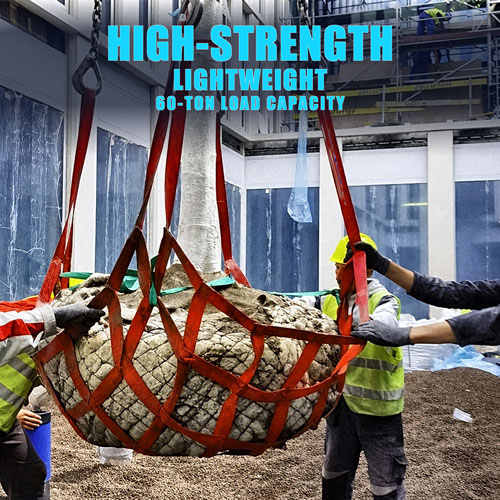
Cargo Webbing Net
-

Color changing nylon double buckle loop nylon braided rope
-

Two end buckle lifting rope, double buckle round lifting rope, double fork nylon lifting rope, non jointed nylon lifting rope
-

Emergency escape lifeline, fire escape rope, fire safety escape emergency rope, steel wire core fire rope

