 Language
 简体中文
简体中文
- On the 2018 National Day holiday, Lifet completed six 100 ton large tonnage lifting belts as a gift
- The role of suspension net in the transportation of goods turnover
- Cargo soft lifting net, lifting net, lifting net, lifting net, bag, climbing net
- Precautions for using Lifutiden elevator
- How to make circular lifting straps
Contact: Wang Lili
E-mail:18066002268
Phone:702461526@qq.com
Address: Lifute Industrial Park, Taizhou City, Jiangsu Province

Lifute Hoisting Co., Ltd. 18066002268 produces lifting belts, lifting nets, nylon ropes, A circular disposable sling is a band of webbing joined to itself into a closed loop, bought to make one journey and not come back. A circular disposable lifting belt and a circular disposable lifting rope are the same article under the trade‘s other two words for it, and the word disposable describes the trip rather than a grade of sling.
Hits: ℃
Release time:2026-09-27 14:36
Lift Sling Rigging Co., Ltd manufactures Circular disposable sling
Circular Disposable Sling, Circular Disposable Lifting Belt and Circular Disposable Lifting Rope — Reading the Two Blocks
The three phrases in this page's name are three names for one closed band, and the fourth word is about the journey rather than the article. A circular disposable sling, a circular disposable lifting belt and a circular disposable lifting rope are the same form of sling under the three words the trade uses for it, and the word disposable says that the buyer has already decided not to bring it back.
The ring form is well written on this site already. The sewn endless flat belt has its standard and its seam; the sleeved construction has its cover and its core; the absence of ends has its own co nsequences, which are the whole subject of the endless sling page; the length convention for a ring is stated on three pages; the fibre choice belongs to the disposal circular sling page; and the colo ur code belongs to the one-way family. All of those are linked from this page and none of them is repeated here.
What this page does instead is read the parameter table that was already on this page. It is published in two blocks — a four millimetre band from one tonne to twelve, and a seven and a half millimetre band from two tonnes to twenty-four — and reading it end to end produces three things a buyer cannot get from either block alone. Every row of the thin block has a twin in the th ick block with the same three widths and exactly double the working load limit. The minimum length column turns out to be a width column in disguise, because it steps up with the band width and not with the tonnage. And in six rows of each block the two middle width columns disagree by a factor of two, which is the one line on this table we will n ot take on trust. All of it is arithmetic on the client's own published figures, and every number below is reproduced unchanged.

This page's own photograph. A flat woven band with the fine longitudinal lines that this family of articles carries, closed into a loop at the left and wound into a coil at the right. There is no eye at either end of the band and no hardware anywhere on it: a ring is one piece of webbing joined to itself, which is why the only figure that can be printed on it is a size. Everything else — what the band is capable of, how thick it is, how much it weighs — has to be looked up, and that is the business of the table further dow n this page.
1. Three Phrases, One Closed Band, and the One Question This Page Answers
A buyer who reads this page's name as three products will order the wrong one, so it is worth being exact about what each phrase names. The table below is short because the answer is short.
| The phrase | What it names | Is it a different article? |
|---|---|---|
| Circular disposable sling | A band of webbing joined to itself into a closed loop, so that it has no end at which a load could be attached and no end at w hich an inspection could begin. The load enters by passing the band around the article and back through itself. | No. This is the article, in the plainest of the three words. |
| Circular disposable lifting belt | The same closed loop, under the word this trade uses when the band is wide, flat and woven rather than round in section. Belt, band and strap are used interchangeably for the fabric; none of them says anything about the loop. | No. Same article, different word for the material. |
| Circular disposable lifting rope | The same closed loop again, under the word used where the article is called a rope because it is handled like one: a continuou s ring with no ends to thread and no eyes to place. In this catalogue the word rope in a product name describes a closed or endless article far more often than it describes twisted fibre. | No, unless the enquiry is genuinely for rope, in which case it is a different department of the catalogue altogether. |
| Disposable | The journey. It says the article has been bought for one trip and will not be brought back, and it says nothing at all about t he form of the ends, the fibre, the factor or the rated capacity. | No. It is a purchase decision, and the page on this site that argues it out is the disposable sling page. |
So the naming question takes three lines to settle and does not need a fourth. The ring form, meanwhile, has been given a great deal of room on this site, and the division of labour is worth statin g because it explains what is left for this page to do. The circular flat lifting belt owns the standard that governs a sewn loop and the sea m that closes it. The endless round sling owns the consequences of having no ends, the arrangements a ring can make, and the wordi ng of the length question on a closed loop. The circular sling page owns the difference between a woven tube and a tube with a seam, and betwee n a sheath over a core and a body that carries the load itself. The circular flexible lifting belt owns flexibility and conformity. The circular eye shaped lifting belt owns the shape of the eye and the cylindrical body. The dispos al circular sling owns the choice between polyester and nylon and the colour band. And the disposable sling page owns the word disposable itself.
None of those pages reads the two-block table that is published on this one. That is the whole of this page's subject: not what a ring is, but what the figures on this particular ring say, and what they do not settle.
2. The Two Blocks on This Page, and How to Read Them
The table below is this page's own parameter table. It was published on the page before this text was written, in Chinese, and it is reproduced here in English with every figure unchanged. It is on e table of eighteen rows arranged in two blocks, and the two blocks are not two products: they are the same width ladder at two thicknesses of band, which is a point developed in the next section.
| Working load limit | Thickness | Width, 5:1 | Width, 6:1 | Width, 7:1 | Minimum length | Maximum length | Weight per metre, 5:1 | Weight per metre, 6:1 | Weight per metre, 7:1 |
|---|---|---|---|---|---|---|---|---|---|
| 1 t | 4 mm | 25 mm | 50 mm | 30 mm | 0.5 m | 100 m | 0.16 | 0.18 | 0.20 |
| 2 t | 4 mm | 50 mm | 100 mm | 60 mm | 1.0 m | 100 m | 0.35 | 0.39 | 0.60 |
| 3 t | 4 mm | 75 mm | 150 mm | 90 mm | 1.0 m | 100 m | 0.52 | 0.73 | 0.78 |
| 4 t | 4 mm | 100 mm | 200 mm | 120 mm | 1.5 m | 100 m | 0.80 | 0.84 | 0.90 |
| 5 t | 4 mm | 125 mm | 250 mm | 150 mm | 1.5 m | 100 m | 0.85 | 0.96 | 1.14 |
| 6 t | 4 mm | 150 mm | 300 mm | 180 mm | 1.5 m | 100 m | 0.96 | 1.12 | 1.33 |
| 8 t | 4 mm | 200 mm | 200 mm | 240 mm | 2.0 m | 100 m | 1.34 | 1.65 | 1.85 |
| 10 t | 4 mm | 250 mm | 250 mm | 300 mm | 2.0 m | 100 m | 1.64 | 1.84 | 2.05 |
| 12 t | 4 mm | 300 mm | 300 mm | 300 mm | 2.0 m | 100 m | 1.86 | 2.06 | 2.70 |
| 2 t | 7.5 mm | 25 mm | 50 mm | 30 mm | 0.5 m | 100 m | 0.38 | 0.44 | 0.50 |
| 4 t | 7.5 mm | 50 mm | 100 mm | 60 mm | 1.0 m | 100 m | 0.68 | 0.74 | 0.86 |
| 6 t | 7.5 mm | 75 mm | 150 mm | 90 mm | 1.0 m | 100 m | 1.28 | 1.42 | 1.50 |
| 8 t | 7.5 mm | 100 mm | 200 mm | 120 mm | 1.5 m | 100 m | 1.61 | 1.80 | 1.96 |
| 10 t | 7.5 mm | 125 mm | 250 mm | 150 mm | 1.5 m | 100 m | 2.04 | 2.42 | 2.62 |
| 12 t | 7.5 mm | 150 mm | 300 mm | 180 mm | 1.5 m | 100 m | 2.32 | 2.68 | 2.86 |
| 16 t | 7.5 mm | 200 mm | 200 mm | 240 mm | 2.0 m | 100 m | 3.30 | 3.70 | 4.10 |
| 20 t | 7.5 mm | 250 mm | 250 mm | 300 mm | 2.0 m | 100 m | 4.62 | 5.02 | 5.46 |
| 24 t | 7.5 mm | 300 mm | 300 mm | 300 mm | 2.0 m | 100 m | 5.12 | 5.62 | 6.10 |
Three notes on reading it. The first nine rows are the four millimetre band and the last nine are the seven and a half millimetre band; the tonnage starts again at two tonnes when the second block begins, so the two blocks overlap between two tonnes and twelve. The second header row of the width columns carries the factor labels, and the second header row of the weight columns carries them agai n; the source table prints the middle weight label with a semicolon in place of the colon and the weight unit as kh per metre. Both are typing slips, and the figures themselves are the ones we work to . And nothing in the table is a stock size: nine tonnages at two thicknesses, three factor columns and a length range make an article that is built to the line, which is why the enquiry conversation m atters more here than on a catalogue item.
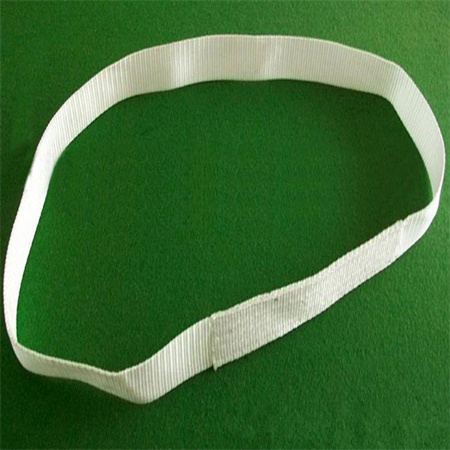
A closed woven ring, shown opened out so that both sides of the loop are visible at once. The band has the fine longitudinal lin es this family carries and a join along the lower edge where it is closed on itself. There is nothing here to measure a length between: the article has no ends, so the size it was made to exists only in the marking and in the order. Everything the table above publishes — thickness, width, minimum and maximum length, weight per metre — is information about an article that looks like this one, and n one of it can be read off the picture.
3. The Same Ladder Twice: What the Thicker Block Actually Buys
The two blocks of the table are not two ranges of product. Read them against each other and they resolve into one ladder of band widths, published twice, with the tonnage doubled the second time. E very one of the nine rows in the four millimetre block has a twin in the seven and a half millimetre block that carries the same three widths and exactly twice the working load limit. The table below puts the nine pairs side by side, with the weight per metre from the first column of each row so that the mass consequence is visible next to the load consequence.
| The four millimetre row | Its twin in the seven and a half millimetre block | The three widths both rows share | Weight per metre at 5:1, thin row then thick twin |
|---|---|---|---|
| 1 t at 4 mm | 2 t at 7.5 mm | 25 / 50 / 30 mm | 0.16 kg/m then 0.38 kg/m |
| 2 t at 4 mm | 4 t at 7.5 mm | 50 / 100 / 60 mm | 0.35 kg/m then 0.68 kg/m |
| 3 t at 4 mm | 6 t at 7.5 mm | 75 / 150 / 90 mm | 0.52 kg/m then 1.28 kg/m |
| 4 t at 4 mm | 8 t at 7.5 mm | 100 / 200 / 120 mm | 0.80 kg/m then 1.61 kg/m |
| 5 t at 4 mm | 10 t at 7.5 mm | 125 / 250 / 150 mm | 0.85 kg/m then 2.04 kg/m |
| 6 t at 4 mm | 12 t at 7.5 mm | 150 / 300 / 180 mm | 0.96 kg/m then 2.32 kg/m |
| 8 t at 4 mm | 16 t at 7.5 mm | 200 / 200 / 240 mm | 1.34 kg/m then 3.30 kg/m |
| 10 t at 4 mm | 20 t at 7.5 mm | 250 / 250 / 300 mm | 1.64 kg/m then 4.62 kg/m |
| 12 t at 4 mm | 24 t at 7.5 mm | 300 / 300 / 300 mm | 1.86 kg/m then 5.12 kg/m |
Two things follow immediately, and both of them are things a buyer can act on.
The first is that the seven and a half millimetre block reaches double the load on the same width of band, and the doubled load costs between about two and about two and three quarter times the wei ght per metre. The weight ratio is not constant: at the bottom of the ladder the twin is 2.4 times heavier for twice the load, and near the top it is around 2.7 to 2.8 times heavier. So the thick bloc k is not simply a heavier copy; expressed as mass per tonne carried it is slightly worse at the top of the range than at the bottom, and a buyer who needs twenty-four tonnes should understand that the y are buying mass as well as capacity.
The second is that the thin block owns the bottom of the range on its own. The four millimetre block starts at one tonne; the seven and a half millimetre block starts at two. Below two tonnes there is only one block to choose from, and a one tonne ring is available only as a four millimetre band — which, at 0.16 kilograms per metre in the 5:1 column, is the lightest article the table publishes.
What the table does not say is what the greater thickness is for. It publishes the difference in load and the difference in mass and stops there. Where a thicker band is being bought for resistance to a particular hazard rather than for load, that is a conversation with the maker rather than a reading of the table, and it is the one question on this page we would rather answer directly than ass ume.
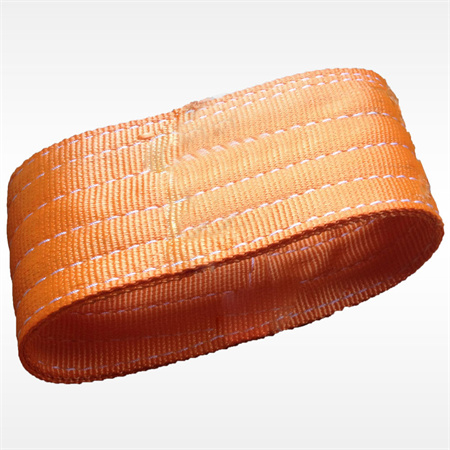
An orange band closed into a ring, held open so that the inside of the loop and the lines of white stitching are both visible. T he band is narrow and the loop is small: this is a ring near the bottom of the ladder in the table above, where the whole article is a few tenths of a kilogram per metre and the two blocks do not both offer a size. The stitching runs along the band rather than closing an end, which is the difference between a ring and a sling with eyes; the page on this site that takes that difference apart proper ly is the circular flat lifting belt page.
4. What the Thickness Column Does Not Change
The parameter table devotes a column to thickness and three columns to width, and the relationship between them is worth stating plainly because it is easy to misread.
The three width columns are the width of the band, and the width of the band is the face that touches the load. It is the figure that decides whether the ring spreads its load over a wide, gentle s urface or concentrates it on a narrow line, and it is the figure a buyer checks against the finish of whatever is being lifted. Now put the two blocks side by side: at every load level the widths are identical. A two tonne ring is published as 50, 100 and 60 millimetres whether the band is four millimetres thick or seven and a half. So the extra thickness does not widen the contact face. If the concern is the width of the band against a delicate surface, the second block buys nothing at all.
What the thickness column does change, on the table's own evidence, is mass. The weight per metre columns are published for both blocks, and the thick twin is roughly twice to two and three quarter times heavier at the same widths. That is not a footnote. On a ring bought for one trip, mass is paid for three times: once in the price, once in the freight, and once by whoever has to carry the art icle to the load and then carry it back. The weight column is the only column on this table that converts a lift into a handling problem, and it is the column most often skipped.
There is a third column the thickness does not change either: the minimum length. That is the subject of the next section, and it is the clearest demonstration on the page that the columns mean les s than they appear to.
5. The Minimum Length Column Is Really a Width Column
The minimum length column looks as though it belongs with the maximum length column beside it. It does not. Put the nine distinct minimum lengths next to the nine distinct widths and the pattern is complete: the minimum length steps up when the width steps up, and it does nothing else. The same ladder appears in both blocks.
| Band width as published | Minimum length in the four millimetre block | Minimum length in the seven and a half millimetre block |
|---|---|---|
| 25 mm | 0.5 m | 0.5 m |
| 50 mm | 1.0 m | 1.0 m |
| 75 mm | 1.0 m | 1.0 m |
| 100 mm | 1.5 m | 1.5 m |
| 125 mm | 1.5 m | 1.5 m |
| 150 mm | 1.5 m | 1.5 m |
| 200 mm | 2.0 m | 2.0 m |
| 250 mm | 2.0 m | 2.0 m |
| 300 mm | 2.0 m | 2.0 m |
Four steps, in both blocks, and they line up exactly with the width: 25 millimetres takes half a metre, 50 and 75 take one metre, 100, 125 and 150 take one and a half, and 200 millimetres and above take two. The seven and a half millimetre block proves the point independently, because it carries double the load and twice the thickness at every level and arrives at precisely the same minimum len gths. Tonnage does not determine the minimum length. Thickness does not determine it. Width does.
That has a practical reading which is worth writing down, because it is the reverse of what most buyers assume. If the job needs the shortest possible ring, the size you are choosing is not decided by the load; it is decided by the band. Asking for a one tonne ring gets you a half metre minimum, but so does asking for two tonnes in the thick block, and if you need a wider band for the surface y ou are lifting you cannot have the short ring at all: the minimum goes to two metres as soon as the band reaches 200 millimetres. On the shortest article in the table, half a metre of band closed on i tself, the loop is small enough to be awkward for hardware — and the pages on this site that deal with what a small loop can and cannot go over are the endless round sling page and the circular eye sh aped lifting belt page.
6. The Longest Ring, and What the Weight Column Turns It Into
The maximum length column is the simplest column in the table: it reads one hundred metres in all eighteen rows, at both thicknesses, at every factor, from one tonne to twenty-four. It is the one f igure on this page that is not a choice.
It is also the figure that makes the weight column necessary, because a hundred metres is nothing like a hundred metres at the two ends of the range. Multiplying the published weight per metre by t he maximum length gives the following, and this is arithmetic on the table rather than a separate claim.
| The ring | Weight per metre as published | What a hundred metres of it weighs |
|---|---|---|
| 1 t at 4 mm, at 5:1 | 0.16 | about 16 kg |
| 1 t at 4 mm, at 7:1 | 0.20 | about 20 kg |
| 2 t at 7.5 mm, at 5:1 | 0.38 | about 38 kg |
| 12 t at 4 mm, at 7:1 | 2.70 | about 270 kg |
| 24 t at 7.5 mm, at 7:1 | 6.10 | about 610 kg |
Six hundred and ten kilograms is a lift in its own right, before the ring has been asked to carry anything. It is also a freight figure and a handling figure, and on a ring bought for a single jour ney it is part of the commercial case rather than an engineering footnote. The buyer who writes a hundred metres on an order without consulting the weight column has ordered something that may need eq uipment to move it into position, and on a one-trip job there is no second chance to arrange that.
Read the other way round, the same arithmetic rescues the small sizes. A one tonne ring at the 5:1 column is about sixteen kilograms at its longest, which one person can carry, coil and pass around a load without help. That is the light end of the same table, and it is the reason the weight column sits next to the length column rather than in an appendix.
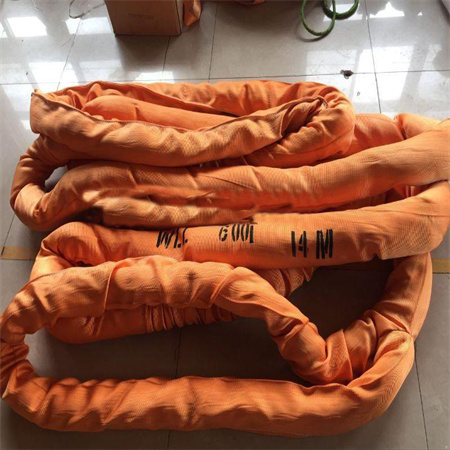
A sleeved round sling, a different construction from the flat ring on this page, and shown here for one reason only: the cover c arries the two figures that matter. The working load limit reads 6T and the length reads 14M, printed directly on the article where the person making the lift will see them. That is what a ring has in stead of a table. There are no ends to measure between and no free band to lay out, so the size the article was built to exists only in the marking and in the order that produced it — which is the pra ctical reason the marking has to be legible rather than merely present.
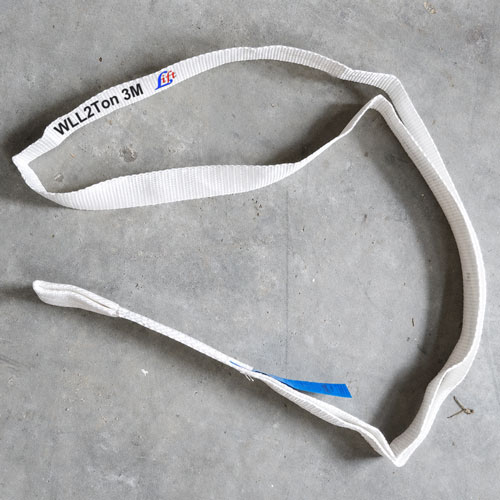
The same two figures on a woven article rather than a sleeved one: WLL2Ton and 3M printed along the band, with a printed label s ewn alongside. The band is white, which is this family's un-dyed fibre, and the loop is long enough that the two printed figures are far apart on it. Read together with the photograph above, this is t he whole of a ring's visible paperwork: a load figure and a length figure, on the article, and nothing else about the table that produced it.
7. The Two Columns That Disagree in Six Rows
Everything above is arithmetic that resolves cleanly. This section is the one place where it does not, and it is better said than left for a buyer to discover.
The three width columns exist because the factor decides how much band a given load needs: a higher factor means less of the band's strength is used up by the margin, which for the same fibre and t he same construction means a wider band. That is the reason the table publishes three columns instead of one, and on this table two of the three columns behave exactly as that reasoning requires. The 7:1 column is 1.2 times the 5:1 column in every row except the largest in each block, where both columns reach 300 millimetres and stop. The 5:1 column rises cleanly with the load through all eighteen rows.
The middle column does not. In the lower six rows of each block — from one tonne to six tonnes in the thin block, and from two tonnes to twelve in the thick one — the 6:1 width is published as
Those two facts cannot both describe the same product. In six rows of each block the middle column is wider than the top column, which contradicts the reason the three columns exist; and the ratio between the first two columns changes from 1.0 to 2.0 as you move down the table, which no change of load explains. One of the two columns is out by a factor of two in those six rows, and the table it self does not say which. Since the 7:1 column tracks the 5:1 column consistently at 1.2, the more economical reading is that the 6:1 column carries a doubled figure in six rows of each block — but tha t is a reading, not a fact the table states, and we will not build a ring on a reading.
The same section carries one more honest note. The table's own two captions, as they were published, name the article differently: one describes the parameters of a circular disposable flat sling a nd the other describes a comparison table of safety factors for circular flat straps. A table with two names has been carried over from another article on this site, and that is the ordinary explanati on for a figure that does not fit. It is why the width will be confirmed, in writing, against the article you are ordering, before the band is cut.
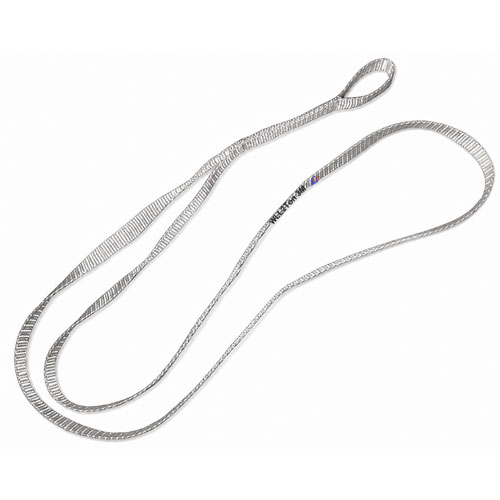
A long white loop gathered into a smaller loop at the top where the band doubles back on itself, with a printed label sewn into the band beside the middle. Nothing about the article in the photograph tells you whether it is a four millimetre band or a seven and a half millimetre one, what its width is, or what it can carry. Al l of that lives in the table and in the marking, which is the argument of this page: the table is the specification, the article is its output, and where the table disagrees with itself the confirmati on has to happen before the band is cut rather than after it has been despatched.
8. What Being Disposable Changes, and What It Does Not
Disposable describes the trip, and on this site the word has been argued out properly on its own page: it is a purchase decision rather than a grade of article, and it does not remove a single requ irement that applies to a rated sling (the disposable sling page). The single use lifting sling page takes the same question further and is t he place to read about the marking, the factor as a labelling decision and the end of the article's life (the single use lifting sling page). Neither is repeated here.
What is specific to a ring, and worth saying once, is what the trip does to the way the article is identified. On a flat sling with eyes, the capacity is marked and the length can be measured betwe en the eyes if anybody doubts it. A ring offers no such second chance. There is no end to measure from, and on the sleeved construction the load-bearing part is inside a cover. So on a disposable ring the marking is not a convenience; it is the entire record of what the article is. The two photographs in the previous section show the trade's answer: the load figure and the length figure printed di rectly on the band or the cover, where the person making the lift will see them at the moment of use.
The other ring-specific consequence of a single trip is that the article is bought and counted rather than stocked and drawn. That is a subject properly belonging to the consumable side of this fam ily, and the page that takes it up is the single use endless webbing sling page, which deals with storage, issue, cou nting and reconciliation. For this page it is enough to note the arithmetic consequence of the table above: because a hundred metres of the largest ring in this table weighs six hundred and ten kilogr ams, the count and the weight of a single-trip order are the same decision seen twice.
9. The Four Figures an Order for This Ring Needs
The most useful thing a parameter table can do is show a buyer how many decisions they are actually being asked to make. This one asks for four, and a fifth and a sixth that are not in the table at all.
| The figure | What to write | Why a ring needs it stated |
|---|---|---|
| 1. The working load limit | The load figure for the arrangement you will actually use, not for the load as weighed. A ring carries differently depending o n how it is passed around the article, and the page on this site that sets those arrangements out is the endless round sling page. | Because a ring has no ends, the arrangement is the only thing that decides how the load enters it, and the arrangement is chos en at the load rather than in the office. |
| 2. The factor | One of 5:1, 6:1 or 7:1, as the columns of the table are published. | Because the width follows from the pair. At one tonne the table publishes the band as 25 millimetres at one factor and 30 mill imetres at another, and at six tonnes as 150 against 180. |
| 3. The thickness | Four millimetres or seven and a half millimetres. For loads between two tonnes and twelve this is a genuine choice, because th e table publishes both. | Because a figure such as four tonnes is ambiguous on this table. Four tonnes exists as a four millimetre row and, in the thick block, eight tonnes shares the same widths. |
| 4. The length, with its convention | The figure, and a word about how it was measured, since a ring has no ends to measure between. The pages on this site that tak e the length convention apart are the circular flat lifting belt page and the endless round sling page. | Because the same figure is quoted under more than one convention in this trade, and the difference is a real distance rather t han a rounding. |
| 5. The fibre, and the environment | The fibre, named, so that it can be marked on the article; and the temperature and the chemistry of the place the ring will wo rk in. The duty envelope for a ring is set out on the circular flat lifting belt page and on the disposal circular sling page. | Because a ring is used in contact with the load along its whole length, so the whole article is exposed rather than two ends o f it. |
| 6. The quantity, and the weight of the order | The number of rings, and the total weight taken from the weight column of the table above. | Because on a single-trip order the count is the order, and because at the top of the table the weight of the order is a handli ng problem in its own right. |
Four figures in the table and two lines outside it, and the reason all six matter is visible in the table itself. A three tonne ring at four millimetres and a six tonne ring at seven and a half mil limetres share the same three widths, so a width alone does not identify the article; a four tonne ring exists in both blocks, so a load alone does not identify it either; and the three width columns mean that a load plus a width still leaves the factor open. A ring order that carries only a tonne and a length does not fix the article at all. It is the most common way this family of orders goes wrong, and it is entirely avoidable, because every figure needed to close it is published on this page.
10. Where Each Question Goes on This Site
A ring raises more questions than one page should answer, and this site answers most of them better elsewhere. This table is the map, and where a question is not in it, the answer is a telephone ca ll.
| The question | Where it is answered | Why it is not repeated here |
|---|---|---|
| What standard governs a closed woven belt, and how is the loop closed? | Circular flat lifting belt | The standard and the seam are that page's subject, argued in full. |
| What follows from having no ends, and what arrangements can a ring make? | Endless round sling | Both belong to that page, including the length convention on a closed loop. This page states the length consequence once and l inks. |
| Is my ring a woven tube or a tube with a seam, and is it a cover over a core? | Circular sling | That page exists to separate the two constructions and to say how to tell which one you have been offered. |
| Polyester or nylon for a one-trip ring? | Disposal circular sling | The fibre comparison, the four conditions that choose between the two, and the colour band are that page's subject. |
| Flexibility and conformity to a shape | Circular flexible lifting belt | That page's whole argument, including where conformity stops being protection. |
| The shape of the eye, and the cylindrical body | Circular eye shaped lifting belt | The eye form and what a cylindrical body changes at contact belong to that page. |
| Why the same capacity can come in two band thicknesses | This page, section 3, and the maker | The table publishes the difference in load and in mass and says nothing about the reason, so the reason is a question rather t han a reading. |
| What has to be marked, and what the marking has to carry | Single use lifting sling | The marking items and the regulatory position are set out there. |
| Is a one-trip ring exempt from inspection? | Disposable sling, and the single use lifting sling page | Both deal with what a single trip does and does not change. |
| Storing, issuing and counting consumables | Single use endless webbing sling | The consumable side of the family, taken up as its own subject. |
| A flat ring made as a flat woven belt with eyes instead | Double buckle flat wear-resistant sling | The flat family with formed ends, where the ends rather than the loop are the working part. |
11. Frequently Asked Questions
Q1: What is a circular disposable sling?
Q2: Why does the table on this page come in two blocks?
Q3: So what does the extra thickness buy me?
Q4: Can I get a four tonne ring in both thicknesses?
Q5: What is the shortest ring you can make?
Q6: What is the longest, and how heavy does it get?
Q7: Why are there three width columns?
Q8: Something in the table does not add up. What now?
Q9: How is the length of a ring stated?
Q10: Is a single-trip ring exempt from anything?
Q11: What is the quickest way to send a workable enquiry?
Contact
Lift Sling Rigging Co., Ltd makes the article on this page: closed woven rings in the width, thickness, length and fibre a job needs, in quantities bought for a single journey. If you are holding a table with two blocks in it and a figure that does not look right, send us the row and the column; we would rather confirm a width before the band is cut than explain one afterwards.
Telephone and WeChat: 18066002268
E-mail: 702461526@qq.com
Address: Lifute Industrial Park, Taizhou City, Jiangsu Province, China
HS code: 630790
- Previous:Glass lifting sling,Bare glass sling,Glass sling manufacturer, Glass sling price
- Next:Double ring disposable lifting strap, double buckle disposab
-
Drone Anti-collision Net
-
Extra Large Capacity Cargo Net
-
Cargo Webbing Net
-

Color changing nylon double buckle loop nylon braided rope
-

Two end buckle lifting rope, double buckle round lifting rope, double fork nylon lifting rope, non jointed nylon lifting rope
-

Emergency escape lifeline, fire escape rope, fire safety escape emergency rope, steel wire core fire rope

