 Language
 简体中文
简体中文
- On the 2018 National Day holiday, Lifet completed six 100 ton large tonnage lifting belts as a gift
- The role of suspension net in the transportation of goods turnover
- Cargo soft lifting net, lifting net, lifting net, lifting net, bag, climbing net
- Precautions for using Lifutiden elevator
- How to make circular lifting straps
Contact: Wang Lili
E-mail:18066002268
Phone:702461526@qq.com
Address: Lifute Industrial Park, Taizhou City, Jiangsu Province

Lifute Hoisting Co., Ltd. 18066002268 produces lifting belts, lifting nets, nylon ropes, soft ladders, steel wire rope rigging, paper ropes, safety belts, safety nets, lifting chains, steel coil hoists, crossbeam hoists, flat lifting belts, circular lifting belts, electric traction ropes, high-altitude safety belts, and anti fall safety nets Four phrases name one fire-resistant range in four shapes: a fireproof lifting belt, a fireproof circular sling, a fireproof circular flexible lifting belt and a fireproof eye type lifting belt.
Hits: ℃
Release time:2026-09-27 15:09
Lift Sling Rigging Co., Ltd manufactures Fireproof lifting belt, fireproof circular sling, fireproof circular flexible lifting belt, fireproof eye type lifting belt
Fireproof Lifting Belt, Fireproof Circular Sling, Fireproof Circular Flexible Lifting Belt and Fireproof Eye Type Lifting Belt — Model Code, Not a Heat Rating
The four phrases in this page's name are four forms of one range in its fire-resistant version: a flat belt, a circular sling, a circular flexible belt, and the eye type belt. Four words, not four products, and this site already writes each of those forms up on its own page.
The heat side of the subject is written up too, and it is not repeated here. The high temperature resistant ring eye type belt page takes the three kinds of heat apart — contact, radiant and weld s platter — and asks what a stated figure of 500 degrees actually requires. The high temperature aramid webbing lifting sling page argues that a high temperature is not a number, that the phrase hides t hree of them, and that the article is four materials rather than one. The aramid round sling page treats aramid as a substitution rather than an upgrade. The flame resistant aramid webbing sling belt page carries the fibre comparison, the construction and the marking. Every one of those is linked from this page and none of it is repeated.
What this page does instead is read the parameter table that was already on it, and that table is a different kind of document from anything else on this site. It is a mode l-code table: ten models, numbered FHD 01-01 to FHD 01-20, with the capacity in kilograms, an approximate thickness, an approximate width, a minimum and a maximum length, and a single weight column headed 6:1. Reading it raises three things that a buyer ordering from a code needs to know, and one that is more important than all three: the code pins down five of the six columns; it skips, so there is no seven tonne model to step to; and the table prints one factor rather than three. And, most importantly, no code in this table expresses a heat rating at all. The word fireproof describes the range. The code describes the article's capacity and its geometry. If a stated heat performance is needed, it has to be writte n in words on the enquiry, because there is nothing in the code that can carry it.

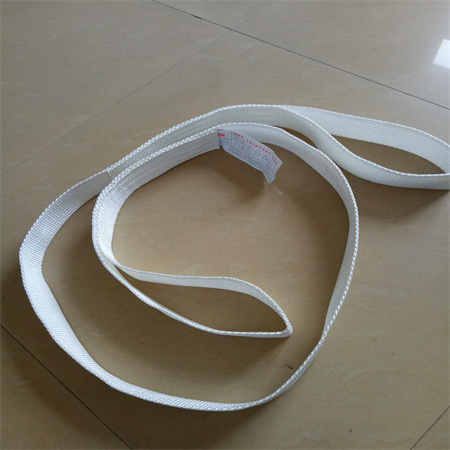
This page's own photograph, and the best possible illustration of the problem the page is about. It is a flat woven band, formed into a long loop and laid in two returning folds, with the joins where the band doubles back visible along it. There is no label in the frame and no printed figure: nothing in the picture says which of the ten models this is, what it can carry, how thick the band is or how wide. The colour is a khaki yellow, which is not one of the capacity colours this family uses on its general-purpose ranges, and it is not a grade marked on the article either. On this range the article is identified from the table and from the label, not from the picture, which is exactly why the next section is about the table rather than about the band.
1. Four Phrases, Four Forms, One Range
A buyer reading this page's name might reasonably think four articles are on offer. What is on offer is one range in four forms, and the four forms are already written up separately on this site. T he table below says which phrase names which form, and where that form is argued out in full.
| The phrase | The form it names | Where that form is written up on this site |
|---|---|---|
| Fireproof lifting belt | The flat woven belt, cut to a length and used as a belt rather than as a closed loop. | The polypropylene flat lifting strap and the polypropylene flat sli ng carry the flat family, its width ladder and its chemistry. |
| Fireproof circular sling | The closed ring: one band joined to itself, with no end to attach a load to and no end to inspect from. | The endless round sling page owns the consequences of having no ends, and the arrangements a ring can make. |
| Fireproof circular flexible lifting belt | The closed ring read as a conforming article: one that is chosen for how it lies against a curved face rather than for how muc h it carries. | The circular flexible lifting belt page takes flexibility and conformity apart, including where conformity stops being protection. |
| Fireproof eye type lifting belt | The form with a formed loop at each end, so that the load enters at two places rather than all along a ring. | The circular eye shaped lifting belt page owns the eye form, the cylindrical body and the duty envelope. |
Because one range covers four forms, the phrase fireproof is doing the work of a range name here rather than the work of a measurement. That distinction is the whole of this page. There is no number in the name, no factor in the name, and no temperature in the name; there is a word that describes what the range is intended to tolerate, applied to four shapes of article. Everything that can be counted, weighed or quoted lives in the table, and the table is the next section.
It is also worth saying plainly what the word cannot do. On the four pages listed above this site deals with heat properly: the three kinds of heat and what a large stated figure requires; the diff erence between a temperature a fibre can be stored at and one it can work at; the fact that a sling assembly is more than its band; and the fact that changing the fibre changes the lift rather than si mply improving it. A page that repeated any of that here would be a fifth version of the same argument. So this page takes the heat material as given and asks a narrower question: when a fire-resistan t range is sold by model code, what does the code actually fix?
2. The Table on This Page: a Model-Code Table
The table below is this page's own parameter table. It was published on the page before this text was written, in Chinese, headed with the words Fireproof lifting belt parameters, and it is reprodu ced here in English with every figure unchanged. It is a different shape of document from the parameter tables on the other pages of this site: those give a capacity ladder and let the buyer choose a factor and a length; this one numbers each article and publishes one line per number.
| Model | Rated load (kg) | Approximate thickness (mm) | Approximate width (mm) | Minimum length (m) | Maximum length (m) | Weight, 6:1 (kg/m) |
|---|---|---|---|---|---|---|
| FHD 01-01 | 1000 | 4 | 30 | 1.5 | 80 | 0.28 |
| FHD 01-02 | 2000 | 5 | 40 | 1.5 | 80 | 0.42 |
| FHD 01-03 | 3000 | 6 | 50 | 1.5 | 80 | 0.50 |
| FHD 01-04 | 4000 | 7 | 60 | 1.5 | 80 | 0.56 |
| FHD 01-05 | 5000 | 8 | 70 | 1.5 | 80 | 0.60 |
| FHD 01-06 | 6000 | 9 | 75 | 2.0 | 80 | 0.70 |
| FHD 01-08 | 8000 | 11 | 80 | 2.0 | 80 | 0.80 |
| FHD 01-10 | 10000 | 13 | 90 | 2.0 | 80 | 1.50 |
| FHD 01-12 | 12000 | 14 | 100 | 3.0 | 80 | 2.24 |
| FHD 01-15 | 15000 | 16 | 110 | 3.0 | 80 | 2.66 |
| FHD 01-20 | 20000 | 18 | 125 | 3.0 | 80 | 3.64 |
Three notes on the document itself. The first is that the model number is not an arbitrary serial: the digits after the prefix are the capacity in tonnes, so FHD 01-06 is the six tonne model and FH D 01-20 is the twenty tonne one. That makes the code readable, and it makes the second note unavoidable: the codes are not continuous. Between the six tonne model and the eight tonne model there is no seven; between ten and twelve there is no eleven; and the last step on the ladder is five tonnes wide. The third note is the weight heading. It reads 6:1 in this table, and it is the only weight colu mn there is, whereas the parameter tables on this site's other ranges publish three weight columns side by side so that the factor can be chosen. Both of those differences change how a buyer has to or der, and they are the subjects of the sections that follow.
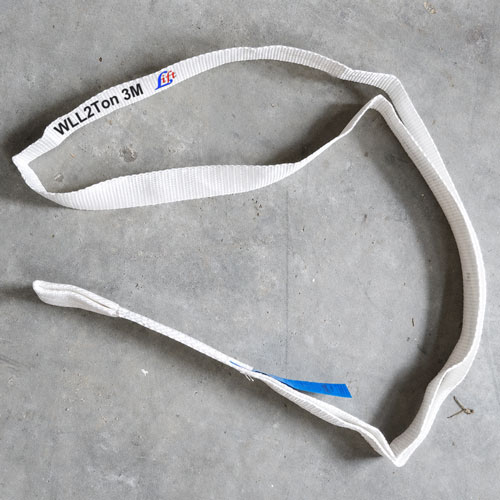
A band of this family carrying its own identification: the working load limit printed as a figure and the length printed beside it, with a smaller label sewn on. Read this against the photograph at the top of the page. There, a band of the same construction was shown with nothing printed on it and no label in the frame, and no thing about it could be established from the picture. Here, two of the six columns of the table are on the article itself. That is the difference a model-code range has to make up for: the code travel s on the paperwork, so whatever is not printed has to be checked against the table rather than read off the band.
3. What the Model Code Pins Down
A model code is only worth having if it carries information, and on this table it carries a great deal. Take the six tonne model, FHD 01-06. The number in the code says six tonnes; the row says the band is approximately nine millimetres thick, approximately seventy-five millimetres wide, that the shortest article made to the model is two metres long, that the longest is eighty metres, and that the band weighs 0.70 kilograms per metre at the factor the table is written to. Five figures, all of them fixed by the code, and a sixth figure — the length — bounded by the row rather than set by it.
That is a real shortcut, and it explains why ranges like this are sold by code in the first place. The ladder is consistent enough that the codes can be read as a progression. Capacity rises from o ne tonne to twenty in eleven steps. The width rises with it from 30 millimetres to 125, almost in step with the capacity, so a buyer who knows they need more capacity also knows they are getting a wid er band. The thickness rises from four millimetres to eighteen. And the weight per metre rises from 0.28 to 3.64, which is a factor of thirteen across the range. Someone who has ordered one model and needs a bigger one can read the next row and know what they are getting without asking.
| What the code fixes | Where it is published | What a buyer does with it |
|---|---|---|
| Working load limit | The number in the code, and the rated load column in kilograms | Chooses the model. This is the one figure most buyers think the code consists of. |
| Thickness and width of the band | The third and fourth columns | Checks the band against the surface it will bear on, and against the space it has to pass through. |
| The shortest article the model is made in | The minimum length column | Rules out a short pick before the enquiry is written, not after. |
| Weight per metre at the stated factor | The last column | Turns a length into a shipping weight and a handling problem. |
| The length itself | Bounded by the two length columns and fixed by nothing else | Has to be stated on the order. This is the column the code does not decide. |
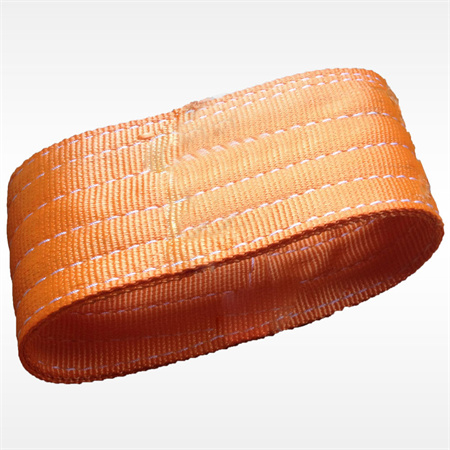
An orange band closed into a ring, held open so that the inside of the loop and the run of white stitching are both visible. Two things in this picture are worth carrying into the discussion of the code. The first is that the article is more than its band: there is a run of thread in it, and the thread is a second material wit h its own behaviour. The second is that the band is one thickness and one width, and the photograph cannot tell you which. Both of those facts bear on what a model code can and cannot carry, and they are why the code has to be read against the table rather than against the article.
4. What the Code Leaves Open: the Length
The one column the code does not decide is the one buyers most often forget to write. Every model in the table is made to a range of lengths, and the range is wide: the smallest model runs from 1.5 metres to 80 metres, and the largest from 3 metres to 80. That is nearly two orders of magnitude of variation sitting inside a single code.
The reason this matters more than it looks is that the length is not a convenience on an article bought by model. It decides the weight, and on this range the weight spans a factor of five across t he ladder before the length is even considered. A hundred metres is not available here — the maximum is 80 metres in every row — but 80 metres of the heaviest model is a different order of object from 1.5 metres of the lightest, and both of them are ordered by a code that looks the same length on the page.
There is also a convention buried in the word length, and it is the same convention question that runs through every family on this site: an article has a length, and the length can be measured mor e than one way. On the forms named in this page's title that question is answered differently, and the pages that own each form set it out: the endless round sling page for the closed ring, the circul ar eye shaped lifting belt page for the form with a loop at each end, and the circular flat lifting belt page for the sewn belt. What matters here is the consequence for an order: a code and a length together still do not describe an article unless the length says how it was measured. It is the cheapest line on the order to write and the most expensive one to omit.
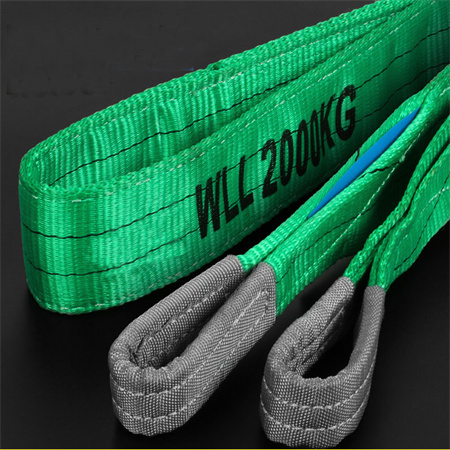
A band that carries two of the six columns of the table on its own face: a working load limit and, on this article, a length. Th e ends are finished with grey sleeving over the formed eyes, which is a second material laid over the band rather than part of it. The picture is here because of what it does not show: the thickness o f the band, its width, and the minimum and maximum lengths it is made in are all absent, and they are the figures a buyer orders from. On this page the table supplies them, and the code is what ties t he table to the article in the hand.
5. The Code Skips: There Is No Seven Tonne Model
The second thing a buyer has to know about an ordered range is that the ladder is not continuous, and on this table it is not. The models are made in the following capacities, in kilograms: 1000, 2 000, 3000, 4000, 5000, 6000, 8000, 10000, 12000, 15000, 20000. Read the codes and the gaps are plain: there is no seven tonne model, no nine, no eleven, no thirteen, no fourteen, no sixteen and no eig hteen.
On a range ordered by model, this changes the nature of the choice. A buyer who needs seven tonnes is not rounding; they are choosing between a six tonne model that is below their requirement and a n eight tonne model that is above it, and those are different decisions with different consequences. Going up costs weight and money and may change the width, the thickness and the minimum length toge ther. Going down is not available at all, because the working load limit is a limit. The same applies at every gap, and the largest gap is at the top: between the fifteen tonne model and the twenty to nne model there is a five tonne step, so an eighteen tonne requirement lands on the twenty tonne model with two tonnes of capacity that was not asked for and a band that is 15 millimetres wider than t he fifteen tonne model's.
| The requirement | The models either side | What the buyer actually decides |
|---|---|---|
| 7 t | FHD 01-06 (6000 kg) and FHD 01-08 (8000 kg) | One tonne of unused capacity, 75 to 80 millimetres wider of band, and 0.10 kilograms per metre more of article. |
| 9 t | FHD 01-08 and FHD 01-10 | The 10 t model adds ten millimetres of width and a large jump in weight per metre, 0.80 to 1.50. |
| 11 t, 13 t, 14 t | FHD 01-10, FHD 01-12, FHD 01-15 | Three requirements in a row land on the same three models, and the choice is made on weight and width rather than on capacity alone. |
| 16 t to 18 t | FHD 01-15 and FHD 01-20 | The widest gap on the ladder. The twenty tonne model is the only model above fifteen, so the five tonne step is unavoidable above it. |
None of this is a criticism of the range; a standardised ladder with sensible steps is what makes a model code worth publishing. It is simply the arithmetic a buyer should do before writing the cod e down, because on an ordered range the phrase the nearest model hides a decision. If the requirement falls in a gap, say so in the enquiry and say which way you would rather go, and the answer can be given against the row rather than against the drawing.
6. One Factor, Not Three
The third difference between this table and the parameter tables on the rest of this site is the weight column. It is headed 6:1, and there is one of it. On the other ranges the same table publishe s three weight columns side by side, one for each of the factors the trade uses, so that a buyer who wants a higher factor can see what it costs in band. Here the factor is not a choice offered by the table: the table is written to a factor of six, both the weight column and the article itself.
Two consequences follow, and they point in opposite directions. The first is convenience. A single factor removes a decision, and on a range sold by model code that is consistent: the code fixes th e capacity, the table fixes the factor, and the buyer is left with the length. For a buyer who has no reason to want a different margin, this is the simplest table on the site to read.
The second is that a different factor cannot be ordered by asking for a different column, because the column does not exist. A buyer whose own specification calls for a higher margin is asking for a different article, and the honest way to handle it is to say so at the enquiry rather than to assume that the range will stretch. The page on this site that explains what a factor is, where the numb ers come from and why it has to be named rather than assumed is the one way sling page, and it is the right place to read that argument rather than this one.
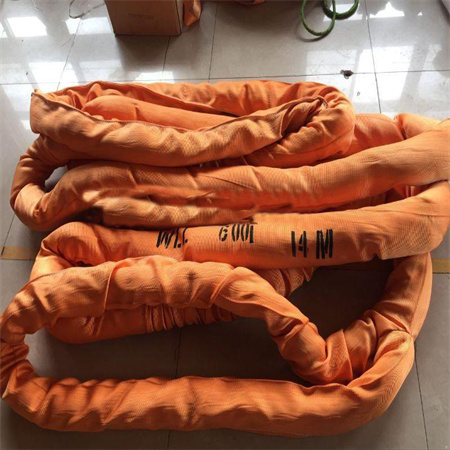
A sleeved round sling with two figures printed along its cover: a working load limit and a length. The article in the photograph is a different construction from the belts in this page's table, and it is here because it makes the point about the columns. The two figures the cover carries are the two a person at the load most n eeds — the limit and the length — and they are printed on the outside where the sleeve is. The factor is not there, the thickness is not there and the width is not there, because none of those can be read off an article in the hand. They come from the table, which is why the table and the code have to travel with the order.
7. The Minimum Length Ladder, in Three Steps
Set the minimum length column against the width column and a rule appears that is not stated anywhere on the page: the shortest article a model is made in is decided by the width of its ban d, not by how much it can carry. The minimum length steps three times across the ladder, and the steps line up exactly with the width bands.
| Band width as published | Models | Minimum length |
|---|---|---|
| 30 to 70 mm | FHD 01-01 to FHD 01-05, one to five tonnes | 1.5 m |
| 75 to 90 mm | FHD 01-06, 01-08 and 01-10, six to ten tonnes | 2.0 m |
| 100 to 125 mm | FHD 01-12, 01-15 and 01-20, twelve to twenty tonnes | 3.0 m |
The practical reading is the reverse of what most buyers assume. If a job needs the shortest possible article, the constraint is not the capacity but the band: a narrow belt can be made short, and a wide one cannot. Three metres is the shortest anything in the top half of the ladder can be made, which is a real limitation for anyone lifting twenty tonnes in a confined space, and it is not a lim itation that the capacity column warns you about. The other way round, the light models are also the short ones, so a small tight pick and a small capacity go together here — which is convenient, and worth knowing rather than assuming.
One more figure belongs in the same breath. The maximum length is 80 metres in every row, at every capacity, which is lower than the 100 metres published on other ranges of this site. A buyer who h as read another page and arrives expecting to order 100 metres will not find it here, and the place to notice that is the table rather than the order acknowledgement.
8. The Weight Column: Twenty-Two Kilograms and Two Hundred and Ninety-One
The last column is the one that turns the table from a specification into a purchase. Multiply the published weight per metre by the maximum length and the ladder's range becomes visible in the onl y unit that matters at the loading bay.
| The model | Weight per metre as published | What eighty metres of it weighs |
|---|---|---|
| FHD 01-01, one tonne | 0.28 | about 22 kg |
| FHD 01-06, six tonnes | 0.70 | about 56 kg |
| FHD 01-12, twelve tonnes | 2.24 | about 179 kg |
| FHD 01-20, twenty tonnes | 3.64 | about 291 kg |
Twenty-two kilograms is a coil one person can lift onto a shoulder and carry through a doorway. Two hundred and ninety-one kilograms is a quarter of a tonne of webbing, and it does not arrive as a coil that one person handles: it needs equipment to move it, a place to put it, and a decision about how it will be paid for, because on this range the weight is a freight figure as well as a lifting figure. Between those two ends of the same ladder are eight more models, and the weight per metre moves by a factor of thirteen across the whole set.
The useful consequence for a buyer is that the weight column lets the question be asked before the order rather than at the gate. A job that needs long articles at the top of the ladder is a job wi th a handling problem attached to it, and the arithmetic is a single multiplication that is published on the page rather than quoted by a sales desk. On a range sold by model code this is also the onl y place where the difference between two adjacent codes can be seen in a unit other than capacity or width: the jump from 0.80 to 1.50 kilograms per metre between the eight tonne and the ten tonne mod els is the largest single step in the column, and it is invisible in the code.
9. What Fireproof Can and Cannot Be on a Model Code
This is the point the rest of the page has been building towards, and it is short because it is a limit rather than an argument.
The table this page publishes has six columns. One carries the model, one the capacity, and four carry geometry or weight: thickness, width, minimum length, maximum length and the weight that follo ws from them. There is no column for heat. Nothing in the table states a temperature, a class, a test or a duration, and the model code has no field in which such a thing could be written. So the word fireproof in this range's name is doing what a range name does — it describes what the range is intended for — while the code describes the article's capacity and its geometry. A buyer who ne eds a stated heat performance cannot express it by choosing a code.
That is not a gap in this page; it is a property of naming a performance in a product name rather than in a specification. The three things buyers fold into the one word are dealt with properly els ewhere on this site and are not re-argued here: the ring eye type belt page for the difference between contact heat, radiant heat and weld splatter, and for what a stated figure such as 500 degrees ac tually requires of an article; the high temperature aramid webbing sling page for the three numbers the phrase high temperature hides, and for the fact that the article is several materials rather tha n one, including the thread that holds it together and the label that carries its rating; the aramid round sling page for what changes in the lift itself when the fibre changes, which is a substitutio n rather than an upgrade. A buyer with a heat question should read those pages, and then come back to this table to choose the capacity.
Two practical points follow for anyone ordering from this code. The first is that a heat performance has to be written in words on the enquiry, because there is nowhere else for it to go. Whether t he requirement is a working temperature, a resistance to a particular kind of exposure, or a test that the article has to satisfy, the way to get it is to state it and have it confirmed in writing for the article you are buying. The second is a caution that applies to any fire-resistant article: the parts of a sling that are not the band are also parts, and on this range that includes the thread r unning through it, the label and anything sleeved or covered. A performance confirmed for the range is not automatically a performance confirmed for every component of the assembly, and the page that sets that argument out in full is the high temperature aramid webbing lifting sling page.
One thing this page will not do is guess. Nothing in this text should be read as a temperature, a class or a duration for the range, because the table does not publish one and this page does not in vent what the table leaves out. Ask, and the answer comes back in writing, against the model and the length you are ordering.
The component that decides whether a rated article can be used at all: a printed label sewn into the band rather than threaded o nto it, so that it cannot be moved to another article. On the question this page ends with, the label is part of the answer. It carries the identification, it is a material in its own right, and an ar ticle bought to work near heat is only as good as its least tolerant component. What a label has to survive, and why it has to survive it, is set out on the high temperature aramid webbing lifting sli ng page rather than here.
10. What to Put in an Enquiry for This Range
An enquiry for a model-coded article is shorter than for most things on this site, because the code does so much of the work. Six lines, and the last two are the ones that get left out.
| The line | What to write | Why this range needs it |
|---|---|---|
| 1. The model | The code, or the capacity in kilograms, or the capacity in tonnes. All three identify the same row, and the row then fixes thi ckness, width, minimum length and weight. | Because the ladder skips. If the requirement falls in a gap, say which way you would rather go — six tonnes or eight, fifteen or twenty — rather than leaving it to be rounded. |
| 2. The length, and its convention | The figure between the minimum and the maximum, plus a word about how it was measured. The maximum is 80 metres on every model in this table. | Because the length is the one column the code does not decide, and because the same figure is quoted under more than one conve ntion in this trade. |
| 3. The heat performance, in words | Whatever the job actually requires: a working temperature, the kind of exposure, or a test the article has to satisfy. | Because no code on this page can carry it. This is the line that a range name makes people think they do not have to write, an d it is the line that decides whether the article suits the job. |
| 4. The environment | Which kind of heat is present, and whether the article will also meet chemistry, water or abrasion at the same time. | Because a fire-resistant article is often asked to work where something else is also present, and the combination is what the article has to survive. |
| 5. The form you want | The belt, the circular sling, the circular flexible belt or the eye type belt. This page's name covers all four and the table does not distinguish them. | Because the same row of the table is offered in four shapes, and the shape decides how the load enters the article rather than how much it carries. |
| 6. The quantity, and the total weight | The number of articles, and the figure you get by multiplying the weight column by the length for each of them. | Because at the top of the ladder the weight of the order is a handling and freight problem in its own right, not a line on an invoice. |
The two lines that go missing most often are the second and the third: the convention behind the length, and the heat performance. They go missing for the same reason, which is that both feel obvio us to the person who already knows the job. Nobody on the factory floor can see either of them from the code, so both have to be written down.
11. Where Each Question Goes on This Site
This page is about one thing: what a model code on this range fixes and what it does not. Everything else a buyer of a fire-resistant sling needs is on another page, and this table is the map.
| The question | Where it is answered | Why it is not repeated here |
|---|---|---|
| What kinds of heat are there, and what does a stated temperature demand? | High temperature resistant ring eye type lifting belt | Contact heat, radiant heat and weld splatter, and the temperature ceiling of ordinary webbing, are that page's subject. |
| Is a high temperature one number? | High temperature aramid webbing lifting sling | The three numbers the phrase hides, the four materials an article is made of, and the label that has to survive are all argued there. |
| What does changing the fibre do to the lift? | Aramid round sling | Aramid as a substitution rather than an upgrade, and what changes in the lift, belong to that page. |
| Aramid webbing, flame resistance and cut resistance together | Aramid webbing sling belt, flame resistant and cut resistant | The fibre comparison, the construction, the capacity range and the marking of that article. |
| What does the factor mean, and why name it? | One way sling | The factor system and the marking conventions. This page only reports that its table is written to one factor. |
| The closed ring, and what having no ends means | Endless round sling | The arrangements a ring can make, and the length question on a closed loop. |
| The conforming ring, and where conformity stops helping | Circular flexible lifting belt | Flexibility is not stretch and conformity is not protection: that page's argument, in its own words. |
| The eye form, its body and its duty envelope | Circular eye shaped lifting belt | The eye shape, the cylindrical body and the fibre envelope. |
| The flat family, its widths and its chemistry | Polypropylene flat lifting strap | The flat ladder, the weave and the chemical exclusions of that fibre. |
| Length, width and factor read column by column on another range | Circular lifting belt | A specification sheet read line by line, and the three words belt, sling and lashing. |
| What removes an article from service | Circular flat lifting belt | The standard's own list of conditions, and the two published sets of temperature figures. |
12. Frequently Asked Questions
Q1: Are these four different products?
Q2: What does the code FHD 01-06 actually tell me?
Q3: Why is there no seven tonne model?
Q4: How long can I order?
Q5: How is the length measured?
Q6: What factor is the table written to?
Q7: Why do the two heavy models weigh so much more?
Q8: The name says fireproof. What temperature is that?
Q9: Is the whole article fire resistant, or only the band?
Q10: Which of the four forms should I choose?
Q11: What is the shortest enquiry that gets a usable answer?
Contact
Lift Sling Rigging Co., Ltd makes the range described on this page: the fire-resistant belt, ring, conforming ring and eye type belt, built to the models in the table, in the lengths and quantities a job needs. If the row you want falls in a gap on the ladder, or if the job needs a heat performance that has to be written rather than coded, send us the job rather than the code and we will put th e two together.
Telephone and WeChat: 18066002268
E-mail: 702461526@qq.com
Address: Lifute Industrial Park, Taizhou City, Jiangsu Province, China
HS code: 630790
- Previous:Lifting straps, lifting slings, nylon lifting slings, flat lifting slings
- Next:Glass lifting sling,Bare glass sling,Glass sling manufacture
-
Drone Anti-collision Net
-
Extra Large Capacity Cargo Net
-
Cargo Webbing Net
-

Color changing nylon double buckle loop nylon braided rope
-

Two end buckle lifting rope, double buckle round lifting rope, double fork nylon lifting rope, non jointed nylon lifting rope
-

Emergency escape lifeline, fire escape rope, fire safety escape emergency rope, steel wire core fire rope

