 Language
 简体中文

- On the 2018 National Day holiday, Lifet completed six 100 ton large tonnage lifting belts as a gift
- The role of suspension net in the transportation of goods turnover
- Cargo soft lifting net, lifting net, lifting net, lifting net, bag, climbing net
- Precautions for using Lifutiden elevator
- How to make circular lifting straps
Contact: Wang Lili
E-mail:18066002268
Phone:702461526@qq.com
Address: Lifute Industrial Park, Taizhou City, Jiangsu Province
A WLL 400 ton endless polyester round sling is a sleeved continuous loop of polyester yarn rated to lift 400 tonnes in a stated configuration, the working load limit being separated from the breaking load by the factor, commonly 7:1 at EN 1492-2. Endless keeps the sewn splice and the end fitting out of the load path; polyester fixes the minus 40 to 100 degrees C window, the exclusion from caustics, and 2 to 3 percent stretch at the working load limit against 7 to 10 for polyamide. HS code 630790, telephone 18066002268.
Hits: ℃
Release time:2026-09-21 15:48
WLL 400 Ton Heavy Duty Endless Polyester Round Sling — Endless and Polyester, the Two Words That Decide Where It May Be Used
Photographs: the Four Hundred Tonne Article, and the Same Construction at Other Rated Sizes
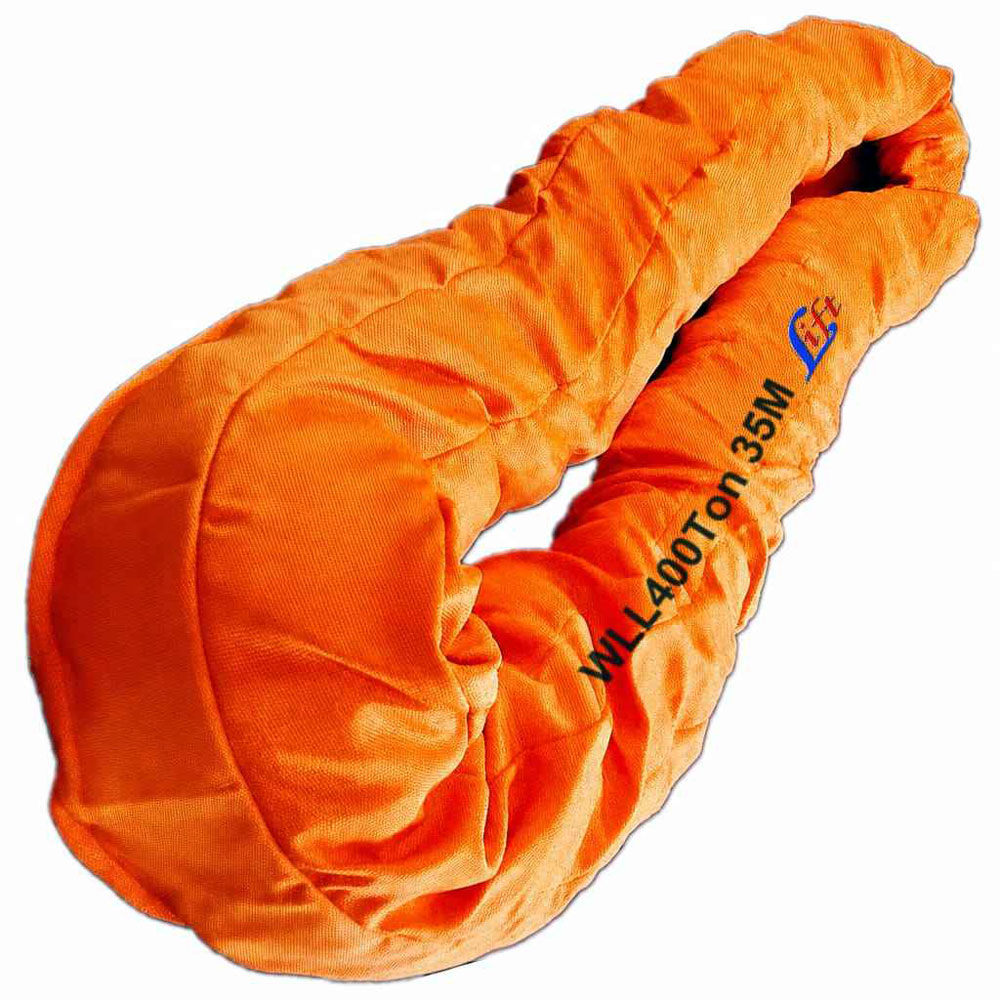
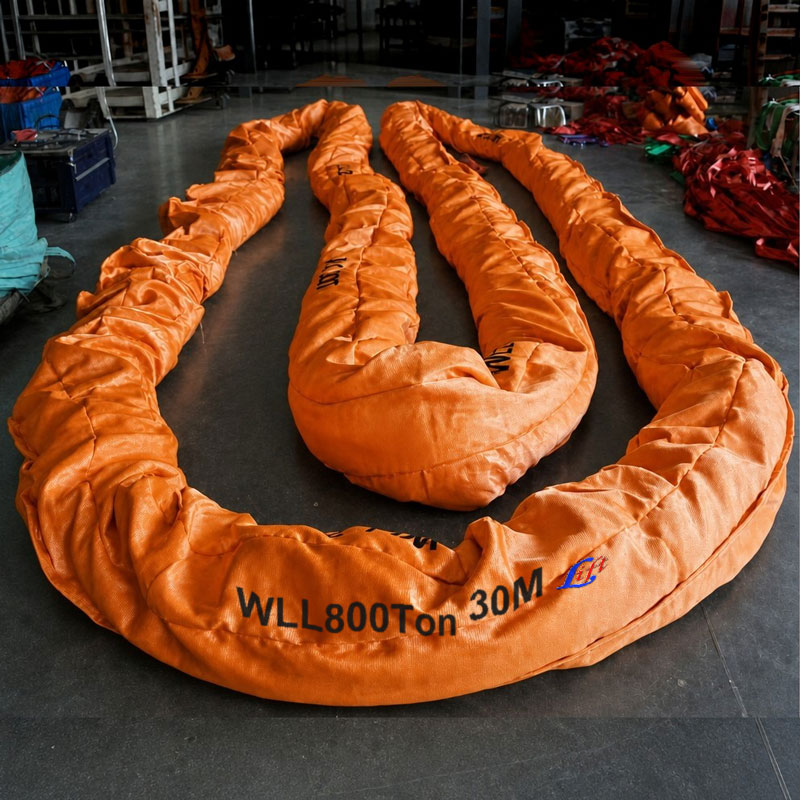
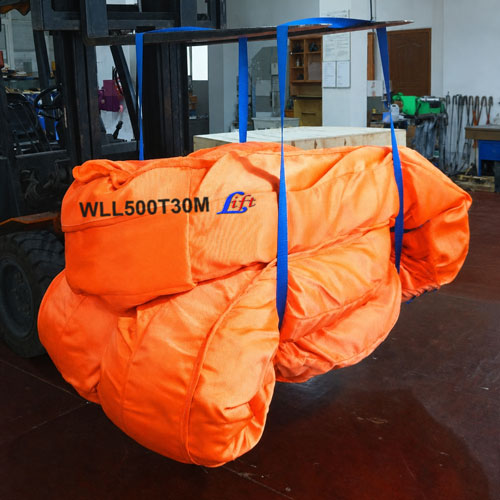
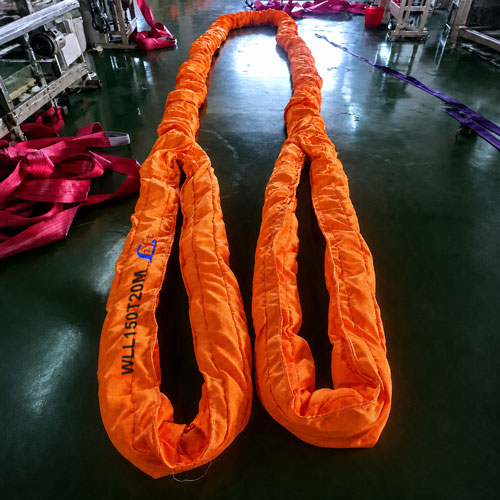
Four photographs are published with this listing, and they are here for one reason: to make the difference between a sleeve and a label visible. Figure 1 is the article this page is about. Figures 2 to 4 are the identical construction at other rated capacities, and they are kept because of what the four have in common and what they do not. Every sleeve in the four photographs is the same orange, because on a round sling the colour marks a class, in this case ten tonnes and above (§6), and never a figure. The figure is printed on the sleeve in letters and numbers, which is why a buyer reads the label and treats the sleeve as a first guess only.
Figure 1. The article this page describes. The printed line on the sleeve reads WLL400Ton 35M — four hundred tonnes at thirty five metres. Nothing is attached to it at either end, because a loop of this construction has no ends (§2). |
Figure 2. The same construction, larger. The printed line reads WLL800Ton 30M. The sleeve is the same orange as figure 1, because the colour marks a class and not a figure (§6). |
Figure 3. The same construction at five hundred tonnes and thirty metres, printed WLL500T30M, suspended on webbing straps from a forklift in the works. It is shown being moved rather than lifted on a hook, which is the handling that §11 is about. |
Figure 4. The same construction, smaller. The printed line reads WLL150T20M, one hundred and fifty tonnes at twenty metres. |
Read the four together and the point of the section is visible. Four articles rated four hundred, eight hundred, five hundred and one hundred and fifty tonnes wear the same orange sleeve, because the colour convention marks a class — here ten tonnes and above — and not a figure (§6). What separates them is the printed line: the figure and the length, in letters and numbers on the sleeve itself. The length is printed beside the figure because a round sling is made to an effective working length, and two articles of the same capacity in two lengths are two different articles (§10).
1. Two Words in the Name, and Where the Rest of the Family Is Written
A buyer searching for this article meets four separate claims in one name, and the useful thing to know before reading further is that the family on this site already divides them. The figures and the construction words are not argued here in detail because they are argued next door, and a page that repeats its neighbours is worse than no page at all: it competes with itself for the same search and gives the reader the same paragraph twice.
So this page takes the two words in the name that are its own — endless and polyester — and answers one question with them: what do these two words permit, and what do they forbid? Everything else is linked rather than restated.
| Page | What it holds | This page |
|---|---|---|
| WLL 100T Heavy Duty Round Slings With Eyes | The four claims in its own name: that the working load limit is not the breaking load, that the tonne figure belongs to a configuration, that heavy duty is a construction description rather than a grade, and that the eyes are the interface where the sling meets hardware | Linked — it owns the two claims this name also makes, so they are not re-argued here |
| Colour code and angle arithmetic | The full colour-code table and the horizontal-angle calculations that turn a straight-lift figure into a leg load | Linked — §6 says why the colour exists and stops there |
| The sleeved loop with no ends | The four arrangements a loop can make, contact-point adjustment, length as an ordering decision, and what it means to lift with an article that has nothing to attach | Linked — §2 keeps to the load path rather than the arrangements |
| The same article with eyes attached | The core-and-sleeve division, the eight-colour code and the label items for the eye variant | Linked — the eye form is the same loop with a different interface |
| Contact point and sharp edges | Where a load meets a sling, and the edge test that decides whether a radius is sharp for a given sling | Linked — §11 does not repeat the edge test |
| The assembly as one rated unit | Multi-leg assemblies and the fact that the rating belongs to the whole assembly, not to each leg | Linked — §10 stays with a single loop |
| This page | Endless and polyester: the continuous core that puts no seam and no fitting in the load path, and the fibre that fixes temperature, chemistry, stretch and colour | Delivered here |
One consequence of that division is worth stating plainly, because it is the reason this page exists at all. A capacity figure is a number on a label, and a label can be read by anyone. The words endless and polyester are not numbers and cannot be read off at a glance: they are the two statements in the name that decide whether the article is allowed into the environment you are about to lower it into (§8, §9), how far it will stretch when the load is applied (§7), and what its sleeve colour is even telling you (§6).
2. "Endless": the Load Path Is One Continuous Core
A round sling of this family is built from two parts. As the standard guide for the family puts it, a typical polyester round sling consists of a load-bearing inner core made from high-tenacity synthetic yarn and a woven protective outer sleeve. And, in its own words, many EN 1492-2 round slings are manufactured as endless round slings, forming a continuous loop.
That is what the word in this name points at, and it is worth being exact about what it removes. A load path can be interrupted in two ordinary ways: by a seam, where two lengths of material are joined, and by an end fitting, where something is attached to the sling to make it connectable. In the flat woven family both of those are normal and both are regulated: the United States rule for synthetic webbing slings states that stitching shall be the only method used to attach end fittings to webbing and to form eyes, which means the splice in a flat sling with eyes is a sewn joint carrying the whole rated load, and it is on the inspection list as such. A sleeved loop has neither of those joints in the path. The core runs from the load, round the workpiece, to the hook and back to the load without a join, and there is no fitting on it anywhere.
That is a genuine difference in where a sling can go wrong, and it is not a claim about how much it will carry (§3). Two honest qualifications belong here as well, because the word endless is easy to over-read.
The first: endless does not mean the core is one unbroken filament. The removal criteria for synthetic round slings list knots in the round sling body, except for core yarn knots inside the cover, which tells you precisely that core yarns are joined inside the sleeve and that the standard tolerates those joins there. What is continuous is the path — the load is carried by a loop of yarn rather than by a seam — not the individual yarn.
The second: endless does not mean the sleeve is seamless, and the sleeve is not the part that carries the load. The sleeve is a woven cover whose job is protection, and the requirement in a chemically active environment is that the cover is the same yarn as the load-bearing core, which is a statement about the cover's material rather than its strength. The sleeve can be destroyed while the core is perfectly intact, and it still takes the sling out of service: holes, tears, cuts, abrasive wear, or snags, that expose the core yarn is a removal criterion in its own right.
| In the load path | What a continuous core changes | What it does not change |
|---|---|---|
| Seam or splice | There is no sewn joint in the path. In the flat family the sewn splice of a sling with eyes is the method the rule prescribes, and one of its own removal criteria is broken or worn stitching | Core yarns are still joined inside the sleeve — knots inside the cover are permitted and are named in the removal list |
| End fitting | Nothing is attached to this article to make it connectable, so there is no fitting in the path to be rated, matched or inspected | If you put it into an assembly, the fittings of that assembly are still rated hardware, and their rating is part of the job |
| The sleeve | Nothing — the sleeve is a cover, and in a chemically active environment it must be the same yarn as the core it protects | A sleeve that is torn through to the core ends the sling's service, however sound the core is |
| Capacity | Nothing. The machine that decides capacity is the rating basis and the design factor, not the shape of the loop | The rated load still belongs to a hitch and an angle, and the label still carries it |
3. Construction Is Not Capacity
The sentence that matters here is short: the shape of a load path does not set its strength. A rated load for a round sling is derived from a stated basis, and that basis is published. Rated loads are based on material strength, design factor, type of hitch, angle of loading, and — a factor that surprises buyers more often than any other — the diameter of curvature over which the sling is used. Five inputs, none of which is the word endless.
What the factor does is separate the rated load from the load at which the article fails: for general-purpose round slings manufactured to EN 1492-2 the commonly specified minimum safety factor is 7:1, which in the plainest terms means a sling rated at one tonne has a minimum breaking force of about seven tonnes under the applicable test conditions. Supply that factor, and it is the factor — not the loop — that buys the margin.
There is a second reason to keep construction and capacity apart, and it is the one that costs money in practice. A sling can fail its inspection for reasons that have nothing to do with strength and everything to do with construction: a sleeve worn through at a contact point, a cut that exposes core yarn, a knot in the body, discoloration and brittle or stiff areas. All of those retire the article on the day they are found, at whatever fraction of its 400 tonnes it has actually been lifting. Construction decides where the article may be used and what will end its life; the rating decides how much it may lift. Reading one as the other is how a perfectly strong sling ends up in the scrap bin, and how a scuffed one ends up on a load it should never have touched.
Two practical consequences follow for this article at this capacity. The first is that the specification conversation in §10 is mostly about the four things that are not the loop: the hitch, the angle, the effective working length and the fittings you will actually use. The second is that the handling in §11 is not decoration. A loop with no ends has nothing to attach, so it is brought to the load by hand and dressed around it, and the practices that damage slings — dragging them, resting loads on them, shock loading — damage this article exactly as they damage any other.
4. "Polyester": the Fibre Fixes Four Things No Capacity Figure Can
The second word in this name is a material, and the standard for this family covers three of them: the standard covers roundslings made from materials such as polyester (PES), polyamide (PA) and polypropylene (PP). Of those three, the family guide is direct about which one dominates general lifting — for general industrial lifting, polyester is a common choice because it offers a useful combination of strength, flexibility, low weight and resistance to many common working conditions — and the United States round-sling guidance makes the same observation from the other end, that the most commonly used synthetic round slings are made of nylon- or polyester-type yarns.
Polyester is not the default because it is the strongest. It is the default because it is the fibre that best fits the way industrial loads are actually lifted: they are lifted near their working height, in weather, in the wet, outdoors, and around whatever the plant already handles. What the fibre decides is everything the label does not.
| The fibre fixes | What it decides | Where that bites at 400 tonnes |
|---|---|---|
| The temperature window | The upper and lower temperature at which the sling may be used and stored. The same figure applies per fibre, so choosing the fibre chooses the window | A large tonnage lift is often a heavy and hot workpiece — a casting, a furnace charge, a welded fabrication — so the window is checked against the workpiece, not only against the air (§8) |
| Which chemicals are excluded | Each fibre has its own prohibition, and they are not the same prohibition. Polyester and polypropylene are excluded from caustics; nylon is the one excluded from acids and phenolics (§9) | The tank, the plating line and the pickling shop are decided by this row alone — and the exclusion applies to fumes, vapours, sprays, mists and liquids, not only to immersion |
| How far it stretches | The elongation under load, and therefore how much energy the sling absorbs and how much the load moves while being lifted (§7) | Headroom is finite and controlled lowering is slow; a fibre that moves less under load is easier to place and easier to hold steady |
| The colour convention on the sleeve | The colour code is a property of the material as much as of the capacity: the colour of a polyester sling follows the guidelines the standard defines for it, which is why a sleeve colour can be read as a fibre and capacity shorthand on one condition | At 400 tonnes the colour cannot distinguish one capacity from another, so the label — not the sleeve — is the source of the figure (§6) |
Read the table as a list of permissions rather than of properties. Every row above is a condition on where this article may be used; none of them is a condition on how much it may lift. That distinction is the whole reason the fibre is in the name: a sling can be perfectly rated for a load and still be the wrong article for the place the load is standing.
5. Polyester, Polyamide, Polypropylene: the Comparison That Decides the Purchase
The three fibres are usually presented as a strength ranking, which is the least useful way to compare them. As one webbing comparison puts it, the largest difference between them is not basic strength, and broad claims that assign a single breaking-strength range to every strap of a given fibre create a false sense of precision — a polyester sling can be made as strong as a nylon one by using more yarn. What actually separates them is behaviour, and behaviour is what the table below compares.
| Fibre | Stretch at the working load limit | Water | Must not meet | Range for use and storage |
|---|---|---|---|---|
| Polyester (PES) | About 2 to 3 percent at the working load limit — the low-stretch fibre of the three | Absorbs very little: a moisture regain of about 0.1 to 0.4 percent is reported for polyester fibre against roughly 4.2 to 5 percent for nylon. This is why marine and outdoor work prefers it | Caustics, and by comparison with nylon, ethers and alkalis | minus 40 to 100 degrees C for polyester and polyamide round slings |
| Polyamide (PA, nylon) | About 7 to 10 percent — the elastic one. More movement under load, and therefore more energy absorbed when the load arrives suddenly | Absorbs noticeably more and responds to humidity; it dries more slowly and changes dimension more as conditions change | Acids and phenolics, and it is not resistant to oxidising bleach agents either | Same as polyester: minus 40 to 100 degrees C |
| Polypropylene (PP) | Sits between the two; it is the fibre chosen where weight and cost matter more than the temperature range | Low absorption, like polyester | Caustics, on the same rule as polyester | The narrower one: minus 40 to 80 degrees C, which is twenty degrees less at the top than polyester |
Two cautions belong under that table, and both come from the same source. The first is that the useful question is not which fibre stretches most or least, but how much elongation the finished article shows under the expected operating load — a generic polyester strap does not become a rated tie-down because polyester stretches less, and the same logic applies upwards. Ask for load and elongation data when small changes in sling length affect the lift. The second is that the fibre choice is a filter, not a rating: it tells you whether the article is admissible into the workplace, and the label tells you what it may lift once it is there.
6. The Colour on the Cover Is the Fibre's; the Figure Is the Label's
Round slings are colour-coded, and the code is one of the most practical features of the family standard, because it lets anyone on site check a sling's working load limit in a straight lift without opening a file. It is also the feature most often over-read, so it is worth being precise about what the colour is.
It is a convention attached to the material and to the rating system together. The colour of a polyester sling follows the guidelines the standard defines, and the colour of the outer cover immediately shows the working load limit in a straight lift. Which is exactly why it should be treated as a first check rather than an authority: in the guide's own words, the colour should never be treated as the only source of capacity information, and the identification label should always be checked before use.
At 400 tonnes that instruction stops being a caution and becomes the whole story. The colour code was built to separate one-, two-, three-, five- and ten-tonne slings at a glance; it has no more steps to give above its last one, so the cover of a 400 tonne article carries the same colour as a ten tonne one. The colour tells you what kind of sling you are holding. Only the label tells you how much it will lift. The full table, and the angle arithmetic that turns a straight-lift figure into a leg load, are on the colour-code page this page links to; the code as it applies to the eye variant of this article is on the eye-type page.
| What the cover colour does tell you | What only the label can tell you |
|---|---|
| Which capacity band the sling was built in, when the band is one the code still distinguishes | The rated load for the type of hitch you are about to use, and the angle that figure is based on |
| At a glance, and without paperwork, whether the sling in your hand is plausibly the one you asked for | The core material, and the cover material where it differs from the core |
| That the article belongs to a controlled, coded product family rather than to an untraceable roll of webbing | The identity of the article: who made it, its length, its traceability code and its inspection history |
7. Stretch: 2 to 3 Percent Against 7 to 10, and What That Decides
Of the four things the fibre fixes, this is the one buyers feel first, and it is the one most often reduced to a slogan. The measured difference is not small. Nylon slings have more give, reported at about 7 to 10 percent stretch at the working load limit; polyester comes in at typically 2 to 3 percent at the same reference point. Neither figure says anything about which is stronger — that is a separate matter of how much yarn is in the sling — and both are worth reading as a description of movement rather than of quality.
What the movement is for is the reason the difference matters. Part of the stretch is energy absorption: under tension nylon lengthens more than polyester and recovers after the load is removed, and that movement lets it absorb part of the energy created by a sudden pull. Part of it is geometry: if the lift is close to the height available, the sling that lengthens less keeps the load higher off the floor. The trade is straightforward once it is stated — a sling that absorbs energy moves further while doing it, and a sling that barely moves passes more of the shock to whatever is above it.
| The number | What it buys | What it costs |
|---|---|---|
| Polyester, about 2 to 3 percent | The load stays close to where it was placed. With limited headroom the lift is comfortably within the available height, and a suspended load is easier to hold steady and easier to set down | Less energy is absorbed by the sling, so a sudden application of load is passed on more directly. Shock loading is prohibited for slings of every fibre, and with a low-stretch sling that prohibition matters more, not less |
| Polyamide, about 7 to 10 percent | More give, and therefore more absorbed energy. Where a load could bounce, the extra stretch softens the pull and reduces the danger of the strap snapping back | The load travels further under load, which is a problem in a height-limited lift and also where the article's position must stay put |
The reason this row belongs in a page about a fibre is that the choice is made by the lift, not by the load. The same mass, lifted in the same building, is a different problem depending on whether the hook has room to move and whether the load can swing. A useful way to put it is the one used in the comparison the table above draws its figures from: the difference in stretch is why recovery straps are typically made of nylon and tow straps of polyester. A tow strap is asked to hold a position; a recovery strap is asked to absorb an event.
Two things are worth saying plainly before this section closes. Polyester does not mean zero stretch and nylon does not mean unlimited stretch — polyester stretches, it simply stretches last among the three. And the number that matters is not in the fibre's data sheet but in the finished article: the useful question is how much elongation the finished sling shows under the expected operating load, and where small changes in sling length affect the fit of the lift, that data should be asked for rather than assumed.
8. Temperature: Three Published Figures, and Working to the Lower
The temperature of a sling is decided by the fibre, and the published figures are not identical across sources. That is not a contradiction; it is three different questions being answered, and the practical rule falls straight out of comparing them.
| The figure | What it is answering | Applies to |
|---|---|---|
| minus 40 to 100 degrees C | The range for use and storage as the family standard gives it. It is the widest of the three and is the figure to quote on a data sheet | Polyester and polyamide round slings. Polypropylene's corresponding range is minus 40 to 80 degrees C |
| 194 degrees F, 90 degrees C | The limit for contact and exposure in use: the sling must not be used in contact with objects, or at temperatures, above it, nor below minus 40 degrees F | Polyester round slings, per the round-sling guidance. The webbing rule sets the same family of limits at 180 degrees F for polyester and nylon, and 200 degrees F for polypropylene |
| 140 degrees F, 60 degrees C | The point above which long-term exposure is a different question: some synthetic yarns do not retain their breaking strength during long-term exposure above it, and the manufacturer should be consulted about the effects | Synthetic yarns generally. This is the figure that binds a sling stored or used continuously in a hot area rather than one that briefly touches a warm surface |
Work to the lower figure, and to the one that matches the exposure. A sling that has a warm workpiece lowered onto it for thirty seconds, and then stands in a foundry aisle for a month, is being asked two different questions by the same lift, and it is the second one that retires it. Ultraviolet light deserves the same treatment as heat and is often forgotten for the same reason: long-term exposure to sunlight or ultraviolet radiation can affect the strength of a polyester round sling, and the retirement criteria for a sling stored or used in sunlight are a matter for the manufacturer rather than for a rule of thumb.
9. Chemistry: the Exclusion That Applies to Polyester, and the One That Does Not
The chemical exclusions are the least negotiable of the four things the fibre fixes, because they are written as prohibitions rather than as reductions. Nothing in them says that a polyester sling in a caustic atmosphere carries less; they say it must not be used there. And unlike a temperature overrun, a chemical attack can leave no visible trace until the sling is being inspected — acid or caustic burns appear in the removal list as a criterion of their own.
| Material | Excluded from, as the regulation states it | Named in the same breath by suppliers |
|---|---|---|
| Polyester (this article) | Where fumes, vapours, sprays, mists or liquids of caustics are present | Ethers and alkalis — described as polyester's particular weakness, and the reason a polyester sling is the wrong article for a caustic tank rather than a reduced-capacity one |
| Polyamide (the fibre this is not) | Where fumes, vapours, sprays, mists or liquids of acids or phenolics are present | Sulphuric, nitric, hydrochloric and phosphoric acids, and oxidising bleaches including sodium hypochlorite, hydrogen peroxide, sodium percarbonate and calcium hypochlorite |
| Aluminium fittings | Where fumes, vapours, sprays, mists or liquids of caustics are present — the same prohibition as the fibre, applied to the hardware | A reason to specify the fitting material with the same care as the sling. The hardware on a large assembly is not a neutral choice |
The two lists above are given separately on purpose. The regulation's exclusions are the floor and they are stated per fibre; a supplier's list adds the specific acids and bleaches by name. For an article that is going to live in a plating shop, a pickling line or a fertiliser plant, the question to answer before ordering is not whether polyester is stronger or weaker than polyamide there, but which of the two lists your environment appears on.
One requirement deserves to be carried out of this section and into §10 and §12, because it connects the sleeve to the chemistry: in chemically active environments the cover is to be the same yarn as the load-bearing core. A sleeve of a different material is a cover that can be destroyed by an environment the core would have survived, and the sleeve taking on the damage is exactly what ends the sling's service. Where the environment is chemically active, the manufacturer should be consulted before the sling is used at all.
10. 400 Tonnes: What the Number Belongs To, and What the Enquiry Has to State
By the time a lift reaches this size, the number in the product name has stopped being the hard part. It is on the label, and it is derived from five published inputs — material strength, design factor, type of hitch, angle of loading and the diameter of curvature over which the sling is used. What makes a 400 tonne purchase difficult is that four of those five are decided by you rather than by the sling, and a supplier can only quote what they are told.
Two rules from the round-sling guidance are worth carrying into the enquiry because they close off the usual shortcuts. Horizontal angles below 30 degrees are not to be used except on the manufacturer's or a qualified person's recommendation, which means the angle is not a free variable to be optimised after the sling arrives. And in a choker hitch the rated load holds only while the angle of choke is 120 degrees or more; below that, the figure has to come from the manufacturer or a qualified person. Neither rule can be answered on the shop floor, which is why both belong on the enquiry.
| The enquiry has to state | Why the supplier cannot guess it |
|---|---|
| The hitch, and the horizontal angle | The rated load is tabulated per type of hitch and per angle. Give a mass without a configuration and the honest answer is a range, not a rating |
| The effective working length | Length is part of what is being certified, and on a loop the length is counted differently from a flat sling. Too short increases the angle and reduces capacity; too long reduces stability |
| The diameter the sling will bend over | Diameter of curvature is one of the five bases of the rated load. A hook, pin or trunnion smaller than the sling was rated for changes the answer |
| The environment: temperature, chemistry, sunlight | This is the fibre conversation from §4 to §9, and it can change the fibre. Confirm that the fibre type and temperature rating match the operating conditions; in a chemically active environment the cover has to be the same yarn as the core |
| The edges the sling will meet | Ask for edge protection or wear sleeves if the load has sharp corners, and expect padding for any edge in contact with the sling |
| The fittings that will be used with it | Fittings are required to have a rated load at least the same as the sling, to sustain twice the rated load of the sling without visible permanent deformation, to be compatible with the environment and to have their sharp edges removed |
| The paper that has to come with it | Ask for the manufacturer's certificate confirming the 7:1 factor and conformity with the family standard, together with the test report. A 400 tonne figure without the certificate behind it is an assertion |
| The inspection regime it will live under | Periodic inspection is at intervals no greater than 12 months, with shorter intervals for severe service. Say what the service will be, and the interval follows from the answer |
When an order is being placed for an assembly rather than a single loop, one further sentence is worth remembering: the rating belongs to the whole assembly, and a multi-leg sling is not a set of independently rated legs. That is the subject of the assembly page this site already carries, and it is linked above rather than repeated here.
11. Handling and Storage of a Sleeved Loop
None of the practices in this section is about strength, and all of them are about the same thing: a sleeved loop has a woven cover standing between the core and the world, and almost everything that ends its service happens to that cover first. The rules are ordinary and they are not optional.
Moving and dressing the sling. Do not drag slings on the floor or over abrasive surfaces; dragging a loop is the fastest way to wear a cover through at the point where it matters. Do not shorten or lengthen a sling by knotting or twisting it, and avoid twisting and kinking generally. Ensure that slings are not constricted, bunched or pinched by the load, the hook or any fitting — a pinched loop is a loop whose capacity you no longer know. Shortening or adjusting is to be done only by methods the manufacturer or a qualified person approves.
The load, once it is slung. Do not rest loads on the sling, and do not pull a sling from under a load while the load is resting on it. Do not allow shock loading: this is the rule that a low-stretch polyester sling, holding a 400 tonne load, has the least room to absorb. Ensure that in a choker hitch the choke point is only on the sling body and never on a splice or fitting, and that an object in an eye of a sling is not wider than one-third the length of that eye.
Position. Ensure that personnel never stand in line with or next to the legs of a sling that is under tension. This is the one rule in this section that is about people rather than about equipment, and it is the reason the rest of them exist.
Storage. Keep slings away from sunlight, chemicals and sharp edges, which are the three ways a stored sling loses strength without being used; the same guidance asks for proper storage away from those three. Long-term exposure to sunlight or ultraviolet radiation can affect the strength of a polyester round sling, so a loop left hanging on a fence for a year is not the same article that came off the delivery. Long-term exposure to heat belongs in the same list, at the lower figure given in §8.
12. Inspection, and the Removals That Apply to a Sleeve
Inspection of this article is two frequencies and one list. Every day before use, a qualified person is to inspect the slings and all fastenings and attachments for damage or defects. Beyond that, periodic inspections are made at intervals no greater than 12 months, with the guidance's own working pattern being yearly for normal service, monthly to quarterly for severe service, and whatever a qualified person recommends for special and infrequent service. At 400 tonnes the second interval is not paperwork: severe service is the normal condition for a sling at this scale, and a monthly to quarterly inspection is the pattern that fits it.
The list below is the round-sling removal list in its own words. Note how much of it is about the sleeve and the identification rather than about the core — which is the practical consequence of everything in §2.
| What is found | Why it ends the sling's service |
|---|---|
| Missing or illegible sling identification | Without the label the sling has no rated load, no material and no traceability. It cannot be used because nothing about it can be verified (§6) |
| Acid or caustic burns | The chemical exclusions of §9 made visible. The fibre has been attacked, and the loss does not reverse |
| Evidence of heat damage | The other way a synthetic yarn loses strength without breaking: the temperature limits of §8 are being exceeded somewhere in the process |
| Holes, tears, cuts, abrasive wear or snags that expose the core yarn | The load-bearing part is no longer protected, and any further damage reaches the yarn rather than the cover |
| Broken or damaged core yarns, and welding splatter that exposes core yarns | The load path itself is compromised. This is the criterion that corresponds to the continuous core of §2 being continuous no longer |
| Knots in the round sling body, other than core yarn knots inside the cover | A knot in the body concentrates stress and shortens the sling in a way that is not part of its rating. The permitted knots are the ones inside the cover, which are part of how the core is made |
| Discoloration, and brittle or stiff areas | A change in the material that no impact produced. It is the criterion that catches chemical and heat attack which has not yet reached the point of a visible burn |
| Fittings that are pitted, corroded, cracked, bent, twisted, gouged or broken | Hardware is rated hardware, and its condition is part of the system's condition |
| Any other condition that causes doubt | The list is not exhaustive, and the last line says so. Where any such damage or deterioration is present, the sling is removed from service immediately |
Two things about repair belong here, because both are attempts people make. Cuts and worn patches on webbing are sometimes sewn up or taped; for this family the position is explicit — do not make any temporary repairs of round slings or fittings, and do not repair melted or damaged internal yarns. A sling with a stitched-on patch is an unrated sling with a reminder of its former capacity printed on the sleeve. Where repairs are made at all they are marked to identify who made them, and any round sling incorporating previously used or welded fittings is proof tested before its initial use.
13. Two Things About This Listing Itself, and the Claim This Page Does Not Repeat
Two defects were measured on the page this content replaces, and both are reported here rather than quietly corrected, because both affect what a buyer sees.
There is no photograph of this article. The gallery image is published with an empty source — two image sources on the page are empty — which means the browser is asked for a file that does not exist and renders a broken image where the article should be. The article has no photograph in this listing at all, so the new content contains no figure image: using another product's photograph would misrepresent what is being sold. The empty sources have been pointed at the site's own placeholder image, which is what this article already falls back to when it is shown as a thumbnail on other pages, and they now carry an alternative text saying that no photograph was supplied. What the listing actually needs is a real photograph of the article, and that has to come from the company.
Four of the six Related Products thumbnails carried pasted rich-text markup. Their alternative text and their link titles had been pasted in from a rich-text editor complete with the editor's own markup: the alternative text of each tile literally opened with the four characters of an opening strong tag and closed with the nine characters of its closing tag, wrapped around the product name. The literal tags were therefore part of the attribute value, and a screen reader announced them as content. The images themselves parsed correctly, because the attribute value is delimited by straight quotes, so this was never a broken layout; it was a broken description. All six thumbnails now carry their own product name as the link title and a descriptive alternative text.
Two further template items were measured and are reported for the site to fix rather than fixed here: the TAG block on this page is empty, so no tag navigation reaches it, and the sidebar contact block prints the telephone number under E-mail and the address under Phone while the footer prints both correctly.
One sentence from the company's own technical note is deliberately not repeated on this page. The note states that the article achieves 100% safety and reliability with zero errors. No manufacturer can support that sentence for a sling, because the outcome of a lift depends on the configuration, the angle, the edge, the environment and the operator as much as on the article. What can be stated is what this page has stated throughout: a rated load for a stated configuration, a factor behind it, an inspection regime in front of it, and a fibre whose limits are published.
14. Frequently Asked Questions
Q1: Is 400 tonnes the load at which this sling breaks?
Q2: What does "endless" actually change?
Q3: Is polyester better than nylon?
Q4: Can I use it in a choker hitch?
Q5: What temperature may it work at?
Q6: What chemicals must it be kept away from?
Q7: Does the colour of the cover tell me the capacity?
Q8: How often must it be inspected?
Q9: Can a damaged sleeve be repaired or sewn?
Q10: What do you need from me to quote a 400 tonne sling?
Contact
Telephone and WeChat — 18066002268
E-mail — 702461526@qq.com
HS code — 630790, textile slings for general purpose use
-
Drone Anti-collision Net
-
Extra Large Capacity Cargo Net
-
Cargo Webbing Net
-

Color changing nylon double buckle loop nylon braided rope
-

Two end buckle lifting rope, double buckle round lifting rope, double fork nylon lifting rope, non jointed nylon lifting rope
-

Emergency escape lifeline, fire escape rope, fire safety escape emergency rope, steel wire core fire rope

