 Language
 简体中文
简体中文
- On the 2018 National Day holiday, Lifet completed six 100 ton large tonnage lifting belts as a gift
- The role of suspension net in the transportation of goods turnover
- Cargo soft lifting net, lifting net, lifting net, lifting net, bag, climbing net
- Precautions for using Lifutiden elevator
- How to make circular lifting straps
Contact: Wang Lili
E-mail:18066002268
Phone:702461526@qq.com
Address: Lifute Industrial Park, Taizhou City, Jiangsu Province
Lift Sling Rigging Co., Ltd manufacture Heavy Duty Round Sling,Heavy Duty Polyester Endless Round Sling,A heavy duty round sling is a class of article rather than a ranking in one: a continuous load-bearing core inside a woven sleeve, rated for the hitch and the angle it is used at. This page covers what the round form is chosen for, how it compares with the flat, wire rope and chain families on the four axes that decide a purchase, the one line in that comparison that separates them permanently, how to read the sleeve, where the capacity figure actually lives, and what to state on an enquiry. EN 1492-2, HS code 630790, telephone 18066002268
Hits: ℃
Release time:2026-09-21 08:10
Lift Sling Rigging Co., Ltd manufacture Heavy Duty Round Sling,Heavy Duty Polyester Endless Round Sling For Hoists,Double Sleeve Heavy Duty Round Soft Lifting Sling.
Heavy Duty Round Sling — A Class of Article, Not a Place on a Scale
A round sling is a class of article rather than a place on a scale: a continuous load-bearing core inside a woven sleeve , with no splice and no termination anywhere in the load path. This page sets out what the form is chosen for, how the round, flat, wire rope and chain families compare on the four axes that decide a purchase, the one line in that comparison that cannot be argued away once the article is worn, how to read a sleeve at goods-in, where the rated capacity really lives, and the three things a round sling enquiry has to say beyond the tonnage. Known in the trade as the round sling, the roundsling or the soft sling; HS code 630790; telephone 18066002268.
1. What a Class Page Is For, and What This One Answers
Most of the pages in this family are about one article: a capacity, a fibre, an end configuration, a duty. This page is the one that sits above them, because the words heavy duty round sling name a class of article rather than a product, and a buyer who arrives on the class has a different question from a buyer who has already chosen one.
That question is not what will this carry. It is which form belongs in this lift at all, and what will decide between the answers. The forms are already written up on this site and this page does not repeat them: the round family's ends on the eye type round sling page, the arrangements the loop can be dressed into on the endless round sling page, the continuous load path and the polyester core on the WLL 400 ton endless polyester round sling page, the contact point and the edge rules on the circular lifting straps page, the flat forms on the flat lifting strap page, and the very large made-to-order articles on the 300 ton lifting belt page.
| The buyer's question | The page that answers it | What this page does instead |
|---|---|---|
| What is a 100 tonne round sling rated for, and how is it identified | WLL 100T heavy duty round slings with eyes | Shows where the figure sits in the family, and why the class cannot be read off it |
| What does the endless form change | endless round sling, endless sling | Compares the class against the other three families rather than within itself |
| Where does the sleeve meet the load | circular lifting straps | Reads the sleeve as identification at goods-in, which is a different job |
| What tonnage can I have | 30 ton flexible lifting belt, 300 ton lifting belt | Explains that this is the last question to ask, not the first |
2. The Word Round Describes the Load Path
A round sling is named for the shape of the thing that carries the load, and that is the whole of the name. The cores of high-tenacity yarn are wound into a closed loop, the sleeve is woven around them, and the result is an article whose load path has no beginning and no end. There is no splice in it, no eye, no termination, and no place where a fitting has to be attached to webbing before the article can carry anything.
That is worth stating precisely, because it is the source of everything else on this page. A flat woven sling is a length of webbing with a join at each end; the joins are rated parts of the article, and the standard cares about them, which is why stitching is the only method permitted for attaching end fittings and forming eyes, and why a seam has to carry enough thread to develop the full breaking strength of the sling. A round sling has no such part. The continuous form removes a class of failure rather than adding a class of strength: the sleeve changes how the load is met, but it does not change what the article can carry, and the capacity figure is set by the core, the hitch and the angle.
Two practical consequences follow, and both are counter-intuitive enough to be worth the sentence. The first is that a round sling has no weak end to inspect, so inspection moves elsewhere: to the sleeve , which is the only part the inspector can see, and to the marks that identify the article, which is why a faded tag removes a sling that may be perfectly sound. The second is that the same article can be dressed into several different lift arrangements, which is an advantage in use and a hazard in record-keeping, because the figure that applies is the one for the arrangement actually used.
3. Reading a Sleeve at Goods-In: Two Jobs, One Object
The sleeve is the only part of a round sling a buyer ever sees, and it is doing two jobs at once. It carries the identification, and it takes the contact with the load. The two jobs are independent, and confusing them is the commonest mistake made at goods-in.
As identification, the sleeve is a label with a surface: the rated capacities for each type of hitch, the type of synthetic material, the effective working length, the standard the article was built to and the traceability code are printed or sewn onto it, and the colour is a quick field check of the capacity step. As contact, the sleeve is a wear item: it is what meets the edge, the abrasive surface, the heat and the chemistry, and it is the part that is examined at every inspection.
| What the sleeve tells you | What it cannot tell you | Where the detail is written |
|---|---|---|
| The capacity step, through the colour, where the code still separates anything | The figure itself, once the code has stopped separating: above its last step the colour marks a class, not a value | 30 ton flexible lifting belt |
| The material class, through the printed marking | Whether the cover yarn is the same fibre as the core, which is a chemical-service question | eye type round sling |
| That the article is a round sling and not a flat sling fed through the same lift | Whether the article underneath is sound; the core is invisible even when the sleeve is intact | circular lifting straps |
| The straight-lift rating step, at a glance | The rating for the hitch you are about to use, which is a different column on the label | WLL 100T heavy duty round slings with eyes |
4. Classification, Not Ranking: the Four Families on Four Axes
The families this site builds are not arranged in a league table, and a buyer who reads them as one will pay for the wrong property. Each family is the best answer to a different question, and four axes separate them: what the article does to the load it touches, how well it conforms to that load, what it costs to keep it in service, and what happens when it is worn out.
| Axis | Flat woven sling | Round sling | Wire rope sling | Chain sling |
|---|---|---|---|---|
| Contact with the load | Wide and flat: pressure spread over a face | Soft, narrow and rounded: pressure concentrated on a line unless the sleeve spreads it | Hard and thin, and it can cut or mark a finished surface | Hardest of the four, and it scratches painted and machined surfaces |
| Conformity to an awkward load | Poor in one direction: the band does not bend around a small radius easily | Best of the four: the loop deforms into the load's shape, which is why irregular loads choose it | Moderate, but the rope has a minimum bend radius of its own | None in practice: a chain presents links, not a surface |
| Cost of keeping it in service | Low, provided the edge and the abrasion are dealt with; the article is cheap enough to hold spares | Low, and the sleeve is the wear part, so wear is visible before the core is reached | High: the rope and the end fittings both need attention, and broken wires are a removal criterion | Low per lift and high at the start; a chain is an asset rather than a consumable |
| What happens at the end of the life | Retired: the article is removed from service and not repaired | Retired: cracking, cuts and worn stitching are removal criteria, not repair jobs | Removed from service on damage to the rope or the end fittings | Repairable by the manufacturer or an equivalent entity, then proof tested and returned with a record |
Two of those axes are usually decided for the buyer rather than by the buyer. Contact is decided by the load's surface: a load that must not be marked, or that has to be borne on a face rather than on a link, takes the textile families before any capacity is discussed. Conformity is decided by the load's geometry: an irregular casting or a bundle that shifts takes the round sling, because it is the one that can be dressed into the shape in front of it.
The other two axes are commercial, and they are where this page's honest advice sits. Buying the textile article for a duty that only a chain can survive, or the chain for a load that must not be touched by one, is the mistake that costs more than the article.
5. The Sharpest Line in That Table: What Happens at the End of the Life
Of the four axes, three can be argued away by buying differently: a wider band, a sleeve, a pad, a bigger figure. The fourth cannot. When a synthetic sling is worn out it is removed from service , and that is an end of the matter; when a chain sling is worn out it can be repaired, proof tested and put back into service with a record of who did it. That difference is a property of the material, and it is the one line in the comparison that a purchase order cannot change.
The rules for the textile article are deliberately blunt, and they are worth knowing before the damage rather than after it. Cracked, broken, melted or otherwise damaged webbing is not repaired, and a load-bearing splice is not repaired in any case. Temporary repairs are prohibited outright, and webbing that has been repaired in a temporary manner is not to be used at all. What can be done is done by the manufacturer or an equivalent entity, and the article returns to service only after a proof test to twice its rated capacity, with the certificate retained and available for examination. Repaired slings are also marked to identify who repaired them.
For the chain family the same regulation goes further in one respect and differently in another: a thorough periodic inspection of every alloy steel chain sling in use has to be recorded, with the record of the most recent month in which each sling was thoroughly inspected kept and made available for examination, and a chain that has been heated or welded does not return to service until it has been repaired, reconditioned and proof tested by the manufacturer or an equivalent entity.
| Question a buyer asks | Round sling and the other textile families | Alloy steel chain sling |
|---|---|---|
| Can a worn article be repaired | No: damaged webbing is not repaired, and a load-bearing splice never is | Yes, by the manufacturer or an equivalent entity, then re-tested |
| Can a damaged article be used in the meantime | No: temporary repairs are prohibited, and the article is removed from service | No: a worn or damaged chain is not used until it has been repaired and proof tested |
| What has to be kept | The proof test certificate for a repaired article, and the removal entry in the inspection record | The record of the most recent month in which the article was thoroughly inspected |
| What a repair changes | Nothing: the article's rating is what its marking says, and the marking travels with it | The reach and the rating: a shortened chain or a changed master link is a different article |
| What that means at the budget meeting | Textiles are consumables with a replacement cost; plan the spare | Chains are assets with a maintenance cost; plan the repair route |
6. The Photographs on This Page, Read as Evidence

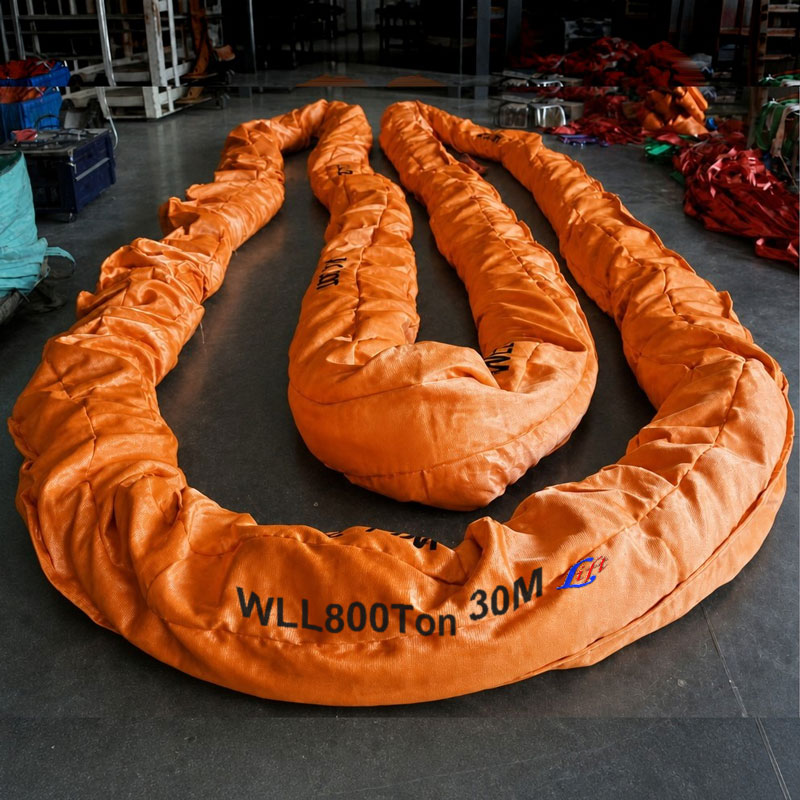
The first photograph is the form itself: a sleeved loop, coiled, with the colour telling you which class of article you are looking at and the label carrying the number that governs the lift. That division of labour is the reason the rest of this page keeps returning to the label, and it is also the reason a faded tag retires an article that may be perfectly sound.

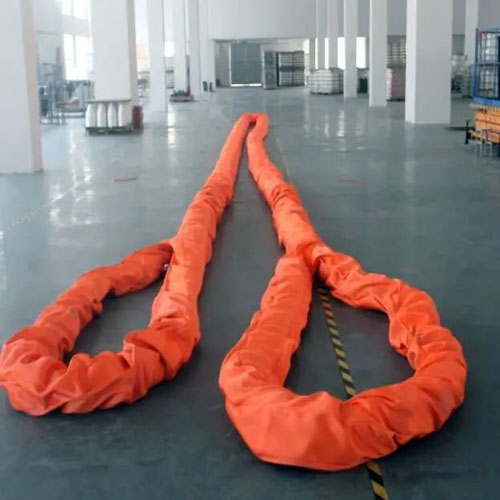
The second photograph is worth one plain sentence, because it is evidence of something a buyer should know about catalogues in general. It shows the eye variant of the same body, so this page's own image library holds two configurations of one family. The distinction is not cosmetic: the eye changes which fittings may be used and where the load path is loaded, and it has its own page. A buyer comparing photographs should compare them against the label, and ask for a photograph of the article being bought where the two have to agree.
7. Where the Figure Lives, and Why the Class Cannot Supply It
The single most useful thing a class page can say is where the number is. On a round sling it is in three places at once, and none of them is the colour.
On the label, as a rated capacity for each type of hitch, which is the set of figures that governs the article
In the configuration, because the same article in a basket or a choker is a different column with a different condition attached
In the geometry, because the angle of the legs and the angle of the choke both move the figure, and the horizontal angle has a floor below which the published practice does not go
Everything else is a field check. The colour is a field check, the sleeve is a field check, and the class this page describes is a field check: it tells a rigger what kind of article is in their hand. The arithmetic of the angle, and what opening the legs does to the figure two legs were meant to add, is worked through on the 30 ton flexible lifting belt page; the way the label has to be read at a hundred tonnes is on the WLL 100T heavy duty round slings with eyes page; and what happens above the tabulated range is on the 300 ton lifting belt page.
8. The Duties That Decide Which Round Sling You Need
Once the form is chosen, three duties decide the article itself, and each of them is a property of the core and the sleeve rather than of the capacity.
| Duty | What it decides | Where the figures are written |
|---|---|---|
| Temperature | The fibre: polyester and polyamide have an envelope of minus 40 to plus 100 degrees C, polypropylene minus 40 to plus 80 degrees C, and the guidance for synthetic slings works to the lower of the published figures, 90 degrees C | WLL 400 ton endless polyester round sling |
| Chemistry | The fibre and the fittings: nylon is excluded where acids and phenolics are present, polyester and polypropylene where caustics are, and aluminium fittings are excluded from caustic service as well | eye type round sling |
| Contact | The sleeve, the protection and the radius: a sling is to be padded or protected from the sharp edges of its load, and it is not to be constricted, bunched or pinched by the load, the hook or a fitting | circular lifting straps, reinforced and sheathed sling |
| Cycle and service | The inspection interval beyond the daily one: frequency of use, severity of service, the nature of the lifts and the experience of the service life set how often the article is examined | this page, section 9 |
The abrasion duty deserves a line of its own, because it is the one that retires round slings early in real service. A sleeve is a wear part and a wear part is a consumable: the correct conclusion is not to buy a heavier article but to choose the sleeve for the surface, and to treat the sleeve's condition as the inspection 's first question. The wear resistant sling page deals with the flat form's version of that problem and the criteria that retire an article for abrasion.
9. What to Send to Buy a Round Sling: Three Things Beyond the Tonnage
An enquiry that states a tonnage will produce an article, and may produce the wrong one. Three additions do most of the work, and all three are properties of the lift rather than of the article.
| What to state | Why it changes the answer | What it prevents |
|---|---|---|
| The length convention | A loop has a circumference and an effective working length, and 3 metre round sling means two different things to two buyers | An article that fits the hook but not the lift; the convention is set out on the 8 ton endless webbing sling page |
| The sleeve, the fibre and the duty behind them | The sleeve is the contact surface and the identification; the fibre decides temperature and chemistry before any capacity is discussed | A stronger article in the wrong material, which is the commonest expensive mistake in this family |
| The configuration and the angle | The rated capacity belongs to a hitch at an angle, and the label carries one figure per type of hitch | A figure read from the wrong column, and a set assembled from legs that were never matched |
The rest of the list is the one this site uses for every article in the family, and it is set out in full on the 30 ton flexible lifting belt page. Two lines are specific to a round sling and worth carrying into the purchase order: the marking the article has to carry, which for a synthetic sling means the rated capacities for each type of hitch and the type of synthetic web material, and the documents your own site has to hold, which decide whether a batch test certificate is enough or whether the inspection record has to name the article. Slings without affixed and legible identification markings are not to be used at all, so an article that arrives without its label has arrived unusable whatever its core can carry.
10. Frequently Asked Questions
Q1: Is a round sling stronger than a flat sling?
Q2: Why is a round sling the first choice for an irregular load?
Q3: What does the colour on the sleeve tell me?
Q4: Can the sleeve be replaced when it wears out?
Q5: Can I use two round slings to double the capacity?
Q6: How long is a round sling?
Q7: What is the hottest a round sling can work at?
Q8: Which chemicals rule a round sling out?
Q9: How often does a round sling have to be inspected?
Q10: Can a round sling be used on a sharp edge?
Contact
Send the lift rather than the word: the load, the hitch and the angle, the surface it presents, the environment, and the length convention you mean. Heavy duty round slings are built in the sleeved endless form and in the eye variant, batch tested with a certificate.
Telephone and WeChat — 18066002268
E-mail — 702461526@qq.com
Address — Lifute Industrial Park, Taizhou City, Jiangsu Province, China
-
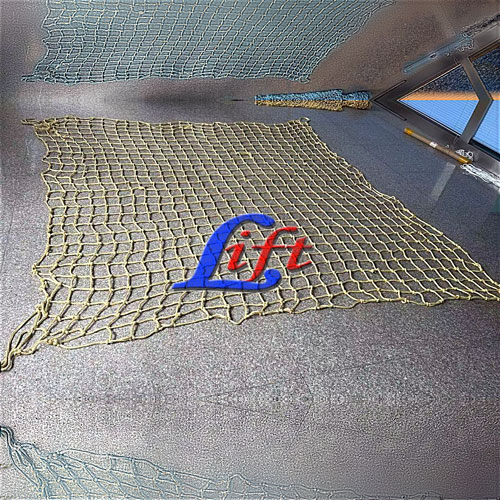
Drone Anti-collision Net
-
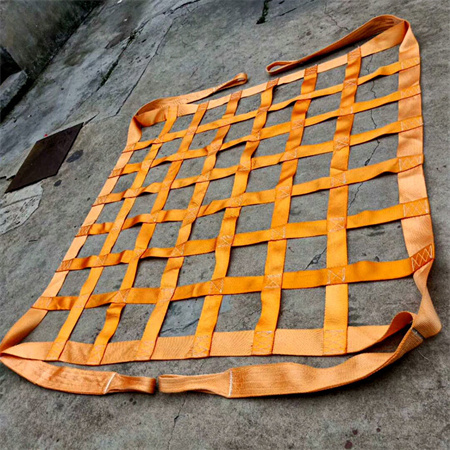
Extra Large Capacity Cargo Net
-
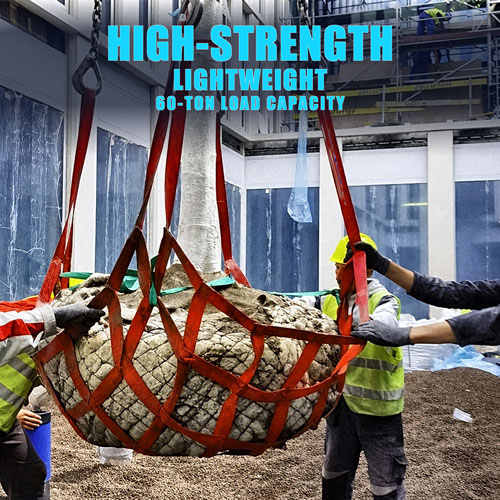
Cargo Webbing Net
-

Color changing nylon double buckle loop nylon braided rope
-

Two end buckle lifting rope, double buckle round lifting rope, double fork nylon lifting rope, non jointed nylon lifting rope
-

Emergency escape lifeline, fire escape rope, fire safety escape emergency rope, steel wire core fire rope

