 Language
 简体中文
简体中文
- On the 2018 National Day holiday, Lifet completed six 100 ton large tonnage lifting belts as a gift
- The role of suspension net in the transportation of goods turnover
- Cargo soft lifting net, lifting net, lifting net, lifting net, bag, climbing net
- Precautions for using Lifutiden elevator
- How to make circular lifting straps
Contact: Wang Lili
E-mail:18066002268
Phone:702461526@qq.com
Address: Lifute Industrial Park, Taizhou City, Jiangsu Province
Fully Braided Seamless Endless Nylon Rope, endless braided coupling rope, fully braided rope, seamless endless rope, endless nylon rope, braided coupling rope, coupling rope for safety nets, rope with no ends, seamless loop rope, endless braided rope manufacturer, braided nylon loop, nylon endless loop rope, coupling rope supplier China, braided rope technical parameters, endless loop length and inside length
Hits: ℃
Release time:2026-09-27 20:34
Lift Sling Rigging Co., Ltd manufactures the endless braided coupling rope, the article this catalogue also names Fully Braided Seamless Endless Nylon Rope. Read the two names together and one word in them is doing something different from every other word. The rest describe the rope: how it is built, what shape it has, what it is made from. That one word describes a job somebody does with it. It is also the only word in either name that this catalogue has never used anywhere else among its more than a hundred product pages, which is why this page spends most of its length on it.
Endless Braided Coupling Rope
1. The Words in the Name, and the One That Is Not a Rope Word
A rope name normally answers four questions at once: what the rope is made from, how it is built, what shape it has, and what it is for. The name on this page answers the first three and then reaches outside the rope trade for the fourth. That is worth noticing before anything else, because the fourth word is the only one in the name that a buyer cannot check against the article in front of him.
Between the two names this product carries there are six words. Five of them describe the rope; one describes a duty.
| The word | What it fixes about the article | What it leaves open |
|---|---|---|
| Endless | That the rope has no ends. It is closed on itself, so nothing is finished at either end and there is no tail to seize a fitting to. | How long the loop is, and which of the three lengths of a loop is being quoted. |
| Braided | That the body of the rope is a braid. | The pattern: how many strands run in it, and how steeply they cross. |
| Fully | That the braid is the whole of the rope, with nothing laid over it. | Nothing about quality. A fully braided rope and a covered rope can look alike in a small photograph. |
| Seamless | That no join was introduced in making the loop. | Anything at all about strength. A seamless loop is not thereby a strong loop. |
| Nylon | The fibre family: polyamide. | The filament, the tenacity, and whether the rope is treated against sunlight. |
| Coupling | What somebody does with it. It holds two things together. | What the two things are, and how hard they pull. |
The five descriptive words are ordinary rope words, and this catalogue uses them on other pages. Coupling is not a rope word at all. It comes from the safety-net trade, and it is worth following it back there, because the trade it comes from attaches figures to the word that a buyer could easily carry across by mistake.
A safety net is held in place by more than one rope, and the net standard names those ropes by the job each one does.
| The rope | What it does in the net | The figure the net standard puts on it |
|---|---|---|
| Border rope | Runs through the mesh all round the perimeter of a single net and takes that net's edge. | Minimum breaking strength 30 kN |
| Tie rope | Fastens the net to a structure or to an anchor point. | Minimum breaking strength 30 kN |
| Coupling rope | Joins two nets together when one is not enough. It is threaded through the edge meshes of both nets and closes the seam between them. | Minimum breaking strength 7.5 kN |
| Mesh rope | Forms the net itself, and has to be built so that it cannot unravel. | At least three strands, braided |
Those figures are clause 7.5 of the safety-net standard EN 1263-1, and they are printed here for one reason only: they are where the word comes from. They are requirements on a net, not properties of the rope on this page. Note what the net trade itself does with its own word: its coupling rope is allowed to be a quarter of its border rope, because a coupling rope carries the seam between two nets rather than the edge of a net. Nothing in this catalogue follows that standard. This catalogue names no rope standard at all, and this page prints no strength figure for this rope. If a strength is what you need, Section 10 lists what has to be on the order before we will put a figure against it.
Outside the net trade the same word is used loosely for any short rope that joins two things, and that looseness is the difficulty with it. A shackle is a coupling. So is a master link, and so is a swivel. Each of those is a connector with a known capacity, while coupling rope as a phrase carries no capacity with it whatever. The reliable action for a buyer is therefore not to lean on the word but to state the duty: what is being joined to what, what the joint has to hold, and what the loop has to pass over on the way. That is the difference between an enquiry we can answer with a figure and an enquiry we can answer only with a shape.
One consequence of the word decides which page of this catalogue is the right page, and it is worth setting down. A sling is arranged around a load: it takes the load at one point and hands it to a hook. A coupling is arranged between two things. This article is the rope form of a connector, which is why the page is named a coupling rope and not a coupling sling, and why the word rather than the rope has taken the first section of this page.
2. What the Article Is, as Far as the Photographs Go
The rope itself is the easy part. It is a braid, it is closed on itself, and there is nothing on it but the braid: no splice, no stitching, no whipping, no ferrule, no thimble, no sleeve and no metal of any kind. Section 7 describes the three photographs on this page one by one. What matters here is what happens at the two turns, because a loop made in any other way would have to show something there.
| How a rope is given a loop | What has been added to the rope | What the turn looks like |
|---|---|---|
| A spliced eye | The rope's own end, tucked back into the body and worked into the braid. | A splice. The pattern is broken over a length of the rope and the rope is thicker there. |
| An eye held by a fitting | A thimble, and a ferrule or a pressed sleeve over the rope. | Metal or a sleeve, and a second short length of rope lying alongside the eye. |
| A knot | Nothing is added, but the rope's end is still inside the knot. | A bulge, and a free end standing out of it. |
| An overlap that is taped or stitched | Tape or thread, and two thicknesses of rope lying together. | A length over which the rope is double, and two places where the joining material begins and ends. |
| This article | Nothing. | The braid running through the turn, no thicker there than anywhere else on the rope. |
That last row is what the two words endless and seamless are pointing at, and it is the strongest thing this page can say about the article. It is also the end of what a photograph can establish, and the limit is better stated precisely than left implied.
A photograph can show that nothing has been added to the rope. It cannot show that nothing was done. A loop can also be closed by turning the braid back into itself so that the join is distributed through the pattern instead of being gathered at one place, and from the outside that looks the same as a loop that came off the machine already closed. Both are seamless to the eye. This page does not claim which of the two this rope is, because that is a fact about the machine rather than a fact about the article, and the person who can answer it is the one who will quote the order.
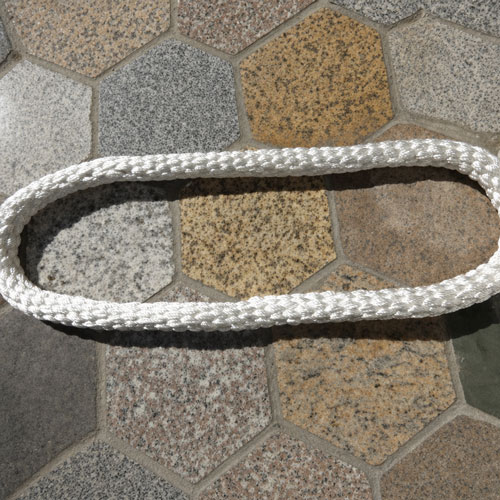
The photograph above is the form in which this article is easiest to recognise and hardest to measure. It is a loop lying flat, which means two parallel legs joined by two turns, and every dimension a buyer might ask for refers to a different part of it. That is the subject of the next section.
3. Technical Parameters: What the Sheet Loses and What It Gains When the Article Has No Ends
The other rope pages in this catalogue describe a length of rope: a coil with two ends, finished at both ends and sold by the metre. This article is not that, and the change of form does more than change the numbers on the sheet. It changes the list. Three things happen to the list at once. Some lines stop applying, because there is nothing left for them to describe. Some lines appear that a length of rope never needs. And some lines pass through untouched, because they are about the rope and not about its shape.
The table below is that movement, line by line. It is the parameter section of this page, and it is written as a comparison because on an endless article the comparison is the parameter: the first question is not what the figure is, but whether the figure exists at all.
| The line on the sheet | On a length of rope with two ends | On this article |
|---|---|---|
| Length | Cut to a stated length and sold as that length. | Stated as the length of the loop, and it has to be said which of the three lengths of a loop is meant. The table that follows this one defines all three. |
| What is at each end | Named end by end: plain, sealed, a spliced eye, an eye with a thimble. | There are no ends to name. The equivalent line is the turn, and there are two of them. |
| Number of ends | Two. | None. |
| The splice | When an eye is spliced, the splice is part of the article and is inspected as part of it. | Nothing is spliced, so there is no splice to inspect and no splice to blame. What replaces it as an inspection point is the two turns, and Section 8 says what to look for there. |
| Hardware | A thimble, ferrule, sleeve or shackle is part of the article and appears on the sheet. | Nothing is attached. If a fitting is wanted it becomes a separate line on the order and is fitted after the rope is made. |
| The tail, and the label | A finished end has a tail. The tail is where the rope is seized and where a label is fixed. | There is no tail. A label has to be tied through the braid or supplied loose in the bag. A staple would be a hole in the rope, and a hole in a rope is where it will fail. |
| How it is pulled | Along one axis, through the two ends. | Wherever the loop passes over something, the two legs leave in different directions and the loop is pulled from both sides at once. A loop is not used in the same way as a line of the same rope. |
| Legs at a load point | One. | Two. |
| Diameter, and the tension it is stated at | Read under a stated tension, and written as a tolerance band rather than as a single figure. | The same requirement, unchanged, and it is the only dimension that means the same thing on a loop as on a coil. Section 5. |
| Mass per metre | Used to check a coil against the figure it was sold on. | Used to check a loop, and it is the only check on this article that needs nothing but a scale and does not require the loop to be taken apart. Section 5. |
| The braid pattern | Stated as a construction: the strand count and the angle. | Unchanged in principle, with one qualification. Section 7 explains why a photograph cannot give either figure, so on this page the construction is a question for the order and not a claim for the page. |
| Fibre and filament | Stated by fibre family and by filament. | Unchanged. The fibre argument belongs to the nylon page of this catalogue. Section 9 links to it rather than repeating it here. |
| Colour and finish | Stated, and checked against a sample. | Unchanged, and on this article it is the only line on the sheet that a buyer can judge from a photograph at all. |
Two of the lines that changed are worth more than the others, because they are the two that catch buyers out on an endless article: the length, and the label. The label is the smaller problem and has a simple answer, given in Section 10. The length is the larger one, and it has three answers rather than one, because a closed loop has three different lengths and not one of them is interchangeable with the others.
| The length | What it measures | How it is read | When it is the number that matters |
|---|---|---|---|
| Overall length | The outside dimension of the loop laid flat: the distance from the leftmost point of the loop to the rightmost. | Lay the loop flat with no load and measure outside to outside along the long axis. | Packing, and whether the loop will lie in the space you have kept for it. |
| Inside length | The clear opening: the distance across the hole, along the same axis. | Lay the loop flat and measure the clear distance between the two inside faces of the turns. | Whenever the loop has to pass over something or sit around something. This is usually the number that decides whether the article is usable at all. |
| Loop length | The length of rope that is in the loop, which is also the length of the rope's own axis. | Not readable with a tape laid across the loop. Either agreed as an order figure or calculated. Section 5 gives the check that confirms it. | When what you are buying is rope and the loop is only the form it arrives in. |
The first two numbers are not two readings of the same thing, and the gap between them is not a rounding error. On the flat loop in the photograph in Section 2, the overall length exceeds the inside length by about two rope diameters, because the difference between the two measurements is nothing but the thickness of the two turns. A buyer who is given one of those numbers and needs the other can move between them only if he knows the diameter. That is one reason the diameter stays on the sheet even though the article being bought is a shape.
The third number is the one people expect to get by doubling one of the first two, and it cannot be got that way. A loop laid flat has two legs and two turns. The rope in it is longer than twice the distance between the turns, because the rope has to go round each turn as well as along the legs, and it is exactly the length of the rope's own axis. There is no part of the loop that can be laid along a tape to read it. If the length of the rope is what you are buying, it has to be agreed as a figure when the order is placed, and it has to be confirmed by the method in Section 5.
This rather than any single figure is the technical difficulty of an endless article, and it can be said in one line: on a coil, the length of the rope is the length of the coil, and on a loop it is not any dimension of the loop.
4. Fully Braided and Seamless Are Two Claims About Two Different Things
The product line uses two words that are often read as one claim about quality. They are two claims about two different things, and they are made in two different places. Fully braided is a statement about the body of the rope. Seamless is a statement about the making of the loop. A rope can be fully braided and still be spliced into a loop. A loop can be seamless and still be made from a rope with a cover laid over a core. Neither word says anything about the other, and neither of them says anything about how much the rope will hold.
| The claim | What it rules out | What it does not say | Where to look |
|---|---|---|---|
| Fully braided | A cover, a jacket or a sleeve laid over a separate core, and any seam where such a cover would close. | How many strands are in the braid, or how steeply they cross. | The surface. On a fully braided rope the pattern is the surface: nothing sits above it. |
| Seamless | A splice, a stitch, a staple, a pressed sleeve, a knot, or a taped joint. | Anything about strength. | Both turns. Section 7 sets out exactly what the photographs on this page do and do not show there. |
| Endless | An end, and with it a place to finish, seal, seize or hang a label. | That the loop is the size you need, or that it will pass over what you mean it to pass over. | The inside length, and it is worth reading that number before ordering rather than after delivery. |
The three words have one thing in common and it is worth naming. Not one of them is a strength word. A rope can satisfy all three and still be a weaker rope than the next one, because strength comes from the filament, the number of strands, the angle of the braid and the amount of material in the section, and not one of those four is fixed by a name or visible in a photograph. That is the reason this page has a section on what photographs settle and a section on what an order has to name, and no section headed load.
5. The Two Figures That Survive the Change of Form: Diameter and Mass per Metre
Of everything on the parameter sheet in Section 3, two lines behave in exactly the same way on a loop as on a coil. They earn a section of their own because between them they carry every check that the buyer of an endless article can actually make.
The diameter is the first. It is read under a stated tension, for the reason that applies to every rope: a rope that is not under tension is not round, and a diameter read on a loose rope is a larger number than the same rope gives under tension. It is written as a tolerance band rather than as a single figure, for the same reason: a rope is built to a construction and not turned to a size, and a figure with no tolerance around it cannot be used to accept or to reject anything. On a loop the diameter has a second job, which a length of rope does not give it. The diameter is the whole of the difference between the overall length and the inside length of the loop, as Section 3 sets out, and it is also what decides how much of the opening the two turns consume. A loop that is comfortably large by overall length can still be too small by inside length to go over what you have in mind, and the number that reconciles the two is the diameter.
Mass per metre is the second, and it is the more useful of the two, because it is the only figure on the whole sheet that can be checked on a closed loop with nothing but a scale and without taking the article apart. Weigh the loop, divide by the length that was agreed when the order was placed, and compare the answer with the figure the order was placed against.
That check works on this article for a reason that is easy to miss, and it is the reason the check is worth having. Nothing has been taken off the rope since the figure was quoted. On a length that is cut to size and spliced, the rope that arrives is shorter than the rope that was weighed, because the splicing consumed some of it, so the same division gives an answer that has to be corrected before it means anything. On an endless article nothing is cut, so there is nothing to correct. A loop is the one form in which this check is exact.
Neither of these two figures needs the loop to be understood before it can be used, and that is what makes them the two to keep. Every other figure on the sheet is a figure about a shape, and a figure about a shape can only be checked by measuring that shape.
6. Where a Rope Like This Is Used, and Where the Name Stops Being Useful
The trade the word comes from uses a rope of this kind for one thing: joining two nets. A net is made in sizes, a large working area needs several of them, and each neighbouring pair is joined along its edges by threading a coupling rope through the edge meshes of both, so that the separate nets become one working surface with a seam across it. Two conditions belong to that job, and both of them are geometric rather than metallurgical. The seam has to be closed, because the requirement the net trade sets on a connection is a limit on the gap it may leave, and the coupling rope is what closes it. And the rope has to follow the mesh the whole way, which means the loop it forms is not a fixed oval at all but a running series of loops along the seam.
That second condition explains the endless form better than any general argument about loops. A coupling rope is threaded through the edge mesh of one net and then the edge mesh of the next, along the seam, and a long seam is a great many repetitions of that. An article with an eye at each end would have to be introduced end first and worked along the whole seam from one end to the other, and it could not be taken off again without being unthreaded the same way. A closed loop can be started anywhere and finished anywhere, because it has no end that has to be passed through anything first. The seam is also opened and closed every time the net is rigged and struck, so the article is one that is made and unmade repeatedly rather than installed once and left.
The same property is what makes the form useful outside the net trade. Wherever a loop has to go round something and hold, and wherever there is no room to introduce an end or to fit a termination, a seamless loop is the article that will do the job. The ordinary uses are the ones that follow from that: a link between two eyes that has to be made and released often, a traveller running along a rail or a wire, a loop dropped over a bollard or a cleat, and a lashing that is left in place while the thing it holds is replaced. In every one of those the article is chosen for its shape, and its shape is the one thing the photographs on this page can prove.
Where the name stops being useful is the moment a figure is wanted. Coupling says what the article does. It does not say how much, it does not say from what, and it does not say what it was tested against. That is not a defect in the word; it is what the word is for. A buyer who has a figure in front of him has already left the word behind and is asking about a rope, which is the question Section 10 is written for.
7. What the Photographs on This Page Settle, and What They Cannot
Three photographs of this product were taken by the maker. They are worth describing in order, because each one is evidence of a different kind, and the set of things they prove is smaller than it looks.
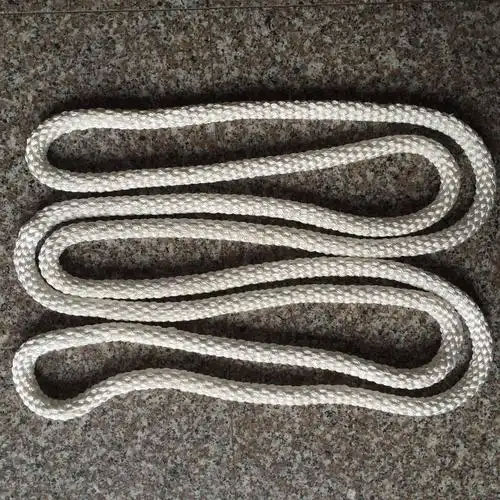
The first is the rope laid out in a serpentine on a dark speckled stone floor, four passes visible, photographed from above. It is the only one of the three that shows a length of braid long enough to read the pattern along: a regular over and under braid with a raised crown at every crossing, and no sign of any layer above the braid. There is no printing, no stencil and no stamp anywhere on the rope in the frame, of the kind that would carry a length, a batch number or a standard number.

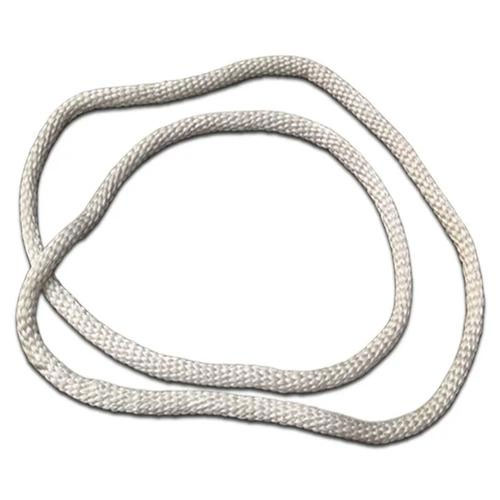
The second is a looser coil of the same rope on a plain white background, photographed slightly off square with the coil standing in two overlapping turns. It shows the same surface with less shadow, and shadow matters for one particular reason: a rope with a cover over a core has a seam where the cover closes, and a hard-edged photograph is where such a seam shows. There is none.

The third is the form the article is sold in, and it is the photograph in Section 2: the rope closed into a long flat loop, photographed on a paved surface, the braid running through both turns without a change in the pattern, without a thickening and with nothing attached.
Between them the three settle a short and definite list. That the body of the article is a braid and that the braid is the surface of the rope. That no splice, stitch, sleeve, ferrule, thimble, tape or knot is visible at either turn of the loop or anywhere along the braid. That the rope presents a uniform white surface. And that there is no printed marking on the rope itself, which is what makes the question of the label in Section 8 a real question rather than a formality.
What they cannot settle is a longer list, and it is the more useful one to have written down.
| The figure | Why these photographs cannot give it |
|---|---|
| The strand count | The count is a fact about the machine that made the rope, not a fact about the picture. A count taken by eye from a photograph of a braid is a guess, and a guess that is written onto a specification sheet becomes a claim. This page does not make it. |
| The diameter in millimetres | Nothing in the frame gives a scale. A rope photographed beside an object of known size could be measured approximately; photographed alone, a rope has no size at all. |
| The length of rope in the loop | The outer dimensions of a loop are not the length of the rope in it, as Section 3 sets out, and in the third photograph the loop is not even wholly inside the frame. |
| Whether there is a core | A core is inside the rope. Whatever the surface shows, the centre of this rope is not in any of the three photographs. |
| The filament, and its tenacity | Two white ropes of the same fibre family can be made from quite different filaments, and no photograph distinguishes them. This is the same reason the page names no strength figure. |
| The strength of the article | Strength is the result of a test on a sample, and it belongs to the batch the sample came from. There is no photograph of a test here, and on that ground alone this page prints no strength figure. |
| The size of loop being offered | The photographs show one loop. They do not say which length of loop is on offer, and a loop is bought by its length. |
| Which of the two ways the loop was closed | Discussed in Section 2. A join distributed through the braid and a loop closed at the machine look the same from outside, and these photographs cannot separate them. |
Every line in that table is something a buyer might reasonably want, and every one of them has to come from the order and from the record rather than from the page. That is not a limitation of this particular set of photographs; it is what photographs of rope are, and it is why Section 10 exists.
8. Handling, Storage and the Record for a Loop
On a finished length of rope the inspection points are the ends: the splice, the eye, the ferrule and the sleeve are where use is concentrated and where a fault is found first. This article has none of those, so the inspection points move, and they are worth naming once so that nobody inspects a loop by looking at the middle and calling it done.
| The place | Why it is the place to look | What to look for |
|---|---|---|
| The two turns | A rope works hardest where it turns. The inside of the bend takes the compression and the outside takes the tension, so if anything on a loop is going to go first, it goes at a turn. | A change in the surface at the outside of the turn: a fuzzy patch, a glazed patch, a strand standing proud of the braid, or grit worked into the braid. |
| The bearing faces | Where the loop passes over a pin, a bollard, a rail or another rope, the contact area is small and the pressure at that contact is high. | Polished or glazed braid and flattened rope on the loop, and a nicked or sharp edge on whatever the loop runs over. A sharp bearing face damages an endless rope and leaves no trace on the rope alone. |
| The whole body | A closed loop has no end, so there is no place where damage collects and no place where it cannot be seen. Walking the whole loop is the only complete inspection there is. | Anything that interrupts the pattern: a pulled filament, a strand cut by an edge, or a stiff place where the braid will not lie flat. |
| The label | It is the only record that travels with the article, and on a loop there is no end for it to hang from. | That it is still attached, still legible, and tied through the braid rather than stapled to it. |
Storage follows from the material rather than from the form, and that argument belongs to the fibre pages of this catalogue, which Section 9 links to. Two points are specific to a loop and are worth the space here. A loop kept hanging on a hook holds a bend at one place for as long as it is stored, and that is where it will first go stiff; a loop is better stored flat, or on a drum large enough that the bend is gentle. And a loop that arrives coiled takes a set from the coil: laid out for measuring, it will still be trying to coil up, which is one reason the three lengths in Section 3 are read with the loop laid flat and left to settle rather than read the moment it comes out of the bag.
The record is the last of the three and the easiest to lose, because the article has no end to carry it. Ask what will travel with the delivery: the length of the loop together with the basis on which that length was agreed, the diameter with the tension it was stated at and the tolerance band around it, the mass per metre, the fibre, and whatever test figures the order calls for. On a length of rope the record decorates the delivery. On a loop the record is the only way the loop can be identified at all once the label has gone.
One point belongs with the record rather than with the rope. A label tied through a braid can chafe the rope it is tied to, and a label supplied loose in the bag is attached to nothing. The first is the smaller of the two risks and the second is the smaller of the two conveniences, and Section 10 says which one to ask for on the order.
9. Where the Rest of This Subject Is Argued
A page about a rope with no ends can only be about half of the subject, because the other half is what a rope with ends is. This catalogue covers that half elsewhere, and the pages below are the ones that carry it. Each of them is a page with figures on it, and each is worth reading before an order rather than after a delivery.
| Subject | Where it is argued |
|---|---|
| The fibre: what polyamide tolerates and what it does not, in water, in heat, in alkali and in sunlight | Nylon woven flat sling |
| The ends of a rope: what a finished end is, what an eye is, what a fitting contributes, and which figures are quoted without their basis | Life safety rope |
| A braided rope bought for a machine rather than for a load, and the only other rope page in this catalogue that carries a full construction table | Nylon paper guiding carrier rope for a dryer cylinder |
| The endless form in the round sling family, where the load-bearing part is under a sleeve | Endless round sling |
| The endless form in the webbing family, where the article is flat | Endless sling |
| The net that a coupling rope is used to join, and the eleven parameters a net is specified by | Cargo webbing net |
| The same joining duty on a heavier net, where the word heavy duty itself has to be pinned down | Heavy duty military cargo netting |
| Size and capacity in a cargo net, and why capacity is a volume rather than a load | Extra large capacity cargo net |
Two of those pages are the two ends of this one, and it is worth saying which. The nylon page carries the fibre argument: if what you need to know is what polyamide does under water, heat, alkali or sunlight, that argument is there and this page does not repeat it. The life safety rope page carries the argument about ends: what a finished end is, what an eye is, and what a fitting contributes to an article. This page is the case in which all of that is absent. Read the three together and the catalogue has covered a rope on both sides of the only structural question that changes the specification sheet, which is whether the article has ends.
10. What an Order Has to Name
Everything this page has declined to print is printed by the order instead. The list below is that order, line by line. It is longer than the list for a plain length of rope, and the extra length is the price of the form: three of the lines exist only because the article has no ends.
| The line | Why the order needs it | What happens if it is left out |
|---|---|---|
| 1. Which name you are buying it under | This product carries two names and the trade uses a third. Naming the one you mean settles what the article is before any figure is discussed. | The maker quotes one article and the buyer expects another, and the difference is found on delivery. |
| 2. The loop length, and which of the three lengths you mean: the overall length, the inside length, or the length of rope that is in the loop | The three are different numbers and none of them converts to another without the diameter. Section 3. | The most common failure on an endless article: a loop arrives and does not do the job it was bought for. |
| 3. The inside length as well, if the loop has to pass over or sit around anything | The inside length is the number that decides whether the article is usable, and it is the smaller of the two outside measurements. | A loop that is long enough is refused for being too tight at the turns, and the rope is not at fault. |
| 4. The diameter, with the tension it is stated at, and the tolerance band around it | Without the tension the figure cannot be reproduced by whoever measures the loop, and without the tolerance it cannot be used to accept or to reject. Section 5. | The diameter is the one dimension that means the same thing on a loop as on a coil, and it is the one that is lost first. |
| 5. The fibre, and the filament if there is a filament you must have | The name says nylon and stops there. The filament is a separate decision with its own consequences. | The fibre argument is left to the supplier, and the article arrives suitable for something other than the job in front of you. |
| 6. The colour and the finish | On this article the colour is the only line on the sheet that a buyer can check against a photograph, which makes it the cheapest line to get right. | A loop in the wrong colour is still a usable loop, and it is still the wrong loop. |
| 7. The mass per metre you are ordering against | It is the only figure that can be verified on a closed loop without taking the article apart. Section 5. | The one check that works on this article becomes unavailable, and nothing replaces it. |
| 8. What, if anything, is to be fitted, and whether it is fitted before dispatch | The article as built has nothing attached. A fitting is a separate line on the order and a separate operation in the workshop. | A wanted fitting is assumed to be included, or an unwanted one arrives having been pressed onto a rope that was specified without it. |
| 9. How the article is to be labelled, and whether the label is tied or supplied loose | A loop has no tail, so this question has no default answer. A staple is a hole in the rope. Section 8. | A label stapled through a braid, or a label in a bag with no article number on it, or no label at all. |
| 10. The packing and the marking | A loop packs and carries differently from a coil, and the outer marking is what identifies the article on arrival. | The article is unpacked somewhere it cannot be identified, which is where a record goes missing. |
| 11. The figures you want with the delivery, and whether they are to come from a test | The record is the only way a loop can be identified after the label has gone, and a tested figure has to be planned for before dispatch rather than after. | There is no record, so there is nothing to compare the next delivery against. |
Three of those eleven lines exist only because the article has no ends: the length with its basis, the label without a tail, and the record without a place to hang. The other eight would be on the order for any rope bought from this catalogue, and they are listed here so that the three do not have to be remembered separately.
11. What This Page Has Deliberately Not Said
A page that declines to print figures owes the reader the list of what it has declined, so that nothing is missing by accident.
| Not on this page | Why not |
|---|---|
| A breaking strength, a working load, or a safety factor | All three are figures, and a figure without a basis is worse than no figure, because it is a figure somebody will plan work around. The basis is what Section 10 sets out to collect. |
| A diameter range | The maker builds to order from the range it holds tooling for. A range printed on a page turns into a range a buyer assumes is in stock and in the size he wants. |
| A strand count, or an angle of braid | Section 7. Neither can be read from the photographs on this page, and a construction figure has to come from the workshop that builds the construction. |
| A rope standard, and an approval against one | This catalogue names no rope standard, and this page follows the catalogue. The one standard named anywhere on this page is a safety-net standard, and it is named only because it is the origin of the word coupling, as Section 1 explains. |
| A service life, in years or in cycles | Life is a result of use and not a property of an article. A number in years would be a statement about somebody else's job wearing it out. |
| A claim about which of the two ways the loop was closed | Section 2. The two are indistinguishable from outside, and the difference is a fact about a machine. |
| A comparison with another maker's rope, or any superlative | A comparison is a claim about a product that is not on this page, and a superlative is a comparison with the name left off. |
Six of those seven have the same cause and it can be stated once rather than six times. This page is built from the name of the product, three photographs taken by the maker, and what the rest of this catalogue already measures. Everything printed on it is either visible in those photographs or consistent with the pages it links to. Where a figure was wanted and no basis for it existed, the figure was left out and the question was moved to Section 10, which is the section that can produce one.
Frequently Asked Questions
What does endless mean on a rope?
That the rope has no ends. It is closed on itself into a loop, so nothing is finished, sealed or spliced at any point, and there is no end to seize or to hang a fitting on. On this page endless is used only in that sense: it is a statement about the form of the article, and not a claim about strength and not a claim about life.
Is a seamless loop stronger than a spliced eye?
This page does not make that comparison and does not hold the figures for it. What can be said without a figure is the difference in kind. A splice is a place where the rope is finished and where a join is gathered at one point, which makes it a place that can be inspected and a place that can fail. A seamless loop has no such place. Whether that makes the article stronger depends on the rope, on the splice and on the efficiency of that splice, and a number for any of the three has to come from a test.
What is a coupling rope?
In the trade the word comes from, it is the rope that joins two safety nets together and closes the seam between them, threaded through the edge meshes of both nets. Outside that trade the phrase is used loosely for any short rope that joins two things. The figures the net trade attaches to its own coupling ropes are not properties of the rope on this page, as Section 1 sets out.
Why does this page give no breaking strength?
Because there is no test behind the figure on this page. A strength figure belongs to a batch and to a test on a sample taken from that batch, and a figure invented for a web page would be a number somebody plans work around. Section 10 lists what an order has to state before we will put a figure against it.
How do I measure the length of a loop?
There are three lengths and they are not interchangeable: the overall length, the inside length, and the loop length, which is the length of the rope that is in the loop. Section 3 defines all three and says how each one is read. The third cannot be read with a tape at all, because there is no part of the loop that lies along it.
Can a fitting be spliced into this rope?
The article as delivered has no fitting and no splice, and no photograph on this page can say what the rope will take. If a fitting is part of what you need, put it on the order as a separate line and say whether it is to be fitted before dispatch, as line 8 of Section 10 sets out. That is a question for the maker who has the rope in his hands, not a question for the page.
Is this the same article as the endless round sling in your catalogue?
No, and the difference matters more than it looks. An endless round sling is a woven sleeve around a load-bearing core, and the sleeve is the outside of it; the two are separate components and the sleeve is what a buyer sees and inspects. This article is a braid with no cover laid over it, and whether it has a core is one of the things the photographs cannot settle, as Section 7 records. The endless form is shared between the two articles; the construction is not.
What is the difference between fully braided and double braided?
Double braided means two braids, one inside the other: a braided core and a braided cover laid over it. Fully braided, in the phrase this product line uses, means the braid is the whole of the rope, with nothing laid over it. A double braided rope is therefore not fully braided in this sense. This catalogue carries both kinds, on different pages, and the two words should not be read as two strengths of the same thing.
How do I check that the loop I receive is the loop I ordered?
Weigh it. Mass per metre is the one figure on the sheet that can be checked on a closed loop with nothing but a scale, and it works here because nothing has been cut off the rope since the figure was quoted. Divide the weight of the loop by the length that was agreed and compare the answer with the figure the order was placed against. Section 5 gives the method and the reason it holds on this article in particular.
Does nylon lose strength when it is wet?
Wet and dry behaviour differs by fibre, and the comparison is drawn out on the nylon page of this catalogue, which Section 9 links to. What is specific to this article is that a wet rope and a dry rope are not the same length, which is why a length is agreed with the basis on which it was measured rather than agreed on its own.
What should I send with an enquiry?
The lines of Section 10, of which the first three carry most of the weight: which of the three lengths of the loop you mean, the diameter together with the tension it is stated at and the tolerance band around it, and whether anything is to be fitted. Add the duty as well if there is one: what the loop is joining, and what the joint has to hold. That last line is the one that turns a shape into a figure.
Contact Lift Sling Rigging Co., Ltd
Lift Sling Rigging Co., Ltd, Lifute Industrial Park, Taizhou City, Jiangsu Province, China. Telephone and WeChat: 18066002268. E-mail: 702461526@qq.com. HS code 630790. When you write, give us the first three lines of Section 10: which of the three lengths of the loop you mean, the diameter with the tension it is stated at and the tolerance band around it, and whether anything is to be fitted. Add the duty if there is one, and we will put a figure against it.
- Previous:Eye-to-Eye Hitch Cord
- Next:Life Safety Rope
-
Drone Anti-collision Net
-
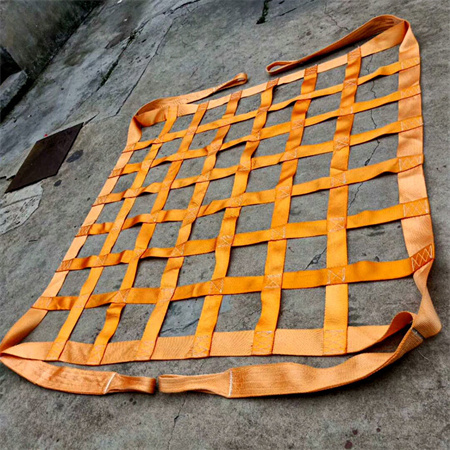
Extra Large Capacity Cargo Net
-
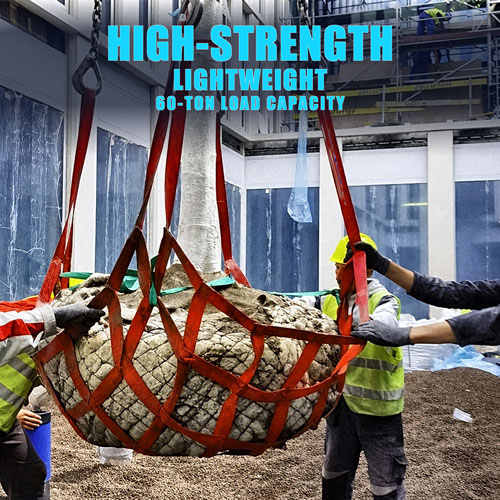
Cargo Webbing Net
-

Color changing nylon double buckle loop nylon braided rope
-

Two end buckle lifting rope, double buckle round lifting rope, double fork nylon lifting rope, non jointed nylon lifting rope
-

Emergency escape lifeline, fire escape rope, fire safety escape emergency rope, steel wire core fire rope

