 Language
 简体中文
简体中文
- On the 2018 National Day holiday, Lifet completed six 100 ton large tonnage lifting belts as a gift
- The role of suspension net in the transportation of goods turnover
- Cargo soft lifting net, lifting net, lifting net, lifting net, bag, climbing net
- Precautions for using Lifutiden elevator
- How to make circular lifting straps
Contact: Wang Lili
E-mail:18066002268
Phone:702461526@qq.com
Address: Lifute Industrial Park, Taizhou City, Jiangsu Province
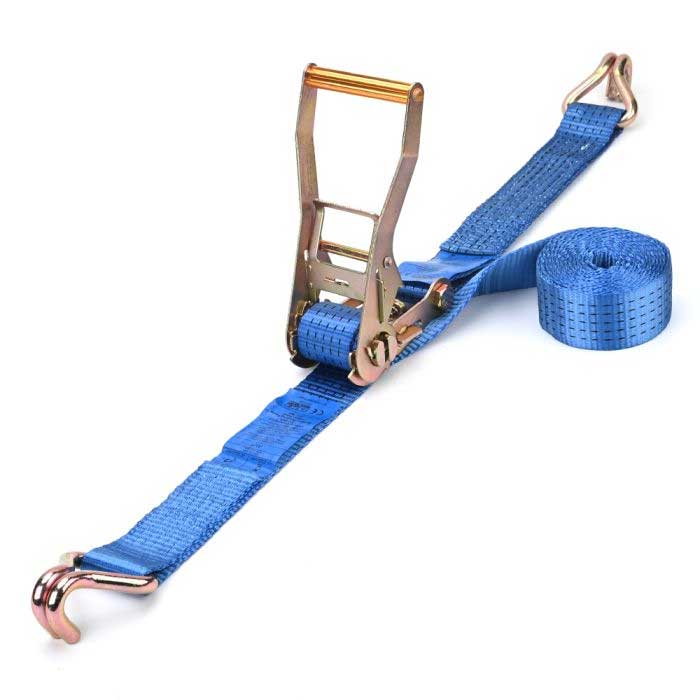
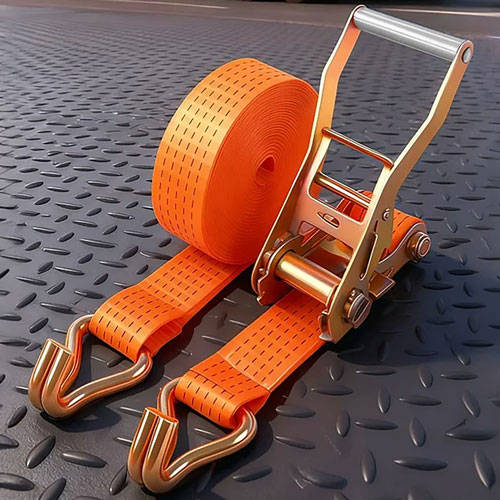
Ratchet tie down strap for holding cargo still on a vehicle: not lifting equipment, and never to be used for lifting. Flat woven polyester webbing with a plated ratchet buckle and J hooks, rated in LC, lashing capacity, in daN, with BF and STF also on the label. Europe rates at 2:1 under EN 12195-2, North America at 3:1 under WSTDA T-1, and the two numbers must not be compared. HS 630790. Phone 18066002268
Hits: ℃
Release time:2026-09-18 11:27
Lift Sling Rigging Co., Ltd produce Ratchet Tie Down Strap,Tie Down Strap,Ratchet Strap,Heavy-Duty Rachet Strap,Ratchet tow strap.
Ratchet Tie Down Strap — a Cargo Lashing, Rated in LC, and Never a Lifting Sling

A ratchet tie down strap: polyester webbing, a plated ratchet tensioner, and a hook at each end. The colour is a webbing choice, not a rating.
1. What a Ratchet Tie Down Strap Is, and What It Is Not
The trade's own definition of the article is worth reading closely, because it names the three parts and the two attachment points in one sentence. A synthetic webbing tie down is "any combination of fittings, webbing and tensioners forming an assembly that attaches to vehicle and cargo anchor or attachment points", used "for securing articles of cargo to a vehicle or restraining articles of cargo from movement on a vehicle". Three parts, two ends, one job: holding a load still.
What it is not is lifting equipment, and the difference is not a matter of opinion or of quality. It is written into the two standards. A synthetic lifting sling made to EN 1492-1 is engineered to a factor of roughly 7:1, and a ratchet lashing made to EN 12195-2 to roughly 2:1. That gap is the whole reason the standard obliges every compliant lashing label to state NOT FOR LIFTING in terms — a strap that is perfectly correct for holding a load down has nowhere near the reserve needed to hold the same load up, and it is also not designed for the shock and the horizontal loading of a lift. A tie down has no lifting capacity, no matter what its LC says, and a lifting sling is not a tie down either: the two are separate products under separate standards and they must not be substituted for one another in either direction.
Because this site sells lifting slings almost exclusively, that warning is the first thing on this page rather than a footnote. The catalogue a buyer arrives from is full of slings; this page is not one of them. If you have come here looking for something to lift with, the flat woven slings and round slings elsewhere on this site are the right products and this is not.
| The part | What it does | Where it decides the outcome |
|---|---|---|
| Webbing | Carries the tension between the two ends and presses the load down where it crosses over it. Almost always high-tenacity polyester on this product, for the reason in §10 | Wherever it crosses an edge or a sharp corner — cuts and abrasion are the leading damage. Also where it is exposed to sun and to whatever the load is treated with |
| The ratchet tensioner | Multiplies the pull of your hand into tension in the webbing, holds that tension, and lets you release it under control | It decides STF, and STF decides how many straps you need (§2). Handle length is one of the things STF depends on, which is why two ratchets of the same rating are not equivalent |
| The end fittings and hooks | Transfer the tension into the vehicle's anchor point and into whatever the hook is hooked over | A hook that can bounce off its anchor, or straighten under load, releases the whole system. The rating of the assembly is set by its weakest part — see §5, where the tensioner is named explicitly |
| The anchor points on the vehicle | Are the far end of the load path. They are part of the system even though they are not part of the product | The US rule states the WLL of a tiedown is the lower of its own weakest component or the anchor points it is attached to. A perfect strap on a weak anchor is a weak system |
2. The Number You Choose: LC — and Why a Tie Down Does Not Use It
Four values describe a lashing system and they are routinely confused with one another, including in supplier listings that quote whichever number looks largest. They are not interchangeable, and only one of the four is the right number for the way a tie down strap is normally used.
The most useful sentence on the subject comes from a manufacturer's own label guide, and it is unusually direct: "Please note the Lashing Capacity is NOT USED for tie down lashing, in that case, STF should be used." That is not a quibble. LC is the strength of the assembly if something pulls on it; STF is the force it actually presses the load down with. A strap crossing over a load stops the load sliding because it presses it onto the deck and creates friction, and the force doing the pressing is STF. Buying a strap by LC alone therefore specifies the strength of a restraint you were never going to load to that strength.
The four values, in the order they confuse people:
LC — lashing capacity, in daN. The rated capacity of the assembly. Used for direct lashing.
BF — breaking force. What the assembly survives in a destructive test. Must be at least 2 × LC. It is a test result, not a second rating.
STF — standard tension force. What is left in the strap after you release the handle. Used for frictional (over-the-top) lashing.
SHF — standard hand force, typically 50 daN. The hand pull the STF figure is defined against.
Two consequences follow, and neither is obvious from a catalogue. First, BF is not a bigger version of the rating. A strap marked LC 2,000 daN must survive 4,000 daN in the standard's test, and the published guidance is careful to say that this "does not make the strap a 4000 daN lashing for operational use" — listings that advertise the breaking force as though it were the capacity are describing a test, not a working limit. Second, STF is not a fixed property of a type of strap. It depends on the tensioner, the handle length and the webbing, which is why it is quoted per product and printed on the fixed-end label rather than assumed.
| Value | What it actually is | When it is the number you need |
|---|---|---|
| LC | The rated capacity of the assembly, in daN (1 daN = 10 N, and about 1 kgf). Set by the weakest component in the assembly, not by the webbing alone | When the strap runs from the vehicle directly to the load and acts against movement itself. This is direct lashing |
| BF | The force at which the assembly fails in a tensile test. Under EN 12195-2 the complete lashing must withstand 2 × LC without failure | Never as a working figure. It is evidence that the 2:1 factor was met, and nothing else |
| STF | The tension remaining in the lashing after the handle is released. Published guidance puts it simply: if STF is 500 daN, the downward force on the load is 500 daN | Whenever the strap goes over the top of the load — which is what a ratchet tie down strap does most of the time |
| SHF | The hand force the STF figure is measured against — 50 daN, about 50 kg of pull, and a universal figure in the European standard | When comparing two straps' STF figures. Two STF values are only comparable if both were established at the same hand force |
| Elongation | How far the webbing stretches at LC. The standard permits a maximum of 7%; better polyester assemblies are made at about 5%, which holds the load tighter | Whenever the load can settle or shift. Stretch is what lets tension, and therefore friction, leak away during a journey |
3. Direct Lashing and Frictional Lashing: Two Jobs, Two Numbers
Everything above becomes practical once the two ways of using a strap are separated, because they use different numbers from the same label. The distinction is set out plainly in the standard's own explanatory material.
Frictional lashing, usually called tie-down lashing, is the strap over the top: it is tensioned to press the load against the deck, and it works by increasing the friction available to resist movement. Its governing number is STF, and its effectiveness depends on the coefficient of friction between the load and the deck, and on the geometry. Direct lashing is the strap arranged so that it acts directly against the movement — from the vehicle's anchor point to the load and back to the vehicle — and its governing number is LC.
This is why the two photographs on this page cannot be specified by one number. A strap over the top of a machine on a flatbed is doing frictional work and its STF is the figure that matters. The same strap run diagonally down to an anchor point on the deck is doing direct work, and its LC is the figure that matters. Most real loads are held by a mixture, and a supplier who quotes only one of the two numbers has not specified the job.
| Method | How it holds the load | The number that governs it, and what else it depends on |
|---|---|---|
| Frictional lashing (tie-down, over the top) | The strap presses the load onto the deck; the pressure raises the friction that resists sliding. It does not hold the load by itself — it makes the surface grip | STF. Also the coefficient of friction between load and deck, the lashing angle, and the number of straps. A high-LC strap with a poor tensioner secures very little this way |
| Direct lashing (straight to an anchor) | The strap itself is the restraint: movement in the direction it is rigged against is stopped by the strap taking the load in tension | LC. Also the geometry, because a strap working at an angle only contributes the component along the direction you are restraining — see §9 |
| Both together | The usual real arrangement: straps over the top for friction, plus straps or a combination acting directly against fore and aft movement | Both numbers, and the geometry. This is what the calculation method in EN 12195-1 exists for, and why the standard is described as a calculation-based approach rather than a table |
| The US alternative | The same physical job, but the rules ask a simpler question: is the aggregate working load limit at least half the weight of the load? | WLL — and note the routing rule in §7, which values a direct strap at only half its WLL |
4. Three Standards, Three Rating Systems — and Why LC Must Not Be Compared With WLL
The same physical strap is rated three different ways in the three big markets, and the difference is not a matter of units. It is a different model of what the number means.
Europe rates the strap in LC, in daN, and requires the complete assembly to withstand at least twice that in test — a 2:1 factor. North America rates it in WLL, in kilograms or pounds, against a design factor that is stated as a minimum of 3:1. Australia and New Zealand pair a lashing capacity with a minimum breaking force and put both on a permanent label. The published guidance on choosing between them says the quiet part out loud: these standards "are not interchangeable", and lashing capacity and working load limit "rely on different safety models", so a direct comparison without technical validation may lead to the wrong specification.
A comparison that looks reasonable and is not
LC 2,500 daN is a force of about 2,550 kgf. A WLL of 5,000 lb is a mass rating of about 2,270 kg. They come from different standards with different factors, and neither one converts into the other. A strap can honestly be sold as LC 2,500 daN in Europe and as a WLL figure in North America, and the two numbers are not the same claim.
One thing the three standards do agree on is the arithmetic within a single system, and it is worth knowing because it shows up on every label. The published size ladder in the trade runs 25 mm webbing at LC 500 daN and BF 1,000 daN, 35 mm at LC 1,000 daN and BF 2,000 daN, and 50 mm at LC 2,500 daN and BF 5,000 daN. In every case the breaking force is exactly twice the lashing capacity: [ARITH] 1,000 ÷ 500 = 2, 2,000 ÷ 1,000 = 2, 5,000 ÷ 2,500 = 2. That is what the 2:1 factor means, and it is why a listing that shows a breaking force of 5,000 with a capacity of 5,000 is showing you a test result being passed off as a rating.
| Standard | How it rates the strap | What that means when you buy |
|---|---|---|
| EN 12195-2 Europe | LC in daN, plus STF and SHF. Complete lashing must withstand at least 2 × LC. Web lashings made from man-made fibres, for road vehicles. Compliance is effectively mandatory in commercial EU transport | You get a mandatory label carrying LC, STF, SHF, material, elongation, manufacturer, traceability code, date of manufacture and the standard reference — §8. Buy the STF, not just the LC |
| WSTDA T-1 North America | WLL, in kg or lb. The design factor for new synthetic web tie downs, with or without hardware, is stated as a minimum of 3:1 | A simpler, more conservative rating, and it pairs with the compliance question rather than a calculation: is the aggregate WLL at least half the load weight? — §7. Label colour is not standardised in this market |
| AS/NZS 4380 Australia and New Zealand | Lashing capacity plus a minimum breaking strength, both required, with testing procedures and defined safety factors for demanding environments | The closest to European practice. Labels must be permanent and legible and must show LC, minimum breaking force, material and the standard reference |
| This article | Made and marked to whichever of the three the destination market requires, and never as though one system's number were another's | Tell us the destination country first. That single answer decides the rating system, the units, the label and therefore what we make |
5. The Weaker Number Wins: the Weakest Component Sets the Rating
Every figure on the label belongs to the whole assembly, not to the webbing. The general rule is stated in the US regulation in the clearest possible form, and the European label guidance agrees with it in a single phrase — lashing capacity "is determined by the weakest link in the assembly".
US rule, 49 CFR 393.108(a), quoted: "The working load limit (WLL) of a tiedown, associated connector or attachment mechanism is the lowest working load limit of any of its components (including tensioner), or the working load limit of the anchor points to which it is attached, whichever is less."
The clause is worth reading twice for two reasons. First, it names the tensioner specifically — the ratchet is not a tool that happens to be attached, it is a rated component and it can be the thing that limits the assembly. Second, it brings in the vehicle's anchor points, which are not part of what you bought. A strap of excellent quality attached to a weak anchor is a weak tiedown, and that is a legal statement rather than an opinion.
| Component | Typical published figure | How it becomes the limiting part |
|---|---|---|
| Webbing | 50 mm high-tenacity polyester: LC 2,500 daN, BF 5,000 daN in the usual trade ladder (§4) | It rarely limits the assembly when new. It becomes the limit through damage, not through rating — a cut or a heavily abraded band is a lower-rated band |
| The ratchet tensioner | Rated as part of the assembly; it also carries the STF figure, which is what the whole frictional job depends on | By being the weakest rated component — and by being damaged: the standard's own inspection list names cracked, deformed or corroded ratchets as grounds for withdrawal (§11) |
| End fittings and hooks | Matched to the webbing rating on a properly built assembly; a wide range of hook patterns is available for different anchor points | By deforming, straightening or releasing under load. A hook that can come off its anchor ends the restraint entirely, however strong the webbing is |
| The anchor point on the vehicle | Not part of the product and not rated by us; the regulation brings it into the calculation anyway | Whenever it is weaker than the strap. This is the component buyers least often check and the one they cannot buy their way out of |
| A knot, or a repair | Not a rated component at all — the US rule simply prohibits them, and requires any repair to follow the applicable standard or the manufacturer's instructions | Immediately. A knot in webbing is a severe local weakening, and a repair that has not been made to a standard has no rating behind it |
And one more rule from the same section of the regulation, aimed at the case where nobody knows what the strap is: synthetic cordage that is not marked so that its composition or working load limit can be identified "shall be considered to have a working load limit equal to that for polypropylene fiber rope". In other words, the law does not assume an unmarked strap is a good one — it assumes the weakest common cordage. Marking is not decoration on this product. It is the difference between the strap's real rating and the lowest guess in the table.
6. The CE Question: a Ratchet Strap Must Not Carry One
This is the question buyers ask most often and it is the one where the correct answer is the opposite of what is expected. A ratchet tie down strap must not be CE marked, and a supplier who puts a CE mark on one has done something the standard forbids rather than something extra for the customer.
The reason is a legal distinction, not a quality one. The CE mark is available only to product categories that fall under a European directive or regulation that requires it. Lifting equipment does — a synthetic lifting sling is governed by the machinery safety framework and must be CE marked. Lashing equipment does not, because EN 12195-2 is not on the European Commission's list of harmonised standards. Cargo restraint sits outside the directives that carry the mark, so applying it is misleading, and the published position is that applying a CE mark to a product that does not fall under an applicable harmonised standard constitutes a legal offence. A major manufacturer states the rule in five words on its own label guide: "A strap can never have a CE label! This is strictly forbidden!"
What replaces the mark is the label, and that is why the European label is so detailed — it carries the identification that a mark would otherwise gesture at, and it does it with numbers. The practical consequence for a buyer or an inspector is simple: if a ratchet strap arrives carrying a CE mark, ask why. Either the mark was applied by mistake, or the product is being presented as something it is not. Neither is a reason to trust it more.
| The product | What governs it | Marking position |
|---|---|---|
| Synthetic lifting sling, flat woven webbing | EN 1492-1, under the machinery safety framework. Built to roughly 7:1 | Must be CE marked. Every flat and round sling elsewhere on this site belongs here |
| Ratchet lashing strap, web lashing | EN 12195-2. Built to roughly 2:1. Not a harmonised standard, so the CE route does not apply | Must not be CE marked. This article. Identification is carried by the mandatory label instead, §8 |
| The same strap sold into North America | WSTDA T-1 and the FMCSA cargo securement rules in 49 CFR 393 | Neither the CE mark nor a European label applies. What applies is the WLL and the aggregate rule in §7 |
| Where independent testing exists | Testing bodies such as TÜV or BG will test a lashing against EN 12195-2 and, where it passes, issue a GS (Geprüfte Sicherheit) certificate | The GS logo goes on the label. That is the mark worth asking for on this product, and it is not the same thing as CE |
7. The US Rule: Half the Load Weight, and Why a Direct Strap Counts Only Half
North America does not ask for a calculation. It asks for a comparison, and the comparison contains a rule that surprises almost everyone the first time they meet it.
49 CFR 393.106(d), quoted: "The aggregate working load limit of tiedowns used to secure an article or group of articles against movement must be at least one-half times the weight of the article or group of articles. The aggregate working load limit is the sum of: (1) One-half the working load limit of each tiedown that goes from an anchor point on the vehicle to an anchor point on an article of cargo; (2) The working load limit for each tiedown that goes from an anchor point on the vehicle, through, over or around the cargo and then attaches to another anchor point on the vehicle."
So the target is straightforward — the straps' aggregate working load limit must be at least half the weight of what they are holding — but the way the aggregate is built is not. A tiedown from the vehicle straight to the cargo is counted at half its working load limit. The same tiedown routed over or around the cargo and back to the vehicle is counted in full. Two straps of identical rating are therefore worth different amounts of compliance depending on how they are rigged, and a direct strap has to be twice as strong as an over-the-top strap to contribute the same amount.
[ARITH] Take a 10,000 lb load and 5,000 lb tiedowns. The requirement is an aggregate of at least half the weight, so 5,000 lb. A strap routed over the load counts in full, so it contributes 5,000 lb and meets the requirement on its own — exactly, with no margin, which is why anyone sensible uses two. A strap taken straight from an anchor point to the load counts at half, so it contributes 2,500 lb, and it takes two of them to reach the same 5,000 lb. Same load, same straps, and the routing alone doubles the number required.
Two further pieces of the same section are worth carrying into a specification. The regulation also requires that a securement system for cargo not fully contained by the vehicle structure provides a downward force equivalent to at least 20 percent of the weight of the article — the direct regulatory counterpart of the STF argument in §2. And for particular commodities the aggregate fraction changes: a stack of logs on a frame vehicle needs an aggregate working load limit of at least one-sixth the weight of the stack, while groups of concrete pipe and boulders need at least half. Commodity-specific rules take precedence over the general ones where they add requirements.
| Rule | What it requires | What to do about it |
|---|---|---|
| 393.106(d) aggregate | Aggregate WLL at least half the weight of the cargo, with a direct tiedown counted at half its WLL and an over-the-top tiedown counted in full | Work out the aggregate from the routing you will actually use, not from the number of straps you own. If the straps go straight to the cargo, you need about twice as many |
| 393.108(a) rating | The WLL of a tiedown is the lowest WLL of any component including the tensioner, or of the anchor points, whichever is less | Take the figure from the assembly as supplied and marked, and check the anchor points honestly — they can be the weakest part of your system |
| 393.108(b) marking | The WLL may come from the manufacturer's markings or from the tables, and where a tiedown is marked with a value that differs from the tables, the marked value governs | A marked strap is rated by its marking. An unmarked one falls to the conservative default below |
| 393.108(c) unmarked cordage | Synthetic cordage not marked to identify composition or WLL is treated as polypropylene fibre rope — the weakest common assumption | Specify marked straps and keep the marking readable. Note that FMCSA guidance confirms the regulation does not itself require securement devices to be marked — which is precisely why an unmarked strap is assumed to be poor |
| 393.102(b) downward force | Where the cargo is not fully contained by the vehicle structure, the system must provide a downward force of at least 20 percent of the weight of the article | This is the legal version of the STF question — and the reason a strap that cannot develop real tension cannot comply, however high its WLL |
| 393.104(b) and (g) | Damaged or weakened components may not be used; tiedowns must not contain knots; repairs must follow the standard or the manufacturer's instructions; and each tiedown must be secured so it cannot become loose, unfasten, open or release in transit | A knot is not a repair, it is a prohibition. Nor is a hook that can work its way off an anchor point acceptable, however strong the webbing |
Commodity-specific requirements exist for the loads most often carried by readers of a page like this one — dressed lumber and building products, metal coils, paper rolls, concrete pipe, intermodal containers, heavy vehicles and machinery, boulders — and they take precedence over the general rules where they add requirements. They are worth looking up before a first shipment of anything unusual, because several of them change the aggregate fraction rather than merely restating it.
8. What the Label Tells You, and What the Colour Does Not
On this product the label carries the weight that a CE mark carries on a lifting sling, and the European standard is specific about what has to be on it. A manufacturer's own label guide states the consequence of losing it in one sentence: "without this label attached to a strap (or if it is unreadable), you are not allowed to use the strap in any way". The label is not documentation. It is a condition of the strap being usable at all.
The label is also designed to survive partly losing the argument with the load. Its lower section is sewn into the seam of the assembly and repeats the critical identification — lashing capacity, material, manufacturer, traceability code, year of manufacture, standard reference — so that if the exposed part is torn or scuffed, the information is still on the strap. On a tie down that spends its life being thrown over loads and dragged across decks, that is a sensible piece of engineering, and it is why "the label is damaged" and "the label is gone" are two different situations.
The colour tells you the fibre, and nothing else. Under EN 12195-2 the identification label's colour is a material code: blue for polyester (PES), green for polyamide, nylon (PA), and brown for polypropylene (PP). Polyester is by far the most common on this product, which is why blue is the colour you will see most often. In North America, by contrast, the published position is that label colour is not standardised at all. So on a ratchet strap, colour is a fibre clue in one market and means nothing formal in the other — and in neither market is it a capacity.
Which brings the two photographs on this page back into focus. They show the same article in blue and in orange. The blue assembly is the common polyester one. The orange is a webbing colour choice — useful for visibility on a dark deck, or simply to match a fleet — and neither one is a statement about how much the strap holds. Capacity is read from the printed numbers, always, and a strap whose numbers cannot be read is out of service whatever colour it is.
| On the label | What it tells you | What it does not tell you |
|---|---|---|
| LC | The rated capacity of the assembly, in daN, set by its weakest component | How much the strap will press the load down with. That is STF — §2. Do not size an over-the-top lashing from LC |
| BF | The force the complete assembly survived in tensile testing — at least 2 × LC | A working limit. It is evidence of the 2:1 factor and nothing else, and must never be quoted as a capacity |
| STF and SHF | The tension the assembly develops after release, and the hand force (usually 50 daN) it was established at. These are on the fixed-end label | What tension you will actually reach. Correct tensioning is a technique, and how well the load is pressed down also depends on the deck and the load surface |
| Webbing material, and the label colour | The fibre: PES polyester, PA polyamide, PP polypropylene — with the label colour coding the material | Any capacity, in any market. And nothing at all formally in North America, where label colour is not standardised |
| Maximum elongation | How far the webbing may stretch at LC — the standard's ceiling is 7%, and good polyester assemblies are made at about 5% | Whether the load will settle and slacken the strap, which depends on the load as much as the strap. Lower elongation holds tension longer |
| Manufacturer, production date, traceability code | Who made it and exactly which batch it came from, with the manufacturer's full address required | How long the strap lasts. The published position is that the standard does not require an expiration date — condition and marking decide, not age |
| NOT FOR LIFTING! | That the article is a cargo restraint and must never be used as lifting equipment — the standard requires the statement to be on every lashing label | Nothing. This one is to be taken literally and it is the reason this page opens the way it does |
| The lengths: LG, LGF, LGL | LG the length of a one-piece lashing; LGF the fixed end, meaning tensioner, webbing and hook; LGL the adjustable end, meaning webbing and end fitting | Whether it will span your load. Always give the length you need between the anchor points, not the flat length of the webbing |
| The GS logo | That the product has been independently tested against EN 12195-2 by a body such as TÜV or BG, where the manufacturer carries the certificate | That every strap of that model is identical. Ask for the certificate reference and check it — this is the mark to ask for, not CE |
9. Reading the Geometry: Angle, Edge Loss and One-Side Tensioning
A tie down strap does not hold a load by being strong. It holds it by where it is put, and three published findings explain why two straps of the same rating secure very different loads.
The angle decides which part of the force is doing the work. A strap working at an angle to the deck has two components: the vertical component, which presses the load down and creates friction, and the horizontal component, which acts directly against movement. For a direct lashing the useful restraint is the horizontal component — the capacity multiplied by the cosine of the angle measured from the deck. For a friction lashing the useful part is the vertical component, which goes with the sine of the angle. Both fall away from their best value as the angle moves, and they move in opposite directions, which is why a single strap at one angle cannot be perfect at both jobs.
The belt loses force as it crosses the load. A strap going over the top is deflected twice, once at each edge. On each deflection the tension is reduced by edge friction, and the published analysis puts the practical result plainly: with lashing angles between 80° and 90° and belt-to-cargo friction of 0.20 to 0.25, "only around half the pre-tensioning force applied with the tensioner is actually present on the other side". That is worth sitting with. Tighten a strap as hard as you like at one end and the far side of the load sees roughly half of it, because the load's own edges take the difference.
Which is why tensioning from one side only is more expensive than it looks. When that edge loss is written into the calculation, the usable sum of vertical components becomes 1.5 × FT × sin α rather than 2 × FT × sin α, and the correction has a name: the k factor, defined as 1.5 where tensioning is carried out on one side only and 2 where it is carried out on both. The published consequence is the part that matters commercially: because tensioners are in practice nearly always on one side only, the mathematical securing effect of a tie-down lashing is reduced by 25%, and that loss must be made up by about 33% more belts at the same friction and the same pre-tension. A load that looks as though it needs three straps may need four, and the reason is not the strap.
The counter-intuitive one
Reasoning from "the sine of the angle is largest at 90°" leads to the common belief that a tie-down strap should be as close to vertical as possible. The published analysis of the complete effect does not support it: the actual securing effect reaches its maximum at a lashing angle of approximately 65° to 70°. Straps that are too steep press the load down well but resist little; straps that are too flat resist movement well but press the load down poorly. The useful band is in between, and it is the flat strap pulled down over the load — the one that looks least dramatic — that is doing most of the work.
| The effect | Published figure | What it means at the load |
|---|---|---|
| Edge friction loss | With a lashing angle of 80° to 90° and belt-to-cargo friction of 0.20 to 0.25, the edge factor squared is about 0.5 | The far side of the load sees about half the tension you applied. Tightening harder has less effect than moving the strap |
| One-side tensioning | k factor 1.5 rather than 2 — a 25% reduction in the calculated securing effect | Make it up with about 33% more belts. Three straps become four. Which side the tensioner is on is a real cost |
| Best lashing angle | The real securing effect peaks at about 65° to 70° from the deck, not at 90° | Aim for a strap that both presses the load down and has some angle to resist movement. A fully vertical strap is doing only half the job |
| The vertical component | Vertical component = force × sin α. It is largest at 90° and shrinks as the strap lies flatter | On low loads, a strap cannot be both steep and long. Height is what buys angle, which is why a low load is harder to restrain than a tall one |
| Friction between load and deck | The coefficient of friction is a first-order factor in every friction lashing calculation, and it has a linear effect on the securing effect while the number of straps needed moves non-linearly | A slippery load is the expensive case. A clean steel deck under a plastic-wrapped load is very different from rough timber under timber, with the same straps |
10. Webbing, Hardware and the Choices That Actually Matter
The article is simple — webbing, a tensioner, two fittings — so the handful of decisions in it decide almost everything. Left unspecified they will all be made for you, usually in favour of the cheapest option, and two of them decide whether the strap does its job at all.
| The choice | What it actually changes | How to decide |
|---|---|---|
| Polyester webbing | Low elongation and low creep, better moisture resistance than nylon, better resistance to acids, and a higher density that allows thinner webbing at equal strength. Its low stretch is the point: it is what keeps the tension — and therefore the friction — from leaking away during the journey | The default for this product and what the published material on tie downs leads with. Blue is its common label colour, which is why most lashing straps are blue |
| Nylon webbing | Higher elongation than polyester of the same construction and strength, which makes it the choice where shock absorption matters, plus better natural abrasion resistance and better resistance to most alkalis | Ask honestly whether you want stretch. On a tie down, stretch lets the load settle and the strap slacken, which is usually the wrong trade — nylon's advantage belongs to applications that take a shock, not to holding a load still for 500 km |
| Ratchet tensioner or cam buckle | The ratchet multiplies the hand force, holds what it has reached, and releases in controlled steps. A cam buckle is quicker and lighter but reaches much less tension and can slip | Ratchets where the job is real: the STF a ratchet develops is what the whole frictional job depends on (§2). Cam buckles for light, quick internal work — and it is worth knowing which one you are being quoted |
| Hook pattern | What the strap can attach to and whether it stays attached: different hooks suit different anchor points, and a hook that can bounce or work itself off its anchor releases the whole system | Describe the anchor point, not the hook. A photo of the anchor is worth more than a hook name, because hook naming is not standardised across suppliers |
| Width | 25 mm, 35 mm and 50 mm are the commercial ladder, and they track capacity: 500 daN, 1,000 daN and 2,500 daN lashing capacity respectively in the usual published figures | Choose from the capacity you need and the hardware it must run through, not from the width alone. Bear in mind that a wider band also spreads the pressure on what it crosses |
| Edge protection | Sleeves and corner protectors are what stands between the webbing and the load's edges. The published guidance names them directly as the means of protecting webbing where straps pass over sharp or abrasive edges | If the strap crosses anything sharper than a rounded corner, add protection rather than buying a heavier strap. Cuts, not overload, are how tie downs actually fail |
| Treated or untreated webbing | A chemical treatment offering some protection against an environmental or mechanical hazard — the sort of thing that matters for sun, moisture or abrasion in a specific job | Tell us what the strap will meet: open deck sun, salt, chemicals, or abrasive loads. A treatment is cheaper than replacing straps, and it is invisible once the strap is made |
11. Inspection, Use and Retirement
The published inspection list for lashing straps is short and specific, and it is a better guide than any general advice about age. Web straps and their fittings should be checked before use for deterioration or damage that could affect performance, and the damage named is: cuts and tears; abrasion; broken or damaged load-bearing fibres; damaged stitching; heat damage; contamination; and damaged, cracked, deformed or corroded ratchets and end fittings. The instruction that follows is equally direct — where the condition of a lashing means its rated performance can no longer be relied on, it should not be used for load restraint.
Three practical consequences fall out of that. First, there is no replacement interval: the standard does not require an expiration date, so a tie down is not retired because it is old but because it is no longer what it was. Which means the check has to be real, because nothing else is going to stop a tired strap. Second, an unreadable label takes the strap out of service just as surely as a cut does, and this is the failure mode of a tie down rather than of a lifting sling — a strap dragged across a deck abrades its own label, and the sewn-in wrapper section is the standard's answer to exactly that. Third, the list includes the ratchet itself: a cracked, deformed or corroded tensioner is a rated component failing (§5), and it is the part most often ignored because it looks like hardware rather than like the strap.
In use, the rules that come from the regulation are worth keeping in view: a tiedown must not contain knots; anything repaired must be repaired to the applicable standard or the manufacturer's instructions and not improvised; and every tiedown must be attached and secured so that it cannot become loose, unfasten, open or release while the vehicle is in transit. That last one is where hook choice, anchor condition and the geometry in §9 all meet. A load that arrives with a slack strap did not fail because the strap was weak; it failed because the tension it started with was not held.
12. Frequently Asked Questions
Q1: What is a ratchet tie down strap?
Q2: Can I use a ratchet strap to lift something if its rating looks high enough?
Q3: What does LC mean, and is it the number I should specify?
Q4: Why does my ratchet strap have no CE mark?
Q5: Is LC the same as WLL?
Q6: How many straps do I need?
Q7: What does the colour of the strap or the label mean?
Q8: What safety factor applies to a ratchet strap?
Q9: When should a tie down strap be taken out of service?
Q10: What do you need from me to quote?
Contact
This is a made-to-order lashing strap, and the two answers that decide it are the destination market and the load. Send the country, the load weight, the length between your anchor points and the hook anchor you need, and add whether the straps will go over the top of the load or straight to an anchor point — that last detail alone can change how many you need. Technical questions on this page are answered by the workshop rather than by a call centre, and if the honest answer is that you need a lifting sling rather than a tie down, we will say so.
Telephone and WeChat — 18066002268
E-mail — 702461526@qq.com
Address — Lifute Industrial Park, Taizhou City, Jiangsu Province, China
HS code — 630790
- Previous:Single Use Lifting Sling
- Next:Ratchet Cargo Lashing Belt
-
Drone Anti-collision Net
-
Extra Large Capacity Cargo Net
-
Cargo Webbing Net
-

Color changing nylon double buckle loop nylon braided rope
-

Two end buckle lifting rope, double buckle round lifting rope, double fork nylon lifting rope, non jointed nylon lifting rope
-

Emergency escape lifeline, fire escape rope, fire safety escape emergency rope, steel wire core fire rope

