 Language
 简体中文
简体中文
- On the 2018 National Day holiday, Lifet completed six 100 ton large tonnage lifting belts as a gift
- The role of suspension net in the transportation of goods turnover
- Cargo soft lifting net, lifting net, lifting net, lifting net, bag, climbing net
- Precautions for using Lifutiden elevator
- How to make circular lifting straps
Contact: Wang Lili
E-mail:18066002268
Phone:702461526@qq.com
Address: Lifute Industrial Park, Taizhou City, Jiangsu Province
Lift Sling Rigging Co., Ltd manufacture Cargo Webbing Net,Belt Strap Cargo Net.Cargo Webbing Net from Lift Sling Rigging Co., Ltd. The page‘s own line names five articles: Cargo Webbing Net, Belt Strap Cargo Net, Webbing Cargo Net With Loops, Large Capacity Cargo Lifting Net and Polyester Flat Lifting Cargo Net. Three of those names say net and two say lifting, and this page separates what the net itself does from what the lifting figure is. A net is not a strap with a different shape: the load no longer travels along one member but through many members at once, and it has to pass from one to another at every node. Section 5 sets out the eleven technical parameters a net is ordered and delivered against, with the unit each is measured in, the way each is taken, and the three relations that link them: opening against spacing, members along a side, and nodes on the net. The rest of the page covers why the mesh, which none of the five names states, is the first line of an order; the difference between a knotted and a knotless construction.
Hits: ℃
Release time:2026-09-30 08:09
Lift Sling Rigging Co., Ltd manufactures Cargo Webbing Net — and the page's own line names five articles, not one. The line that came with this product reads: Cargo Webbing Net, Belt Strap Cargo Ne t, Webbing Cargo Net With Loops, Large Capacity Cargo Lifting Net, Polyester Flat Lifting Cargo Net. Three of those five names say net, and two of them say lifting. That division is the whole subject of this page, because a net is not a strap with a different shape: it changes where the force goes, and it changes what has to be written on the order before anything can be quoted.
Cargo Webbing Net
1. Five Names, and the Two Questions Inside Them
The five names are not five products and they are not synonyms either. Read them as two groups and the page becomes short.
| The name | What it is actually asking for |
|---|---|
| Cargo Webbing Net | A netting made of webbing, for cargo. The material is named and the shape is named; nothing is said about what it carries or h ow it hangs. |
| Belt Strap Cargo Net | The same thing described from the material again. Belt and strap are the words this site's flat pages use; the name adds nothi ng about the mesh. |
| Webbing Cargo Net With Loops | The first name that says something about the build: the net is finished with loops, which is where it will be attached. This i s the name that decides Section 6. |
| Large Capacity Cargo Lifting Net | The word lifting appears. Once an article is a lifting accessory, its figures have to come from a lifting document rather than from a netting description, and Section 8 takes that up. |
| Polyester Flat Lifting Cargo Net | The material is narrowed to one fibre and the word lifting comes back. The fibre itself is argued on the pages that own it, an d this page does not restate them. |
Two questions therefore run through every one of the five names. The first is what the mesh is, because that is what decides what the net holds and it is the one thing none of the names state. The second is what document the article is being bought against, because the same netting sold to hold a tarpaulin over a load and sold to lift a load are two different transactions.
2. A Net Is Not a Strap: Where the Force Goes Instead
Every other article on this site carries its load along one path. A flat sling is one member; a round sling is one loop; even a rope with a buckle at each end is one continuous line of material fro m one attachment to the other. A net is different in kind, and the difference is worth stating plainly because it is the reason the rest of this page exists.
| The article | Where the load travels | What that means for the order |
|---|---|---|
| A strap or a sling | Along one member, from one end to the other. If that member is sound and the ends are sound, the article is sound. | The lines that matter are the material, the width and the ends. Everything else follows. |
| A net | Through many members at once, and it has to pass from one member to another at every node. The path a particular load takes de pends on where the load is sitting and which members it is resting on. | Two nets of the same material, the same total weight and the same outside size can behave differently, because the members and the nodes are not the same. The mesh, not the material, is the first line. |
| Where it concentrates | At the nodes, and at the edge. A member is strongest in its middle and weakest where it is joined or where it turns. | The two places to specify and to inspect are therefore the nodes and the border, and they are dealt with in Sections 3 and 6.< /td> |

One consequence follows immediately and is easy to miss. On a net, a single damaged member does not necessarily take the article out of service the way a cut strap does, but it does move load onto the members beside it. Judging that is a different judgement from judging a strap, and Section 11 returns to it.
3. Knotted and Knotless: Two Ways of Joining Members
The word that decides how a net's nodes are made does not appear on this site. Knotless, in the sense of a net built without knots, is absent from all one hundred product pages, and so is the word for the spacing of a mesh. What the site does have is the ordinary word for a knot, used more than a hundred times, and the word for something being knotted, used across fifteen pages, almost entirely about flat articles rather than about netting.
| The construction | What happens at the node | What the order has to add |
|---|---|---|
| Knotted | Members are tied to one another. The knot is a bend in the material, and a bend is where a member gives up part of what it cou ld carry if it were straight. | Whether the figures being quoted are for the member or for the knotted net, because they are not the same number and a supplie r can be quoting either. |
| Knotless | Members are joined without being tied, so there is no bend and no loose end at the node. The node is made by the construction itself. | The same question, plus the one this word raises: if nothing is tied, what holds the node, and what has to be watched there ov er the life of the article. |
| Neither word present | If the buyer says neither, the construction is undecided, and the two products will not be interchangeable at the same figures . | One line: knotted or knotless. It is the cheapest line on the order and the one most often left out. |

The photographs on this page settle one of those two constructions for this product line. In the flat-laid views the members pass over and under one another in a plain weave, and where two of them cross there is neither a knot nor a cut end: the tape simply goes on. That is a knotless node, made by the interlacing rather than by a tie, and it is worth knowing before an enquiry is written, becau se it decides which of the two columns above the buyer is asking about.
4. The Mesh Size: the Number the Name Does Not Contain
None of the five names gives a mesh size, and neither of the two words that would describe one appears anywhere on this site. So this is the line that has to travel from the buyer to the supplier i n writing, and it has to say which measurement is meant, because two people can agree on a figure and still be describing different openings.
| What can be measured | Why it is not the same as the others |
|---|---|
| The clear opening | The hole a small object can pass through. This is the figure that decides what the net will hold in practice, and it is the on e a user thinks he is quoting. |
| The spacing from centre to centre | The distance between two neighbouring members, measured through their middles. This is the figure a maker works to, and it is larger than the clear opening by roughly the width of one member. |
| The count across the net | How many openings along one edge and up the other. It fixes the mesh only together with the outside size, and it is how a net is often described in a hurry. |

The practical rule that follows is short: a net order that gives the outside size and the clear opening is complete enough to quote, and one that gives the outside size and the count is complete on ly if the person reading it makes the same assumption about the member width. Writing both the opening and the spacing removes the assumption entirely.
5. Technical Parameters: the Numbers a Net Is Ordered and Delivered Against
An article with one member needs three lines on an order and the rest follows. A net needs the eleven lines below, and they are not independent of one another: change the spacing and the number of members moves, change the member width and the clear opening moves with it. This section lists the parameters, gives the unit each is measured in and the way each is taken, and then gives the three re lations that link them, so that a quotation and a delivered net can be compared line by line instead of by impression.
| Parameter | Unit | How it is measured | What it decides |
|---|---|---|---|
| Mesh clear opening | mm | The largest square that will pass through one opening, measured between the inner faces of the two members that bound it, in b oth directions of the grid | What the net will hold in service. It is the figure a user has in mind when he says the mesh |
| Spacing, centre to centre | mm | From the centre line of one member to the centre line of the next, taken in both directions of the grid | What the maker builds to. It is larger than the clear opening by exactly one member width |
| Member width | mm | The flat width of one webbing member, measured across the tape at three places and taken at the smallest | The difference between the two figures above, and the width every node has to take |
| Outside size | mm | The net laid flat and unstressed, measured between the outer edges of the border, length first and width second | The coverage. It is the first figure anybody asks for and the last one that should be agreed alone |
| Border band width | mm | The width of the border band measured across it, taken at a point away from a corner | How much of the outside size is not grid, and how quickly the border can gather the inner members |
| Members along each side | pcs | Counted along one edge and up the other on the finished net, including the border member | The density of the grid, once the outside size and the spacing are fixed |
| Nodes | pcs | Counted where two members cross, on the finished net | How many places the load passes from one member to another, and therefore how large the inspection task is |
| Loops: how many, and how far apart | pcs, mm | The number of attachment loops, and the distance from one loop to the next measured along the edge between them | How the net may be hung, and on how many points |
| Loop clear size | mm | The inner clear of one loop, measured across its widest point with the tape straightened but not pulled | Which fitting, shackle or connector will pass through it |
| Fibre and colour | none | Taken from the label and from the order, not from the colour of the tape | Identification of the article. On a net it says nothing about what the net will carry |
| Mass | kg | The net alone, without fittings, weighed once on the finished article | Handling at the point of use, and nothing else |
Three of those eleven carry the others with them, and they can be written out. Putting them on the order is what turns a description into a specification.
| The relation | Written out | Why it belongs on the order |
|---|---|---|
| Opening against spacing | Clear opening = centre-to-centre spacing minus member width | This single line is why a buyer and a maker can agree on the mesh and still build two different nets. State both figures and t he assumption disappears |
| Members along a side | Outside size minus twice the border band width, divided by the spacing, rounded, then plus one | The border is not grid, so it comes off first, and the one at the end counts the last member. This is the line that tells a bu yer how fine the grid will actually be |
| Nodes on the net | Members along the length minus one, multiplied by members along the width minus one | Each node is a transfer point and a place to look. The count tells the buyer the size of the inspection task before the net is ordered rather than after |
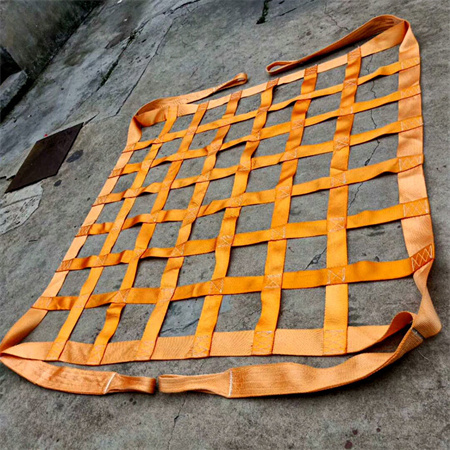
The photographs on this page settle the construction questions in the list and none of the dimensional ones, and it is worth being exact about which is which, because a photograph is the most commo n substitute for a specification and it is not one.
| What the photograph shows | What it settles | What it cannot settle |
|---|---|---|
| Members passing over and under one another in a plain weave | That the construction is knotless, and that no cut end is left standing at a node | How tightly the interlace is drawn, which is a making parameter and not a visible one |
| Openings that are square in plan and regular across the net | That the mesh is square rather than diamond, and that it is uniform | Any dimension at all. There is no scale in the picture, and tape width and opening look alike from a distance |
| A band running round the perimeter that is wider than the members | That the border is a separate and wider member, and that the grid stops short of the outer edge | Its material, and whether it is stronger than the mesh it gathers |
| Flat rectangular tape used as the member | That this is a webbing net and not a rope net, and that each member has four faces and two edges | The tape width, and therefore the opening that goes with it |
| Long flat loops left standing at the corners | That loops are part of the build on this product line, and that they are made from tape | How many there are, their clear size, and what closes them |
| A rectangle, laid flat and unstressed | That the plan shape of this build is rectangular | Whether square, tapered or shaped nets are also available in the same construction |
The point of putting all three tables on one page is that a quotation and a delivered net can only be compared against the same list. A photograph, a name and an outside size will not do it, and no ne of the five product names contains a single one of the eleven parameters.
6. The Border: Where Every Member Ends Up
One of the five names in the product's own line says the net comes with loops, and that is the name that decides this section. On a net, the members run outwards until they reach the edge, so whate ver is put along the edge collects from the whole net at once. The site's pages about loops and about the finished edges of flat articles are about those articles; the point here is narrower and belon gs to netting alone.
| The edge | What it has to do | What has to be asked |
|---|---|---|
| A border member | It gathers the ends of the inner members and spreads the attachment loads back into the net, so it is loaded in a way that no single inner member is. | What the border is made of, and whether it is the same material as the mesh. A border that is weaker than the mesh moves the f ailure to the edge, where it cannot be seen from above. |
| Loops along the edge | They are the attachment points, and every one of them carries a share of the load that may not be even between the loops. | How many loops, where they are, and what closes the loop. Above all, whether the net is meant to hang on all of them or on a s tated subset, because a net hung on too few points is a different article. |
| Corners | On a rectangular net the corner is where two borders meet and where the load from two directions adds together. | Whether the corners are reinforced, and whether the net may be lifted from them. This is a yes or no line on the order, not a matter of judgement on site. |

7. A Cargo Net Is Not a Safety Net
This distinction is worth a section of its own on a page whose first word is cargo, because the two articles are made of similar material, look similar in a photograph, and are bought for opposite reasons. Across the whole site the phrase for a net that catches a person does not occur once, and neither does the standard that governs that kind of net. On this site those words have never been use d.
| The article | What it is for | Where the site argues it |
|---|---|---|
| A net that holds cargo | Keeping a load together and, where the name says lifting, carrying it. The load is material and it does not move on its own. | This page. It is a lifting article when the name says lifting, and the figures then come from a lifting document. |
| A net that catches a person | Intercepting a body that is already falling, which means absorbing energy rather than merely holding weight. | Nowhere on this site. If an enquiry is for that article, it is a different conversation and it needs a different document, not this page's figures. |
| The boundary between them | An article that holds a load and an article that arrests a person are two different things, and the line between them is argue d in full on another page of this site. | The mining reflective lifting belt page, which is where that boundary is set out. This page assumes it and stays on the cargo side. |
8. When the Name Says Lifting, the Figures Come From Elsewhere
Two of the five names contain the word lifting, and that word changes the transaction. Netting bought to cover a load and carry nothing is judged by what it keeps in place. Netting bought to lift a load is a lifting accessory, and its figures have to be traceable to a lifting document, on this site or wherever the buyer's own rules point.
| What is being bought | What the supplier has to be able to show |
|---|---|
| Cover netting | The material, the mesh, the outside size and the finish. No load figure is claimed, and none should be inferred from the mater ial. |
| A lifting net | Where the number comes from, what configuration it was measured in, and whether it is the figure for the mesh or for the finis hed net with its border and loops. |
| The trap in between | The same netting can be sold both ways. If the order does not say which, the cheaper reading will be assumed by whoever is ans wering, and the net will arrive described by the material rather than by a lifting figure. |
9. Polyester and Webbing: Two Words That Belong to Other Pages
Two more words in those five names are already thoroughly in use on this site, and honesty about that shortens the page rather than lengthening it. Webbing is one of the most used words in the cata logue, appearing on seventy-one pages, and the material behaviour of polyester and of the other fibres is argued on the flat pages that live outdoors. None of that is repeated here.
| The word | Where it is already argued | What this page takes from it |
|---|---|---|
| webbing | The flat sling pages, where the tape itself, its width and its weave are the subject. | Only that the members of this net are made of it, and that a member cut from tape has two edges per member. |
| polyester, and the other fibres | The pages that deal with sunlight, water, rot and the way a fibre behaves out of doors. | That a net exposes far more edge and far more surface per kilogram than a strap does, so whatever those pages say about wear a rrives here sooner. |
| edge | The same pages, and the word is used on seventy-three of them. Wear and abrasion are argued there and not here. | One consequence of the shape: a net has many more places where something can rub, and the count is a design choice rather than an accident. |
10. What the Order Has to Name
Written in the order in which the lines decide whether the rest can be answered. The first four are the ones the five names make it easy to leave out, because each of the names sounds as if it has already said something. Read together with Section 5, this is the same list put into the sequence an enquiry is answered in.
| # | The line | Why it has to be there |
|---|---|---|
| 1 | Which of the two transactions this is: cover netting, or a lifting net | It decides whether a load figure is being bought at all, and therefore which document the reply has to point at. |
| 2 | The outside size, and the mesh stated twice, as clear opening and as spacing | These are the two figures nobody can infer from the five names, and the pair removes the assumption about member width. |
| 3 | Knotted or knotless | It changes the node, and the node is where a net is weakest and where it is inspected. |
| 4 | The border: its material, its width, and whether it is stronger than the mesh | Everything the net carries arrives at the edge. A border weaker than the mesh puts the failure where it is hardest to see. |
| 5 | The loops: how many, where, and what closes them | One of the five names already promises loops, so the order has to say what that promise means in numbers. |
| 6 | How it will be hung, and on how many points | A net lifted from four points and the same net lifted from two are not the same article, whatever the netting is. |
| 7 | The fibre, and the colour if the colour is doing a job | The fibre's behaviour belongs to other pages; the colour, where it is used to identify an article, belongs to the order. |
| 8 | Marking, the instructions supplied, and the record | On this article the record carries the mesh, the construction and the border, because those are the three things that cannot b e read off a photograph. |
11. Inspection and Retirement on an Article With Many Members
The site's other pages say what can be seen is one input rather than the whole answer. On a net the same principle applies with more places to look, and the order of looking is what keeps it practi cal.
| What is looked at | What is being looked for |
|---|---|
| The border and the loops, first | Rubbing, chafing and local wear where the loops meet the structure that holds them, and any sign that the edge has begun to gi ve along one side rather than another. This is where a net tells you the most in the least time. |
| The nodes | On a knotted net, a knot that has worked loose, drawn tight, or worn at the bend. On a knotless net, local distortion at the j oin. Both are found by looking along the members rather than only at the outside face of the net. |
| The members | Cuts, abrasion and local thinning. Because load transfers to neighbours, one damaged member is not automatically the end of th e article, but it changes what the neighbours are carrying. |
| The record | The mesh, the construction and the border, and how the net has actually been hung. Without the last item the inspection cannot distinguish a net that was overloaded from one that was hung on too few points. |
On retirement, one difference from a strap is worth stating. On a single member, damage localises into one obvious place. On a net, damage is distributed and the count of small defects matters more than any single one, so a net is more often retired for the accumulation than for one event. That makes the record, rather than the bench, the deciding input, and it is why this page has put the reco rd in the list twice.
Frequently Asked Questions
Is this net rated for lifting?
That depends on which of the five names is being bought. Two of them contain the word lifting, and an article sold as a lifting accessory needs its figures traceable to a lifting document. If the o rder does not say which transaction it is, assume the reply will describe the material rather than a load, and ask again.
What technical parameters should I give you?
The eleven in Section 5: the clear opening, the spacing, the member width, the outside size, the border band width, the members per side, the nodes, the loops and their spacing, the loop clear size , the fibre and the colour, and the mass. In practice four of them decide whether the rest can be answered at all: the outside size, the mesh stated both ways, the construction and the border. Send th ose and a quotation can be checked line by line rather than by impression.
What mesh size should I specify?
Give the clear opening and the spacing between members, not just one of them and not just a count. The clear opening is what decides what the net holds; the spacing is what a maker works to; the tw o differ by exactly the width of one member, which is the assumption that causes disagreements.
Knotted or knotless - which is better?
Neither is better in the abstract; they are two ways of making the same kind of node, and they are not interchangeable at the same figures. What matters for a quotation is that one of the two words is on the order, because the name of the product does not contain either.
Do your nets come with loops?
One of the product's own names says webbing cargo net with loops, so loops are part of what this product line describes. How many, where they sit, and what closes them still has to be stated, becau se a loop is an attachment point and the whole net arrives at its attachment points at once.
Can a cargo net be used to catch a person?
No, and it should not be asked to. A net that holds cargo carries a load that is not moving; a net that catches a person has to absorb the energy of a fall. That is a different article with a diffe rent document, and it is not what this page describes. The boundary between a lifting article and an article that arrests a person is argued in full on the mining reflective lifting belt page of this site.
How many lifting points does it need?
That is a property of the installation rather than of the netting, and it has to be stated before quotation. A net lifted from four points and the same net lifted from two are different articles ev en when the netting is identical, and no inspection afterwards can tell the two histories apart without a record.
Which fibre is used?
Polyester is named in one of the five product names. The behaviour of polyester and of the other fibres under sunlight, water and rot is argued on this site's outdoor flat pages, and this page does not repeat that. One thing does change on a net: there is far more surface and far more edge per kilogram, so those effects arrive sooner.
What has to be inspected first?
The border and the loops. Everything the net carries reaches the edge, and the edge is where rubbing happens, so it gives the most information for the least time. The nodes come second and the memb ers third.
What does a damaged member mean?
On a net it does not automatically end the article, because load transfers to the members beside it. What it does is change what those neighbours are carrying, which is why the count of small defec ts and the history of how the net was hung matter more here than on a single-member article.
What if one corner has been taking the load?
Then the record should say so. Uneven wear between corners usually means the net has been hung on fewer points than intended or that the load was not centred, and that is a question about the insta llation rather than about the netting. It is also the kind of finding that a photograph of the top face will never show.
What should I send with an enquiry?
The first four lines of Section 10: which transaction it is, the outside size with the mesh stated both ways, knotted or knotless, and the border material and width. Then the loops, the number of h anging points, the fibre, and the marking and record. The first four decide whether the rest can be quoted.
Contact Lift Sling Rigging Co., Ltd
Lift Sling Rigging Co., Ltd, Lifute Industrial Park, Taizhou City, Jiangsu Province, China. Telephone and WeChat: 18066002268. E-mail: 702461526@qq.com. HS code 630790. State which of the two trans actions the enquiry is for, the outside size with the mesh given both ways, and how the net will be hung, and the reply can be checked line by line.
Where the rest of this subject is argued, on this site: mining reflective lifting belt, nylon woven flat sling, polypropylene flat sling, flat sling, splicing, threading and wrapping sling, circular sling, one-way sling.
- Previous:Heavy Duty Military Cargo Netting
- Next:No time
-
Drone Anti-collision Net
-

Extra Large Capacity Cargo Net
-
Cargo Webbing Net
-

Color changing nylon double buckle loop nylon braided rope
-

Two end buckle lifting rope, double buckle round lifting rope, double fork nylon lifting rope, non jointed nylon lifting rope
-

Emergency escape lifeline, fire escape rope, fire safety escape emergency rope, steel wire core fire rope

