 Language
 简体中文
简体中文
- On the 2018 National Day holiday, Lifet completed six 100 ton large tonnage lifting belts as a gift
- The role of suspension net in the transportation of goods turnover
- Cargo soft lifting net, lifting net, lifting net, lifting net, bag, climbing net
- Precautions for using Lifutiden elevator
- How to make circular lifting straps
Contact: Wang Lili
E-mail:18066002268
Phone:702461526@qq.com
Address: Lifute Industrial Park, Taizhou City, Jiangsu Province
Lifute Hoisting Co., Ltd. 18066002268 produces lifting belts, lifting nets, nylon ropes, soft ladders, steel wire rope rigging, paper ropes, safety belts, safety nets, lifting chains, steel coil hoists, crossbeam hoists, flat lifting belts, circular lifting belts, electric traction ropes, high-altitude safety belts, and anti fall safety nets Wear resistant lifting belt. The product line on this listing carries three descriptions, and the third one - wear-resistant and anti cutting lifting belt - promises two protections joined by the word and. Those two are not measured the same way.
Hits: ℃
Release time:2026-09-27 17:03
Lift Sling Rigging Co., Ltd manufactures Wear resistant lifting belt, wear-resistant sling, wear-resistant and anti cutting lifting belt. Wear Resistant Lifting Belt — The Name Joins Two Promises W ith "and", and Only One of Them Can Be Tested Like a Property
Wear Resistant Lifting Belt — The Name Joins Two Promises With "and", and Only One of Them Can Be Tested Like a Property
The short answer. Read this listing's own product line carefully: wear resistant lifting belt, wear-resistant sling, wear-resistant and anti cutting lifting belt. The thi rd name promises two protections joined by the word and, and the interesting thing about that pair is that they are not measured the same way.
Wear resistance has a published, comparable answer for a lifting sling, because abrasion appears on the same removal criteria list that retires the article: you can point at a worn band and say why it is out of service. Anti-cut resistance has no such thing. There is no cut class in any flat webbing sling standard. Cut resistance is measured by glove and garment standards, and those standards contain two different cut tests that do not always agree — one of them is known to mislead on exactly the class of high-performance fibre that cut-resistant articles are made from. So an anti-cut claim on a lifting belt is a construction description that has to be qualified by the threat it is written against, and this page is largely about what that qualification has to contain.
There is a second reason the pair deserves a page. The two promises pull in different directions. A hard, dense, tightly bound or coated surface is what resists abrasion, and it is not automatically what resists a blade; a compliant surface that conforms to a load can behave the opposite way. A buyer who treats wear-resistant and anti-cut as two ticks on one list has not specif ied anything, because the article that does both best is a compromise between them.
What follows: Section 1 reads the three names in the line. Section 2 sets the two promises side by side and keeps them apart. Sections 3 and 4 are the centre of the page — what an anti-cut claim ca n actually be measured against, and why the test used changes the answer. Section 5 sets out what a usable anti-cut specification has to say. Section 6 is the tension between the two promises. Section s 7 to 9 cover the article itself, what a damaged article looks like, and the enquiry. Where the abrasion half of the subject is argued in full — the zones where a flat band wears, and the four ways a band is made to resist it — this page links to the page that owns that argument rather than repeating it.

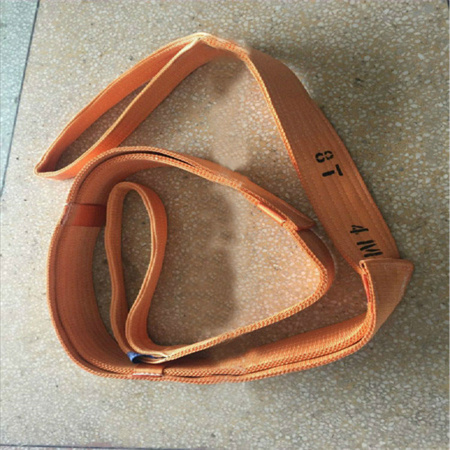
The page's own photograph, and worth reading before the arguments. Four things are visible and one is not. The band is flat wove n and formed into a loop with no fittings at all, so nothing is being gripped by a hook here. The figures are printed directly onto the webbing in the direction a person handling the article reads the m. A stitching line runs the length of the band, which is what a folded or layered construction looks like from the outside. And the colour is a plain dyed orange — there is no coating, no sleeve, no wear pad and no second material laid over the band anywhere in this photograph. That last point is the one that matters most to this page: nothing visible here is an add-on, so whatever this a rticle does about wear and about cutting is being done by the woven band itself. What the photograph cannot tell you, and what Section 5 is about, is which threat the article was built agains t — because a band can be made to survive abrasion and still be opened by a blade, and the photograph looks the same either way.
1. The Three Names in the Line, and Which One Does the Work
The product line on this listing carries three descriptions of one family of articles: wear resistant lifting belt, wear-resistant sling, and wear-resistant and anti cutting l ifting belt. Two of them are restatements. The third adds something, and it is the only one that needs explaining.
| Name | What it adds | What it still leaves open |
|---|---|---|
| Wear resistant lifting belt | The headline: an article built to survive being rubbed. It says nothing about how, and that is deliberate — Section 6 lists th e routes. | Everything quantitative. There is no wear class to buy, so the word describes a construction rather than a grade. |
| wear-resistant sling | Nothing new. It is the same promise written with the other noun this catalogue uses for the same family of articles. | Same as above. Treat it as the same article, not a second one. |
| wear-resistant and anti cutting lifting belt | A second threat. A blade is not the same antagonist as grit, and this is the only name in the line that claims protection against both. | What "anti cut" is measured against, which standard it was tested to, and which threat it was written for. Sections 3 to 5 exi st because nothing in the words answers any of that. |
One clarification about the noun, because it causes real confusion at the ordering stage and this family is full of overlapping listings. A belt and a sling in this catalogue's us age are the same kind of article: a flat woven band of man-made yarn, rated by a working load limit, with ends that are either looped back and sewn or formed as an endless loop. The word does not dist inguish a construction. Where a listing adds words that do distinguish construction — a ply count, a buckle end, a coating, a sleeve — those are the words to read, and they are treated on the pages that own them. This page takes the two promises in the third name instead.
2. Two Promises Joined by "and", and Why They Are Not One Subject
Wear and cutting are different failures, and treating them as one subject is the most common mistake a buyer makes with a name like this one. A worn band fails because material has been rem oved over a large area and over time: the surface abrades, filaments are gradually lost, and the band gets thinner in the place that rubs. A cut band fails because a concentrated load crossed a small area once: a blade or a sharp corner parts filaments that a rubbing load would have taken months to reach, and it can do so in a single lift, in an area the size of a fingern ail.
Those two mechanisms differ in where the damage sits, how fast it arrives, and therefore in what an inspector is looking for. That distinction is set out properly, with the two failure modes treate d as what they are, on the wear resistant flat lifting belt sling page, and its argument is not repeated here. What this page adds is the consequ ence for a name that claims both.
| Question | The abrasion half | The anti-cut half |
|---|---|---|
| How the damage arrives | Gradually, over many lifts, spread across the place that rubs. | At once, from one contact, concentrated in a small area. |
| What is being tested | Loss of material and section, judged against a limit the site agrees. | The force needed to part the material with a blade, which is a laboratory measurement rather than a service observation. |
| Is there a value on the label | No. Wear resistance is a construction description, not a rating. | Not for a lifting article. Cut ratings exist, but they belong to a different family of standards than the one this article is made to. Section 3. |
| What the buyer has to state | What the band will rub against, and how much of the time. | What could cut it, at what angle, carrying what load. A direction and a pressure, not a material name. |
| What goes wrong if it is assumed | The band arrives built for the wrong abrasive and wears somewhere nobody is looking. | The band arrives with a cut-resistant fibre in it and is still opened by the corner it actually meets, because fibre choice al one is not the whole of cut resistance. |
The practical conclusion from this section is short. A name that claims two protections should be read as a request for two specifications, and the two get written down in differen t units: one in terms of what rubs and for how long, the other in terms of what cuts and with what force. Section 5 is the form the second one takes.
3. What an "Anti Cut" Claim Can Actually Be Measured Against
This is the section that nothing else on this site covers, and it is the reason to read this page rather than the one next door.
The first thing to understand is a structural fact about the standards. A flat woven lifting sling is made to a sling standard, and no sling standard contains a cut class. Cut resistance is measure d by standards written for gloves and protective clothing, because those are the articles whose wearers are exposed to blades in the hand. So when a supplier says an anti-cut lifting belt is cut resistant, the number behind that sentence comes from a different industry's test method, applied to the material, and it does not become a property of the sling merely by being quoted on the same line as it.
That is not a reason to distrust the claim. It is a reason to ask which test, because the glove standards contain more than one cut test and they are not interchangeable.
| What it is | How it works | What it reports |
|---|---|---|
| The Coup test, inside EN 388 | A rotating circular blade is drawn back and forth across the specimen under a fixed load, and the number of cycles to cut thro ugh is counted. | A performance level on a small numbered scale. It is the traditional test and it is still quoted widely. |
| The ISO 13997 test, the TDM method | A straight blade is drawn once across the specimen under increasing load, and the load at which it cuts through is measured di rectly. | A force, in newtons, which is why it can be converted into a lettered class rather than a small number. It is the method used for high-cut materials. |
| ANSI/ISEA 105 | The North American counterpart, whose cut section is built on the blade-under-load method rather than the rotating blade. | A lettered scale stepping from A1 upward, each step corresponding to a band of force measured by that method. |
So the honest position, stated plainly: an anti-cut claim on a lifting belt has to name the test method to mean anything, and a claim that names neither the method nor the class is a description of the fibre rather than a statement about the article. That sentence is the whole reason this page exists, and the next section explains why a careful supplier will volunteer the metho d rather than wait to be asked.
4. Why the Test Method Changes the Answer
The two cut tests in Section 3 do not merely report in different units. One of them has a known blind spot, and the blind spot lands squarely on the materials that cut-resistant articles are made f rom.
The rotating-blade test depends on the blade staying sharp. Its principle is that a fresh blade is drawn back and forth and the number of cycles is counted, so the result assumes the blade cuts the same way on the last cycle as on the first. Against a soft material that is roughly true. Against a hard, high-modulus yarn — the kind of fibre chosen precisely because it resists cutti ng — the blade does something else: it dulls. A dulled blade cuts less efficiently, so the specimen survives more cycles, and the test reports a higher level than a fresh blade would have produced. The material is being credited for blunting the tool rather than for resisting the cut.
That is not a rumour about the test. It is why the blade-under-load method was adopted for high-cut materials in the first place, and why the rotating-blade test was itself amended to take blade du lling into account. The consequence for a buyer is direct and worth carrying away: on a cut-resistant article, a rotating-blade number and a blade-under-load number are not two spellings of on e result, and the rotating-blade figure can flatter exactly the material you are paying for.
There is a second reason the method matters, and it is about relevance rather than accuracy. The rotating-blade test applies a slicing action, with the blade moving across the material man y times. The blade-under-load test applies a single pass with rising force. Which of those two matches your lift depends entirely on what is happening at the contact: a band being dragged across a rou gh edge is closer to the first; a band settling once against a stationary corner under load is closer to the second. So the question to ask is not only what did it score but which motion was scored.
| If the claim comes with… | Then ask… | Because… |
|---|---|---|
| A small number on a scale of a few levels | Which test produced it, and whether a blade-under-load figure exists for the same material. | A rotating-blade number can be inflated by blade dulling on a hard fibre, which is the fibre a cut-resistant article is likely to contain. |
| A force in newtons, or a lettered class | Which motion was tested: a single pass under rising load, or repeated cycles. | The figure is sound, but its relationship to your lift depends on whether your contact is a settling corner or a repeated drag . |
| A fibre name and nothing else | Whether any cut test was run on the finished construction, or only on the yarn. | A yarn's resistance is not the article's. Stitch density, ply, edge finish and the geometry of the contact all change the answ er. |
| Nothing at all — the claim is just the words | What the article was built to resist, and whether the supplier will say so in writing. | An unqualified anti-cut claim cannot be verified, compared or inspected against, so it cannot appear in a specification. |
5. What a Usable "Anti Cut" Specification Has to Say
If a cut class cannot be quoted for a lifting article, the specification has to be written in terms of the threat instead. That is not a weaker answer than a class — for a lifting duty it is a
| Statement | What it means, written out | Why it changes the article |
|---|---|---|
| The geometry of the threat | Is it a straight edge, an outside corner, a burr, a serrated or a sheared edge? A sheared plate edge and a machined radius loa d a band nothing alike. | A contact that presents a small radius concentrates the load into a few filaments. The construction that survives it is not th e same as one built for a broad rough face. |
| The pressure at the contact | The mass being carried, divided over the contact area, and how that changes if the band shifts. A heavy load on a narrow edge is a different problem from the same load spread over a wide face. | Cutting is a pressure phenomenon, not a weight phenomenon. Two identical lifts with different contact areas are two different demands on the same band. |
| Whether the contact moves | Does the band sit still against the threat for the whole lift, or slide across it as the load is taken up and set down? A repe ated drag is the motion that abrades and cuts at once. | This is the question that decides which of the two tests in Section 3 describes the duty, and therefore which figure means any thing. |
| What is allowed to touch the band at all | Whether the site's practice keeps the band off the threat, uses a separate protection at the contact, or asks the band to do t he job unaided. | The cheapest cut protection is a change of method, and it is worth deciding deliberately rather than by default. Section 6 ret urns to this. |
Two honest boundaries belong here, because this page would rather be useful than flattering. First, this page does not quote a cut class for a lifting article, and no supplier shou ld, because the class does not exist for one. What can be quoted is the test that was run on the material, the figure it produced, and the construction it was run on — and the second of those has to b e named as the material's figure, not the sling's. Second, an anti-cut construction is not a licence to lift against a knife edge. It changes how long the article survives a threat th e site has already decided to accept; it does not convert a sharp corner into a safe one. Where a corner is sharp enough to matter, the answer is still a separate protection at the contact, and this p age will say so in writing rather than let the word anti cutting carry it.
6. The Two Promises Pull in Different Directions
This is the section a buyer who has read a feature list will not expect, and it is the practical heart of the page. Wear resistance and cut resistance are not two benefits of one property. They are two properties that a construction trades against each other, and the trade is physical rather than commercial.
The surfaces that resist abrasion best are hard, dense and tightly bound. Abrasion is a process of material being pulled away grain by grain by something harder, so the answer to it i s to give the rubbing face something that resists being pulled away: a denser weave, a harder surface, a layer of polymer laid over the yarn. Every one of those choices makes the outside more like a s olid. A solid transmits force, and a cutting edge presented to a solid surface gets a clean purchase on it.
The constructions that resist a blade best behave in two different ways, and neither of them is hardness for its own sake. A high-modulus yarn resists the blade because of how the fib re itself responds to it, and a compliant, yielding construction helps by letting the material move and spread under the edge instead of presenting a stiff face to be parted. Both routes exist in this family, and both of them can be undone by the answer given to the abrasion half. A densely bound or coated face, chosen to stop the band wearing, can present exactly the stiff purchase a blade wants.
The consequence for a specification is that wear-resistant and anti-cut is a balance to be chosen, not a pair of features to be collected. There is a version of this artic le that leans toward surviving an abrasive floor and a version that leans toward surviving a once-a-shift contact with a sheared edge, and they are not the same article even when the title is the same .
| What the site's real problem is | Which half should be favoured | What to say in the enquiry |
|---|---|---|
| The band is dragged and set down on a rough floor many times a shift; nothing sharp is touched. | Abrasion. Cut resistance is money spent on a threat that is not present. | "Floor contact, dragged. No blade or sheared edge anywhere in the duty." |
| The band settles once against a sheared plate edge under a heavy load, every lift. | The cut half, plus a decision about padding the contact rather than paying the band to do it all. | "Sheared edge, one settling contact per lift, mass and contact width as follows." |
| Both, in the same lift: a rough floor on the way in and a sharp corner at the load. | Neither can be maximised. Choose by which failure would cost more, and protect the other at the contact. | Describe both contacts separately and say which failure would be worse. |
| Nobody is sure, and the article is being bought to cover both. | Go and look. A photograph of the two contacts is worth more than any adjective. | "Attached photographs of the floor and the load edge; advise which construction suits." |
One more honest note, because it is the practical form of the trade. Where the two promises conflict, the usual answer on a real site is to buy the abrasion half and fix the cut half by met hod: keep the band off the edge with a separate protection, correct the hitch, or add a removable pad. A separate protection can be replaced when it is consumed and can be chosen for the thre at by someone who can see it, which a woven band cannot do for itself. Section 6 of the argument against assuming that a coating does this job is made on the page that owns it; here it is enough to no te the trade exists and that this page will name it in a quotation rather than let a title imply otherwise.
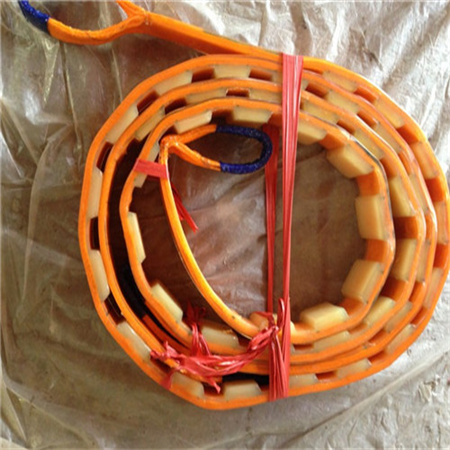
The trade in Section 6, in one photograph. The orange casing is a solid layer laid over the band, and a solid layer is exactly w hat abrasion wants: it takes the rubbing instead of the yarn, and it can be renewed by the maker rather than by the fibre. It is also exactly what a blade wants, because a solid layer gives an edge a clean purchase instead of letting the material move away from it. This page does not argue that the coating is a bad choice — on a dragged duty it is often the right one. It argues that the choice has a price, and that the price is paid on the cut half of a name like this one's. Notice also the windows: whatever else they do, they keep the layer that carries the load visible, which is the arrangem ent Section 8 relies on when it asks what an inspector should look for.
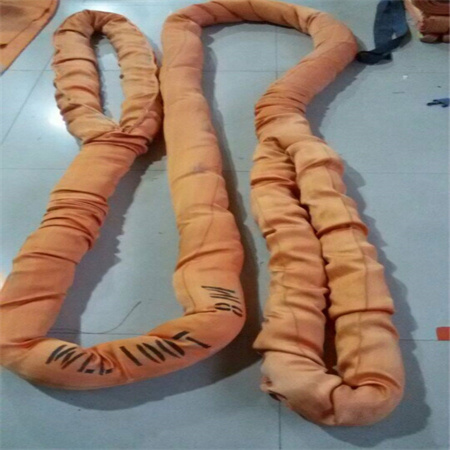
The alternative to paying the band to resist a threat: buy the protection as a separate object. Here the article is a load-beari ng core inside a cover, and the cover is the part that meets the world. That arrangement has its own rules, argued where round slings are argued, and this page references it for one reason only — it i s the shape of the answer when the two promises in this listing's name conflict. A protection that can be replaced is doing the same job as a protection woven into the fibre, and on a site where the t hreat is visible and known, it is usually the cheaper way to get both.
7. The Article Itself: Band, Ends, and What Is Printed on It
Set the two promises aside for a moment and this is a flat woven lifting article, and it is built the way this family is built. The band is man-made yarn woven flat, rated by a working load limit t hat depends on the hitch and the angle as much as on the band, and finished at the ends either by looping the band back and sewing it or by forming it endless. The photograph at the top of this page i s the endless form: no fittings, nothing to inspect at a hook, and the whole article is band.
Three things about the article are worth stating because they decide how the wear and cut arguments above actually land on it.
The ends are where a flat article is most exposed. On a sewn end the stitching is the connection, and it sits exactly where the load enters and where the band is doubled back on itsel f. On an endless form there is no stitched connection in the load path at all, which removes one failure mode and moves attention entirely onto the band. Neither is better in the abstract; the point i s that the two forms concentrate the same wear and cut questions in different places.
The ply count and the width are where the two promises are actually traded. More layers and more width spread a load over more material and over a wider contact, which is good for bot h abrasion and cutting. They also add mass and stiffness, which is the opposite of what a compliant construction does to help against a blade. So the ply and width figures in a quotation are not admin istrative details: they are where the compromise in Section 6 has been made, and a buyer comparing two quotations for the same duty should compare them first.
What is printed on the band is the identification the removal criteria protect. The supporting rules do not allow a sling into service without an affixed and legible identification, a nd a missing or illegible identification is the first item on the list of reasons a synthetic webbing sling is removed. On a brightly dyed band that is good news: the printed figures stand out against the colour, as they do in the photograph at the top of this page. It is also why a band whose colour has been chosen and whose print has been allowed to fade is a worse article than it looks.

Where the identification lives on a flat article, on a construction with the other kind of end. Here the band carries its figure s printed straight onto the webbing, and the eyes at both ends are reinforced and sleeved in a contrasting colour so the contact points are distinguishable at a glance from the body of the band. Compa re it with the endless band at the top of this page, which has no ends to reinforce at all. Both arrangements put the working load limit where a handler reads it; neither of them says anything about w ear or about cutting, and that is the gap this page's Section 5 exists to close. If the article is meant to resist a threat, the enquiry is where that is recorded — because the band cannot print a cla im it was never built to.
8. Inspection: What a Damaged Article Looks Like, and What It Does Not
The routine is the same as for any synthetic sling: an inspection by a competent person each day before use, more often where service conditions warrant it, and immediate removal from service of an ything damaged. The removal criteria for a synthetic webbing sling are published in ASME B30.9 and adopted in OSHA 29 CFR 1910.184, and they are a list about the band and the fittings — cuts, snags, p unctures, holes and tears; abrasive wear; broken or worn stitching in load-bearing splices; knots; melting, charring or heat damage; acid or caustic burns; discoloration or brittle and stiff areas; da maged fittings; and, first on the list, a missing or illegible identification. The full list with the two forms of article side by side is set out on the wear resistant flat lifting belt sling page, and it is not reproduced here. What belongs here is the part that changes when the article carries an anti-cut claim.
The most important thing to say is the uncomfortable one: a cut-resistant band can fail in a way that a routine inspection is not looking for. The usual inspection habit is to run the eye along the band and look for a loss of material — a thin place, a frayed patch, an opened stitch line. That habit finds abrasion, because abrasion removes material over an area and material los s is visible. A cut is the opposite: it removes very little material and removes it in a line. A partly severed band can look almost intact to an eye trained on wear, and it can be at its weakest at e xactly that line.
So an article with this claim needs two extra passes, and they are cheap.
| Pass | What to do | What it catches that a visual sweep does not |
|---|---|---|
| Run the band through the hand, slowly, along its whole length | Both faces and both edges, feeling for a discontinuity rather than looking for a mark. | A partial cut that has closed up and is nearly invisible, and a nick in an edge that has been smoothed over by later rubbing.< /td> |
| Look hardest where the threat actually is | The contact zone recorded in the enquiry, and the band's position in the hitch, rather than the middle of the band. | Damage concentrated in a small area that a general sweep passes over. On a sewn end, the transition into the splice; on an end less form, wherever the band creases against the load. |
| Compare the two edges of the band | Hold them side by side. One edge sees the load, the other does not. | A difference between the loaded edge and the free edge is the cheapest early signal that a threat is doing something the site has not accounted for. |
| Wipe before judging | A dirty band is a band whose surface is a layer of something else. | Everything above. Dirt, grit and process material fill the features the inspection is looking for, and they hide a line as eas ily as a patch. |
One further point, and it is the one that decides whether the money spent on an anti-cut construction is ever recovered. A claim on a title is not an inspection criterion. If the article was bought because it resists cutting, then "what does a partly cut band look like, and who decides it comes out of service" has to be written down somewhere before the article is issued — beca use it is not in the published list in a form that mentions a blade, and a criterion that lives only in the supplier's catalogue page cannot be applied on a night shift. That is a sentence on a proced ure, not an extra item on a purchase order, and it is the cheapest part of buying this article properly.
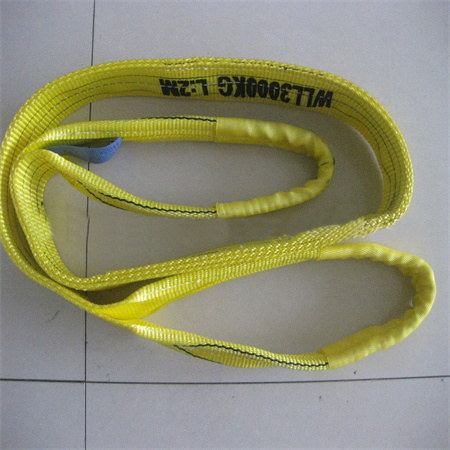
Why the identification is worth a routine of its own, on two ordinary pale bands. The printed figures on the webbing and the sma ll blue label are the two copies of the same information, and one of them is designed to survive what the other will not: the print can be rubbed off by the load the band carries, while the label sits outside the contact zone. The reason this matters more on an article with a claim attached is that the identification is where a site records which article it is holding — and an inventory t hat cannot tell a plain band from an anti-cut one will issue the wrong one to the duty that needs it. The published removal criteria put a missing or illegible identification first on the list for exa ctly this reason, ahead of cuts, wear and chemical damage, because an unidentifiable sling cannot be used lawfully however sound the band looks.
9. Ordering: the Six Lines That Turn a Claim Into a Specification
Buying this article well is not a matter of choosing a better adjective. It is a matter of writing down the two threats, and then letting the construction follow. Six lines do it.
| Line | What to write | Why the name does not cover it |
|---|---|---|
| 1. The abrasion contact | What the band rubs against, how often, and whether it is dragged across it or set down on it. | The name claims wear resistance and says nothing about the abrasive. The route chosen depends entirely on the answer. |
| 2. The cut threat | The geometry of the edge, the pressure at the contact, whether the band settles or slides, and whether a photograph can be sen t. | This is the half of the name that cannot be answered with a number for a lifting article. Section 5 is written to be pasted in to an enquiry. |
| 3. Which promise has priority | If the two conflict, which failure would cost more, and whether the site is willing to protect one contact by method instead o f by fibre. | The two promises trade against each other (Section 6). A maker who is not told which to favour has to guess, and the guess is invisible on the invoice. |
| 4. Working load limit, form, length, ends | The rating in the hitch you will actually use, the number of legs, whether the article is endless or has sewn ends, and the ef fective length. | Carries no rating and no dimensions. Sections 7 and 8 explain why the form and the ends change where the wear and cut question s land. |
| 5. Width and ply | The width and layering the application allows, or an instruction to propose them against the duty described. | This is where the compromise between the two promises is physically made. Left unstated, it is made by whoever fills the order . |
| 6. Marking and documentation | What has to be printed, in which language, and what paperwork the site has to hold — including any statement about the constru ction that the inspection regime will refer to. | The claim is not a rating, so the only place it can live permanently is the documentation and the site's own procedure. Sectio n 8. |
Two closing notes on the enquiry, both of which save a round of questions. First, a photograph of the contact is worth more than any adjective. Where an edge is involved, a picture with something in it for scale settles in one message what three descriptions would not. Second, if the two promises cannot both be honoured, say which one you would rather lose — because the maker's honest options are to build toward one, to build a compromise between them, or to recommend that a separate protection carries one of the two, and only the buyer can decide which of those is acceptab le.
Frequently Asked Questions
Is a wear resistant lifting belt simply a heavier flat sling?
No, and the difference is in the construction rather than only in the mass. Wear resistance is the name given to a set of construction choices — the weave, the yarn, the layering, and sometimes a l ayer or cover added over the yarn — that change how the rubbing face behaves. Weight is one consequence of some of those choices and not of others, so a heavier band is not automatically a more wear-r esistant one, and the two are not interchangeable as a specification.
Does the name promise two protections, or one written twice?
Two. Read the product line: wear resistant lifting belt and wear-resistant sling are two ways of writing the same promise, but wear-resistant and anti cutting lifting belt adds a second one. A blad e and grit are different antagonists and they fail a band by different mechanisms, which is why this page treats them as two specifications rather than one.
Is there a cut class for a lifting belt, the way there is a working load limit?
No. There is no cut class in any flat webbing sling standard. Cut ratings belong to the standards written for gloves and protective clothing, and they are measured on those articles. A supplier who quotes a cut class for a lifting sling is quoting a material's test figure and presenting it as a property of the finished article, which is a different statement.
Why does it matter which cut test was used?
Because the two tests do not always agree, and one of them is known to mislead on the kind of fibre a cut-resistant article is made from. The rotating-blade method counts how many cycles a blade ta kes to cut through, so a material that dulls the blade scores better than it deserves — it is being credited for blunting the tool. The blade-under-load method measures the force needed to cut through in a single pass, which is why it became the reference method for high-cut materials.
What does a cut rating in newtons or in letters actually measure?
The load at which a straight blade, drawn once across the material under rising force, cuts through it. Because it is a force, it can be divided into bands and reported as a lettered class. That is a genuine measurement, and it is the more meaningful figure of the two — as long as it is described as the material's figure on a laboratory specimen, not as a rating of the finished sling in service .
So how should an anti-cut requirement be written?
In terms of the threat. Four statements do it: the geometry of the edge, the pressure at the contact (mass over contact area), whether the band settles or slides against it, and what the site is wi lling to do by method rather than by fibre. That is a specification a maker can build against and a site can inspect against, which a class number measured on a flat specimen is not.
Does wear resistance help against cutting, or not?
It can go either way, and that is the trade this page is built around. Abrasion is resisted by giving the rubbing face something hard and densely bound; a blade is resisted by the way the fibre res ponds to an edge and by a construction that lets material move away from it. A dense or coated face chosen to stop abrasion can present a blade with a cleaner purchase. That does not make either choic e wrong; it makes them a balance to be chosen.
Why would a supplier not simply maximise both?
Because they pull against each other in the material, not in the price list. More layering and more width help both, but also add stiffness, which is the opposite of what a compliant construction c ontributes against an edge. Beyond some point a maker is choosing which of the two promises to lean toward, and the honest thing is to say so and ask which failure would cost the site more.
Can I use an anti-cut lifting belt against a knife edge?
No, and this claim is the one most often asked to carry more than it can. An anti-cut construction changes how long the band survives a threat the site has decided to accept. It does not turn a sha rp corner into a safe one, and it is not a substitute for protecting the contact. Where a corner is sharp enough to raise the question, the answer is still a separate protection at that contact.
How do I inspect an article like this if there is no cut criterion?
Two passes beyond the usual sweep. Run the band slowly through the hand along its whole length, feeling for a discontinuity rather than looking for a mark, because a partly cut band can close up an d look almost intact. And look hardest at the contact zone the enquiry recorded, comparing the loaded edge against the free one. Then write down who decides a partly cut band comes out of service — a criterion that exists only in a catalogue cannot be applied on a night shift.
Does the article's form change any of this?
It changes where the questions land rather than whether they apply. A sewn end concentrates the load at the stitched splice, so that is where a contact does its damage first. An endless form has no stitched connection in the load path, which removes one failure mode and puts all the attention on the band itself.
What should I send with an enquiry for this article?
The six lines in Section 9: the abrasion contact, the cut threat, which promise has priority, the working load limit with the form, length and ends, the width and ply the application allows, and th e marking and documentation you have to hold. Where an edge is involved, add a photograph with something in it for scale. Those six lines are the difference between buying a name and buying an article .
Contact Lift Sling Rigging Co., Ltd
The wear resistant lifting belt and the wear-resistant sling are made to order in flat woven construction, in endless and in sewn-end form, at the width and layering the duty calls for, with the id entification printed where a handler reads it. The wear-resistant and anti cutting lifting belt is quoted on the two promises separately rather than as one adjective: what the abrasion contact is, wha t the cut threat is, and which of the two the construction is being asked to favour.
Tell us both contacts. Describe what the band rubs against and how often, and describe the edge — its geometry, the pressure at the contact, whether the band settles against it or slides across it — and send a photograph with something for scale if one is easy to take. Say which failure would cost you more if the two cannot both be maximised, and whether your site is willing to protect one of t he contacts by method rather than by fibre. Add the working load limit in the hitch you will actually use, the form of the ends, the effective length, the width and layering the application allows, an d the marking and documentation you have to hold. With those we will confirm the construction, say plainly what the article is and is not built to resist, and quote it without letting the word on the title carry a claim the construction does not make.
Where the abrasion half of this subject is argued in full — what wear resistance buys and what it does not, the three zones where a flat band wears, the four ways a band is made to resist it, and t he published criteria that retire a worn sling — that is the wear resistant flat lifting belt sling page. Where the ends are a double-buckle end the wear question changes shape and is treated on the double buckle flat wear-resistant sling page. Where a load-bearing core sits inside a replaceable cover, the rules for that arrangement are on the circular lifting straps page. And where the outside of the article is a polymer layer rather than a plain dyed band, the construction and ageing questions are on the polyurethane lifting strap page.
Telephone and WeChat: 18066002268
E-mail: 702461526@qq.com
Address: Lifute Industrial Park, Taizhou City, Jiangsu Province, China
HS code: 630790
- Previous:Stone lifting belt, stone lifting sling, stone specific lifting rope
- Next:Polyurethane lifting strap | Polyurethane flat lifting strap
-
Drone Anti-collision Net
-
Extra Large Capacity Cargo Net
-
Cargo Webbing Net
-

Color changing nylon double buckle loop nylon braided rope
-

Two end buckle lifting rope, double buckle round lifting rope, double fork nylon lifting rope, non jointed nylon lifting rope
-

Emergency escape lifeline, fire escape rope, fire safety escape emergency rope, steel wire core fire rope

