 Language
 简体中文
简体中文
- On the 2018 National Day holiday, Lifet completed six 100 ton large tonnage lifting belts as a gift
- The role of suspension net in the transportation of goods turnover
- Cargo soft lifting net, lifting net, lifting net, lifting net, bag, climbing net
- Precautions for using Lifutiden elevator
- How to make circular lifting straps
Contact: Wang Lili
E-mail:18066002268
Phone:702461526@qq.com
Address: Lifute Industrial Park, Taizhou City, Jiangsu Province
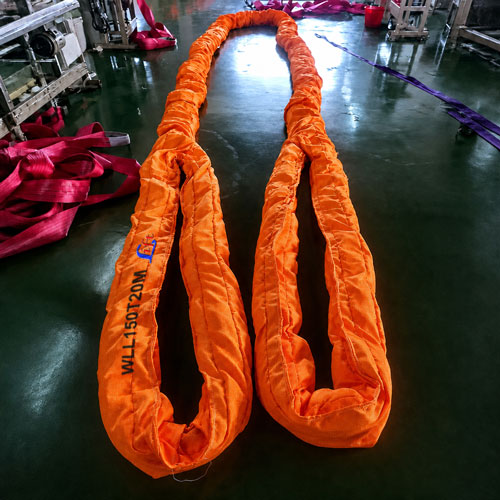

Lift Sling Rigging Co., Ltd manufacture WLL 150T Polyester Round Slings,150000kg Heavy Duty Round Lifting Sling,150 Ton Lifting Sling Belt,A 150 tonne polyester round sling sits above the range the published tables cover, so it is a size you order rather than a size you look up: the working load limit belongs to a hitch and an angle, the colour code has already stopped separating values, and the figure that governs the lift is the one on the label. This page covers what 150 tonnes means for the hitch, why it is not two legs of seventy-five, why polyester is the fibre at this size, and what has to be written into the order. Made to order, batch tested with a certificate, HS code 630790, telephone 18066002268.
Hits: ℃
Release time:2026-09-21 22:08
Lift Sling Rigging Co., Ltd manufacture WLL 150T Polyester Round Slings,150000kg Heavy Duty Round Lifting Sling,150 Ton Lifting Sling Belt,150 Ton Lifting Strap.
WLL 150T Polyester Round Sling — A Size You Order, Not a Size You Look Up
Fifteen tonnes is a table lookup; 150 tonnes is an order. This article is a sleeved polyester round sling rated at 150000 kg working load limit, and the useful things to know about it are the ones the standard tables no longer answer: the hitch the figure belongs to, why the colour code has stopped separating values above ten tonnes, why a 150 tonne article is not two legs of seventy-five, why polyester is the fibre at this size, and what has to be written into an order when there is no row to point at. Made to order, batch tested with a certificate. HS code 630790; telephone 18066002268.
1. Where This Article Sits in the Range
The round sling pages in this family sit at three points, and this is the middle one. The WLL 100T heavy duty round slings with eyes page takes the eye-ended article and the reading of its label; the WLL 400 ton endless polyester round sling page takes the continuous load path and the fibre; and the heavy duty round sling class page takes what the round form is for at all. What none of them covers is the step in between, where the figure stops coming from a table and starts coming from an order.
That step is easy to miss from the outside, because the article on the hook looks like the same article at any size: a sleeved loop, coiled, with a label on it. What changes is not the appearance but the arithmetic and the paperwork. A fifteen tonne sling is a catalogue item with a row in a published table and a colour that tells a rigger what it is from across the yard. A one hundred and fifty tonne sling is an order: a length, a sleeve, a core, a marking, a test and a certificate that were agreed before the cores were wound, and a figure that exists in one place only, which is what the label says.
| The question | Where it is answered | What this page adds |
|---|---|---|
| What is a round sling for at all | heavy duty round sling | Nothing: this page assumes the form is chosen and stays with the figure |
| How the label is read, and what the ends do | WLL 100T heavy duty round slings with eyes | The reading stays the same at 150 tonnes; what changes is that there is no colour cue to check it against |
| What the continuous load path and the fibre do | WLL 400 ton endless polyester round sling | Why polyester is the fibre at this size, in one section rather than in the whole page |
| What happens above the tabulated range | 300 ton lifting belt | The same problem one range further up: what the contract has to carry when there is no table row |
2. What 150 Tonnes Means on a Sling, and What It Does Not
The figure this page is named after is a working load limit, which is the maximum load the article may be subjected to in the configuration it is being used in. It is not the load at which something happens, and it is not a strength: the article is made to withstand a multiple of it, and that multiple is a property of the standard the article is built to rather than of the number printed on the label. A buyer who treats 150 tonnes as a strength figure will eventually use the article in a configuration nobody rated, and the label will not have misled them.
| The figure is | The figure is not | Why it matters at this size |
|---|---|---|
| A working load limit for a hitch at an angle | A breaking strength, or a figure for any hitch the rigger chooses | The label carries one rated capacity per type of hitch, and choosing the hitch after delivery is choosing an unrated lift |
| A maximum permitted working load | A load the article may be shock loaded with; shock loading is prohibited whatever the figure | At a hundred and fifty tonnes the mass behind the load makes a snatch lift unaffordable rather than merely improper |
| A figure that travels with the article, on its marking | A figure that can be inferred from the colour, the size or the price | Slings without affixed and legible identification are not to be used at all, and at this size there is no second cue |
| A figure for the article as built | A figure for the article after a change: a shortened loop or a replaced fitting is a different article | Any repair returns through the manufacturer, a proof test and a certificate, and the marking travels with it |
3. Why 150 Tonnes Is an Order Rather Than a Table Lookup
The published tables for round slings tabulate the sizes the market buys in quantity, and those tables stop well below this article. That is not a gap in the standard; it is where the standard's assumptions about the range of manufacture end and the buyer's specification begins. Above that point the article is still built to a recognised construction and rating discipline, but the individual figures have to be agreed rather than read off.
Three things follow for an order, and all three are worth having in writing before the cores are wound. The first is the figure itself and the configuration it belongs to: the working load limit, the hitch, the length convention and the angle. The second is the factor the article is built to, which is the margin between the working load and what the article is made to withstand, because at this size the margin is a contract term rather than a catalogue line. The third is the evidence: what is tested, what the certificate states, and what the marking will say. The 300 ton lifting belt page sets out how that pack is assembled one range further up, where the same three questions are answered for a three hundred tonne article.
| Because there is no table row | It has to be written into the order | What the buyer receives |
|---|---|---|
| The rated capacity column cannot be pointed at | The working load limit, the hitch and the angle, agreed as a set | A label that carries the rated capacities for each type of hitch, as the requirement is written |
| The margin is not implied by a catalogue the buyer can consult | The factor the article is built to, stated in writing | An article whose margin can be quoted to an auditor rather than asserted |
| Nothing can be inferred from the colour above ten tonnes | The marking the article must carry, and the language it must be in | An article that can still be identified in a store room a year later |
| The evidence is what the contract says it is | Whether the article is batch tested, and what the certificate has to state | A certificate that names the article rather than a production week |
4. Why 150 Tonnes Is Not Two Legs of Seventy-Five
The commonest way to arrive at a hundred and fifty tonnes is arithmetic: two slings of seventy-five tonnes, used in a two-leg set, and the set is ordered as though the figures added up. They do not, and the reason is not a technicality. A two-leg set is a configuration with its own rated load, and the figure for the set depends on the angle between the legs: a set is strongest when the legs hang nearly vertical and weakest as the angle between them opens, because the tension in each leg rises as the pair spreads. The rated load of a set is not the sum of its legs; it is read from the column for the configuration actually made.
There is a second difference that matters more at this weight. A single 150 tonne leg carries the load on one article, with one label, one certificate, one inspection history and one contact surface. A two-leg set carries it on two articles, each of which has to be marked, tested, inspected and recorded, and each of which can be damaged on one side of a load while the other stays sound. Both are legitimate ways to lift a hundred and fifty tonnes; they are not the same purchase, and the arithmetic that made them look interchangeable is the arithmetic the 30 ton flexible lifting belt page works through in full.
| The comparison | One article at 150 tonnes | Two legs at 75 tonnes each |
|---|---|---|
| What the load path is | One load path, one contact surface, one figure to read | Two load paths whose tension depends on the angle between them |
| What the capacity is | The working load limit of the article in the hitch used | The rated load of the set, read from the column for that configuration and that angle |
| What has to be managed | One label, one certificate, one inspection record | Two of each, and the pair has to be retired and replaced together |
| When it is the right answer | The load presents one point of support and the geometry is fixed | The load needs two points of support, or the lift is a balance rather than a hang |
5. Why Polyester Is the Fibre at This Size
Polyester is the default core fibre for a large round sling for two reasons that both get stronger as the load grows. The first is that polyester stretches very little under load and recovers, so a heavy load does not sink further into the sling as the lift proceeds, and the height at which the load comes off the ground can be predicted. At fifteen tonnes a metre of creep is an annoyance; at a hundred and fifty it is a handling plan. The second is stability: polyester is the fibre that tolerates the moisture, the ordinary industrial atmosphere and the repeated loading of a working sling without the loss of strength that the alternatives suffer, and it is the fibre with the widest published experience behind large sleeved articles. The continuous load path and the fibre envelope are the subject of the WLL 400 ton endless polyester round sling page, so this page keeps to the parts that are specific to a large article.
| What the article asks of the fibre | Why polyester answers it | What that costs the buyer |
|---|---|---|
| Low and predictable stretch under a heavy load | The load comes off the ground where the plan says it will, and the hook height can be set in advance | Less shock absorption, so the lift has to be made smoothly rather than allowed to settle |
| Tolerance of moisture and weather | A working sling is stored in a shed, not a laboratory, and gets wet | The same storage rules apply as for any large textile article: dry, off the floor, out of the sun |
| A published envelope for the duty | The temperature and chemistry limits can be written into the order rather than discovered on site | The limits have to be checked against the site before the order, not after delivery |
| A known behaviour in inspection | Wear shows in the sleeve and in the stitching before the core is reached | The sleeve is the wear part, so it is replaced by replacing the article, not by re-covering it |
6. What the Article Is, and What Handling It Involves
The article is a closed loop of high-tenacity polyester yarn, wound into a core, enclosed in a woven sleeve that carries the load's surface and the article's identification. At a hundred and fifty tonnes there is no hardware in the load path and no join anywhere in it, which is the property the round form is chosen for. The class page carries the reasoning; what belongs here is the handling, because at this size the article is no longer something one person carries.

The photograph above is the article as it is supplied: a sleeved loop, coiled, with the identification on the sleeve rather than on a tag that can be lost. Read it against section 7, because at this figure the marking is the only place the rating exists: the colour says class, and the label says one hundred and fifty tonnes.

| Feature | Why it is built this way | What it means on site |
|---|---|---|
| Closed core in a woven sleeve | The load path has no splice, no eye and no termination, so there is no weaker end in the path | Inspection looks at the sleeve and the marking, because the core cannot be seen |
| Sleeve woven around the core | The sleeve is the contact surface and the label; it is also the part that wears first | The sleeve's condition is the first question at every inspection |
| A heavy article by nature | The mass of a sleeved loop at this figure is a handling problem in its own right | Plan how it will be carried, stored and dressed onto the load before the day of the lift |
| Batch tested, marked and certificated | Above the tabulated range the evidence is what the order says it is | The certificate and the marking are the parts of the purchase that survive the delivery |
7. Marking, Colour and the Certificate at 150 Tonnes
At this size the identification rules stop being a formality and become the only way the article exists as a rated object. The colour code is the clearest example. It gives one colour per capacity step and its last entry is orange for ten tonnes and above, so from ten tonnes upward the colour marks a class of article rather than a value, and at a hundred and fifty tonnes it says nothing about the figure at all. A rigger who reads a large article by its colour is reading a label that says heavy rather than a label that says one hundred and fifty tonnes.
| The element | What it has to say | Why it matters most at this size |
|---|---|---|
| The marking on the article | The rated capacities for each type of hitch, and the type of synthetic material | It is the only place the figure exists: colour has stopped separating values, and slings without legible identification are not used at all |
| The colour of the sleeve | The capacity step, up to orange for ten tonnes and above | Useful below ten tonnes and useless above it, which is why the label is the figure here |
| The length convention | Whether the figure ordered is the circumference or the effective working length | A loop has both, and a mistake at this size is not a mistake that can be cut out and re-sewn |
| The certificate | What was tested, to what figure, and which article the certificate names | It is the document that answers an auditor's question about a bespoke article |
| The traceability code | Which production batch and which article the marking belongs to | It is what links the article on the hook to the certificate in the file |
8. Inspection and Retirement at This Figure
The inspection regime does not change because the article is large, and that surprises buyers who expect a bespoke article to have a bespoke routine. The article is inspected each day before use, and periodic inspections are made at intervals no greater than twelve months, with additional inspections where service conditions warrant them, judged on the frequency of use, the severity of the service, the nature of the lifts and the experience of the service life. A large article used twice a year is not on a lighter regime than a small one used daily.
What does change is the consequence of a removal. A retired article at this size is a capital item rather than a consumable, and the removal decision is therefore worth recording properly: what was found, when, and by whom. The removal criteria themselves are the ordinary ones for a synthetic sling: acid or caustic burns, melting or charring, snags, punctures, tears or cuts, broken or worn stitching, and distortion of fittings, any of which removes the article from service immediately. Repairs belong to the manufacturer or an equivalent entity, damaged webbing and load-bearing splices are not repaired, temporary repairs are prohibited, and a repaired article returns to service only after a < strong>proof test to twice its rated capacity with the certificate retained. The heavy duty round sling page sets out what that difference means against the chain family, where the same article can be repaired and re-tested instead of retired.
9. Ordering a 150 Tonne Round Sling: the Six Lines That Matter
An order for this article is short, and every line on it is a figure or a decision rather than a preference. The list below is the one this article is built to, in the order in which the answers constrain each other.
| Line | What to state | What it fixes |
|---|---|---|
| 1 | The load, and where it is supported | Whether the answer is one leg or a two-leg set, which are different purchases (section 4) |
| 2 | The hitch and the angle the lift will make | Which column of the label the figure comes from, and therefore what the article is rated for |
| 3 | The length, and which convention is meant | The circumference of the loop or the effective working length it presents in use (section 7) |
| 4 | The environment: temperature, chemistry, wet or dry, inside or outside | The fibre, and whether the sleeve needs a construction beyond the standard one |
| 5 | The interface: the hook, shackle or master link the loop will sit in, and the radius it presents | How the article is dressed onto the hardware, and how the contact area is arranged |
| 6 | The marking and the documents your own site has to hold | What the label says, what the certificate names, and what is kept in the file afterwards |
10. Frequently Asked Questions
Q1: Is a 150 tonne round sling a standard size?
Q2: Can I use two seventy-five tonne slings instead?
Q3: What does the colour of the sleeve tell me at this size?
Q4: Why polyester rather than nylon or polypropylene?
Q5: How long is a 150 tonne round sling?
Q6: How often does it have to be inspected?
Q7: Can it be repaired if the sleeve is cut?
Q8: What temperature can it work at?
Q9: Can it be used with a sharp edge on the load?
Q10: What do you need to quote it?
Contact
Send the six lines in section 9, or send the lift as it stands and we will come back with the questions that are missing. Articles at this figure are made to order and batch tested, and the certificate travels with the article.
Telephone and WeChat — 18066002268
E-mail — 702461526@qq.com
Address — Lifute Industrial Park, Taizhou City, Jiangsu Province, China
-
Drone Anti-collision Net
-
Extra Large Capacity Cargo Net
-
Cargo Webbing Net
-

Color changing nylon double buckle loop nylon braided rope
-

Two end buckle lifting rope, double buckle round lifting rope, double fork nylon lifting rope, non jointed nylon lifting rope
-

Emergency escape lifeline, fire escape rope, fire safety escape emergency rope, steel wire core fire rope

